
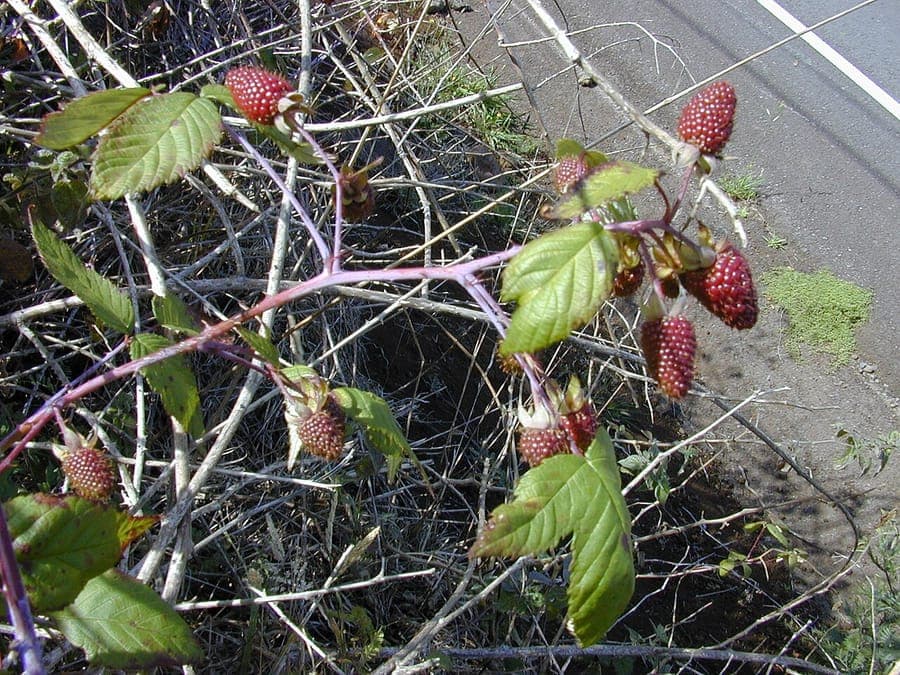
Forest & Kim Starr / CC BY 3.0, via Wikimedia Commons
Andean blackberry: complete guide
Rubus glaucus
Want to see Andean blackberry: complete guide in your garden?
1 minute, no credit card
Overview
Rubus glaucus, commonly known as the Andean blackberry or Andes berry, is a remarkable fruiting shrub in the rose family Rosaceae. The species was described by the botanist Bentham in 1845 from specimens collected in the Andes mountain range. Its native distribution stretches from central Mexico through Guatemala, El Salvador, Costa Rica, Colombia, Ecuador, Peru and Bolivia, growing naturally on cool, moist Andean slopes at elevations between 1,500 and 3,000 metres.
In its native countries, particularly Colombia and Ecuador, Rubus glaucus is one of the most commercially important fruit crops, sold at local markets and exported under the names 'mora de Castilla' or 'mora andina'. The large, glossy drupes - ranging from deep red to nearly black when fully ripe - are substantially larger than common European blackberries and carry a rich, intensely aromatic flavour with a pleasant balance of sweetness and acidity. The fruits are used fresh, in juices, jams, desserts and wine.
In European gardens, the Andean blackberry remains a specialist plant sought by enthusiasts of unusual fruiting shrubs. Its cultivation in cooler climates requires understanding of its frost sensitivity and willingness to protect the plant over winter. At gardenworld.app you can explore how to incorporate this exotic fruiting shrub into a garden or patio design and discover what companion plants complement it best.
The species epithet glaucus refers to the waxy, blue-green bloom that coats the young canes - a striking feature that gives the plant visual appeal quite apart from its fruiting value. The canes carry small, curved thorns similar to those of common blackberry, though generally less aggressive in character.
Appearance & bloom cycle
Rubus glaucus is a semi-woody, arching shrub that can reach 3 to 5 metres in its native habitat when given support. In European cultivation, especially in containers or cooler conditions, it typically remains more compact at 1.5 to 2.5 metres. The canes are pale green to blue-green with a waxy coating and bear small, curved thorns.
The leaves are compound, comprising three to five leaflets that are oval to egg-shaped. The upper surface is dark green and somewhat glossy; the underside is paler and finely hairy. In its native Andean climate the plant is effectively evergreen, retaining its leaves throughout the year.
In European conditions, flowers appear mainly in May and June. Each flower is small, white to pale pink, with five petals and numerous stamens, typical of the rose family. Flowers are carried in loose, branching clusters and are mildly fragrant, attracting bees and other pollinators. The flowering period can extend over several weeks.
After pollination, the characteristic compound drupes develop. Unripe fruits are green, turning red and finally dark purple to near-black at full ripeness. Fully ripe fruits measure 2 to 3 cm across - notably larger than European blackberries - with an intensely aromatic, rich flavour. In its native tropical mountain climate the plant fruits almost year-round. In European gardens the main harvest falls in summer and early autumn.
Ideal location
The Andean blackberry has specific site requirements due to its frost sensitivity. Rubus glaucus tolerates brief light frosts down to about -3 to -5 degrees Celsius but cannot survive sustained hard freezes. In the Netherlands and Belgium, outdoor cultivation is only feasible in the mildest city gardens with sheltered walls, warm microclimates, or in mild coastal areas. For most gardeners in northern Europe, overwintering in a frost-free space or cool greenhouse is essential.
During the growing season, the plant does best in a sunny to lightly sheltered position with at least four to five hours of direct sun per day. In its Andean homeland it grows on mountain slopes with generous light but also some protection from drying winds - a combination of good light and shelter is ideal. Avoid exposed positions that experience strong, desiccating summer winds.
Container cultivation works very well for this species and simplifies the practical challenge of winter protection: move the pot to a frost-free space before the first hard frosts and return it outdoors in spring. Choose a large container of at least 40 to 50 litres with generous drainage holes. In summer, position the container in a warm, sunny courtyard or on a sheltered balcony.
Soil requirements
Rubus glaucus prefers moist, fertile, well-drained soil with a slightly acid to neutral pH of 5.5 to 6.5. In its native range, it grows on the rich volcanic mountain soils of the Andes - soils high in organic matter but well-structured and freely draining thanks to the sloping terrain.
Prepare the planting site by digging a generous hole at least 50 cm wide and 40 cm deep, filling it with a mixture of two parts good garden topsoil or planting compost, one part well-rotted compost, and one part perlite or coarse grit to ensure drainage. Avoid heavy, poorly drained clay soils without significant amendment, as waterlogged roots quickly lead to root rot.
Apply an annual mulch of organic material - well-rotted compost, leaf mould, or composted bark 5 to 8 cm deep - around the base of the plant. This retains soil moisture, suppresses weeds and gradually adds nutrients. Keep the mulch clear of the cane bases to prevent fungal problems at ground level.
For container growing, use a good-quality potting compost enriched with approximately 20 percent perlite. Refresh the top layer of compost annually and repot into a larger container every two to three years to prevent nutrient depletion.
Free design
Want to see Andean blackberry: complete guide in your garden? Make a free design now.
Watering
Rubus glaucus has a relatively high water requirement, particularly in summer during active growth and fruit development. In its native mountain environment it benefits from well-distributed rainfall throughout the year, and garden cultivation should aim to replicate this steady moisture supply.
During summer, water two to three times per week in dry, warm weather. The soil should remain consistently moist but never waterlogged. Check soil moisture by pushing a finger 5 cm into the growing medium: if the soil feels dry at that depth, it is time to water. A layer of mulch significantly reduces the watering frequency needed.
In winter, when the plant is overwintering in a cool greenhouse or frost-free shed, water requirements drop considerably. Water only occasionally to keep the roots very lightly moist, never allowing the compost to dry out completely, but equally avoiding any waterlogging.
Drip irrigation or directed watering at the base of the plant is preferable to overhead watering, keeping foliage and developing fruits dry and reducing the risk of fungal diseases such as botrytis grey mould.
Pruning
Proper pruning is essential for a productive and healthy Andean blackberry. Like common blackberries, Rubus glaucus bears fruit on second-year wood: canes that grow in year one bear fruit in year two, then should be removed. Understanding this cycle is the basis of good management.
In early spring, before growth resumes, remove all dead, diseased or damaged canes completely to ground level. Also thin out canes that are crowded together to improve air circulation - this reduces the risk of fungal diseases. Retain six to eight strong, healthy canes per plant.
After the autumn harvest - or, for plants overwintering indoors, after the last fruits are picked - cut the fruited canes back to ground level. The new canes that have grown during that season become the fruit-bearing wood for the following year. Tie these new canes to a support structure.
For container-grown plants, more frequent pruning is needed to keep the plant manageable in size. Always disinfect pruning tools with alcohol between plants to prevent the spread of pathogens.
Maintenance calendar
January - February: Plant overwinters in a frost-free space or cool greenhouse. Water sparingly. Check for pests such as spider mite or scale insects and treat if necessary.
March: Remove dead and damaged canes. Apply a layer of well-rotted compost around the base. Gradually increase watering as growth resumes.
April - May: Move plant outdoors when night frosts are no longer expected. Flowering begins. Maintain steady watering. Apply a balanced fruit fertiliser.
June - July: First fruits ripen in warm conditions. Harvest regularly. Water generously in dry spells. Monitor for pests and diseases.
August - September: Main harvest period. After harvest, remove the old fruited canes. Apply compost mulch around the base of the plant.
October - November: Bring the plant indoors before the first hard frosts are expected. Gradually reduce watering frequency. Inspect canes and remove any damaged material.
December: Dormant period in the frost-free space. Minimal watering. Check for pests.
Winter hardiness
Winter hardiness is the key challenge of growing Rubus glaucus in northern European climates. The plant tolerates brief light frost to -3 or -5 degrees Celsius but is damaged or killed by sustained freezing temperatures below -8 degrees Celsius. It is suitable for outdoor year-round cultivation only in USDA zone 9 and warmer - broadly equivalent to the milder coastal areas of southern France, Italy and Spain.
In the Netherlands and Belgium (USDA zones 7-8), the plant must be overwintered in a frost-free but cool environment: an unheated greenhouse, a cool conservatory, or an insulated shed with temperatures staying above 0 degrees Celsius. The plant enters a period of semi-dormancy in these conditions and may drop some or all of its leaves.
For outdoor plants in sheltered positions, wrapping the container with multiple layers of horticultural fleece and positioning it against a south-facing wall provides significant frost protection during mild winters. Ground-planted specimens can have their bases mulched thickly with straw or leaves and canes wrapped in fleece for short cold snaps.
Companion plants
Rubus glaucus combines well with other fruiting shrubs and plants that prefer similar growing conditions and care regimes. Suitable companions include:
- Rubus idaeus (Raspberry) - shares the preference for moist, fertile soil and is fully hardy in northern European gardens. Raspberries fruit slightly earlier, followed by the Andean blackberry, extending the soft fruit harvest season.
- Vaccinium corymbosum (Blueberry) - similar soil preference for slightly acid conditions; fully hardy, ornamental autumn colour, and edible fruit that complements the Andean blackberry well.
- Passiflora caerulea (Blue passionflower) - another semi-hardy climber that can survive mild winters outdoors and adds an exotic tropical look to garden walls.
- Fuchsia (Hardy fuchsia species) - similar need for shelter and frost-free overwintering; colourful flowers and suitable for container groupings.
- Fragaria x ananassa (Garden strawberry) - can be used as a ground-covering plant around the base of the shrub, sharing its preference for moist, fertile soil.
Visit gardenworld.app to find design ideas for combining exotic and native fruiting plants in attractive, productive garden arrangements that look beautiful through every season.
Conclusion
Rubus glaucus, the Andean blackberry, is an exceptional choice for gardeners seeking something more exotic and productive than standard soft fruit shrubs. The large, intensely flavoured berries, attractive foliage and appealing flowers make this plant a rewarding ornamental and fruiting subject for a sheltered garden or a generous container on a warm patio. The main challenge in northern European climates is winter frost sensitivity, but with appropriate care and protection this beautiful Andean native rewards its grower year after year with abundant, distinctive fruits. Specialist garden centres are the best source for young plants.
Want to see Andean blackberry: complete guide in your garden? Make a free design now.
Upload a photo, pick a style, and get a photorealistic design with plant list in under a minute.
10,000+ gardens designed already
No credit card required


Similar plants
Siberian crab apple: complete guide
Malus x robusta
Complete guide to the Siberian crab apple (Malus x robusta): location, soil, pruning, winter hardiness and the best companion plants for your garden.
Chinese flowering crabapple (Malus x spectabilis): complete guide
Malus x spectabilis
Meet the Chinese flowering crabapple (Malus x spectabilis): a classic spring bloomer with carmine buds and pink blossom.
Potentilla crassinervia: complete guide
Potentilla crassinervia
Potentilla crassinervia, the Corsican cinquefoil, grows wild on Corsica and Sardinia's peaks. Discover how to grow this hardy alpine rock garden gem.