
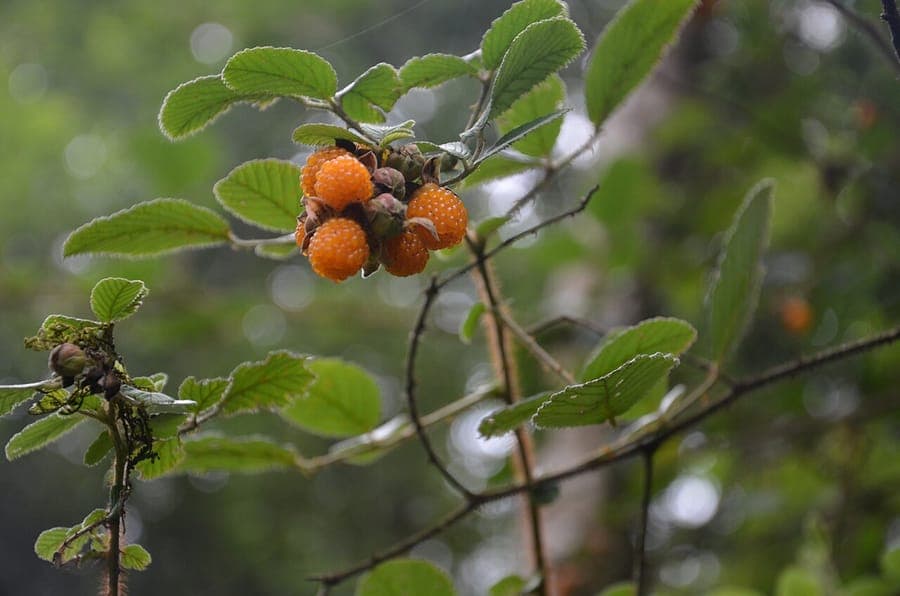
pratap baniya / CC BY-SA 4.0, via Wikimedia Commons
Yellow Himalayan Raspberry: complete guide
Rubus ellipticus
Want to see Yellow Himalayan Raspberry: complete guide in your garden?
1 minute, no credit card
Overview
The Yellow Himalayan Raspberry (Rubus ellipticus), also called the Cheeseberry, is a fascinating tropical ornamental shrub from the Asian subcontinent. With its evergreen foliage and stunning golden-yellow fruit, this plant brings exotic warmth to temperate gardens. It is persistently evergreen and produces flowers and fruit year-round under favorable conditions.
Appearance & bloom
This mid-height shrub reaches 1.5 to 2 meters tall with dense, silky-hairy branches. Leaves are dark green, elliptical, and remain on the plant year-round. Small white to pink flowers appear in clusters from April to June. Fruit follows, initially orange but reaching full golden-yellow color in autumn. They have a distinctive aroma and are highly attractive to birds.
Ideal location
The Yellow Himalayan Raspberry thrives in warm, sheltered locations with full to partial shade. In temperate climates, grow in containers and bring indoors for winter. In South Europe and Mediterranean regions, it can remain outside. Wind protection is essential.
Soil
This tropical species requires rich, nutrient-dense soil. Use potting mix with ample humus and organic matter. A pH of 6.0 to 7.0 is ideal. Good drainage is crucial to prevent root rot. In containers, replace half the soil annually.
Watering
The Yellow Himalayan Raspberry needs regular water, especially during growth season. Keep soil consistently moist but not waterlogged. Misting foliage helps suppress spider mites. In winter when indoors, reduce water but don't let soil dry completely.
Free design
Want to see Yellow Himalayan Raspberry: complete guide in your garden? Make a free design now.
Pruning
Prune after blooming to encourage branching. Remove weak, diseased, or damaged branches. In containers, light pruning during growth promotes desired shape. Annual sanitation prevents disease spread.
Maintenance calendar
- January-February: Harden off outdoors (mild regions). Prune weak branches.
- March-April: Indoors: increase water and temperature. Bloom begins.
- May-June: Weekly feeding. Blooming continues. Regular watering.
- July-August: Fruit development. Biweekly feeding. Control spider mites.
- September-October: Fruits ripen. Reduce temperature.
- November-December: Winter dormancy indoors. Minimal water. No feeding.
Winter hardiness
Not winter-hardy in temperate zones and cannot tolerate frost. Minimum temperature is around 5 degrees Celsius. Only in subtropical regions (southern Spain, Italy, Greece) can it grow permanently outdoors. In Northern Europe and Benelux: container growing with winter storage (greenhouse or indoor space).
Companion plants
The Yellow Himalayan Raspberry pairs well with:
- Other tropical fruit walls (mango, avocado)
- Jasmine for fragrance
- Bougainvillea for color contrast
- Philodendron as underplanting
- Cycas for exotic texture
Conclusion
The Yellow Himalayan Raspberry is an exceptional choice for growing exotic plants in temperate climates. With proper care and winter storage, this plant will produce flowers and stunning fruit for years. Find container specimens at specialty nurseries. More exotic insights at gardenworld.app.
Develop your tropical garden vision on gardenworld.app/en.
Want to see Yellow Himalayan Raspberry: complete guide in your garden? Make a free design now.
Upload a photo, pick a style, and get a photorealistic design with plant list in under a minute.
No credit card required


Similar plants
Siberian crab apple: complete guide
Malus x robusta
Complete guide to the Siberian crab apple (Malus x robusta): location, soil, pruning, winter hardiness and the best companion plants for your garden.
Chinese flowering crabapple (Malus x spectabilis): complete guide
Malus x spectabilis
Meet the Chinese flowering crabapple (Malus x spectabilis): a classic spring bloomer with carmine buds and pink blossom.
Potentilla crassinervia: complete guide
Potentilla crassinervia
Potentilla crassinervia, the Corsican cinquefoil, grows wild on Corsica and Sardinia's peaks. Discover how to grow this hardy alpine rock garden gem.