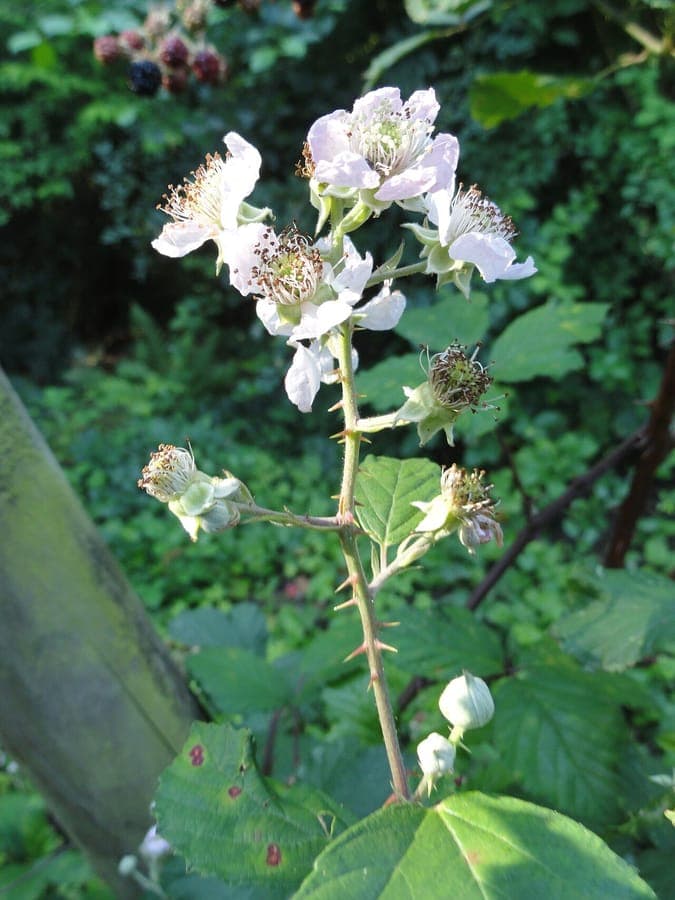
Daderot / CC0, via Wikimedia Commons
Rubus bifrons: complete guide
Rubus bifrons
Want to see Rubus bifrons: complete guide in your garden?
Full design in HD: €7.99
Look after your Rubus bifrons with the GardenWorld app
Identify plants with your camera and get a care calendar with reminders for this plant.


Overview
Rubus bifrons, commonly known as Two-colored bramble or Himalayan bramble, is a robust bramble shrub native to Europe. This plant is celebrated for its purple flowers, edible black berries, and strong growth pattern. Unlike many bramble species, this plant is quite manageable and produces fruit generously.
The plant grows as a creeping or climbing shrub to 2-3 meters. The red, thorny canes are characteristic. In June-July purple flowers appear, followed by black, edible berries in August-September.
Appearance and Bloom
The Two-colored bramble is a shrub with green, trifoliate leaves that turn purplish-red in fall. The canes have characteristic red thorns in two forms - hence the name "bifrons" (two faces).
The flowers are purple to red-purple, approximately 1-2 cm diameter. They appear in clusters at shoot ends. The berries are large, glossy black, and very edible. They have a pleasant, sweet taste.
Ideal Location
Choose a full sun to half-shade location for this bramble. At least 4-5 hours daily sunlight leads to best bloom and fruit production. In warmer climates, some afternoon shade helps.
This plant grows along heaths, woodland edges, and other semi-open places. Plant where it can climb or spread without smothering other plants. Strong support helps upright growth.
Soil Requirements
Rubus bifrons grows in many soils. Prefers well-draining, neutral to slightly acidic soil (pH 6-7). The plant tolerates poor soils well but grows better in richer soil.
Add organic matter. Good drainage is important to prevent root rot. This plant is not food-demanding - minimal feeding suffices.
Watering
Once established, this bramble is drought-tolerant. Water regularly during the first growing year. Thereafter, water as needed, in extremely dry periods.
Drip irrigation helps maintain consistent moisture. Dry feet can lead to fewer berries. Water sparingly in frost periods.
Free preview
Want to see Rubus bifrons: complete guide in your garden? Make a free preview of your design.
Pruning
Pruning is important for control and production. Remove dead, damaged, or diseased wood yearly. Old, thin canes (older than 2-3 years) cut back to ground level.
In March-April cut plant back to desired size. When growing along support, shorten side shoots. This stimulates further branching and flower formation. After harvest, more pruning can be done.
Maintenance Calendar
March-April: Heavy pruning. Check frost damage. Top up mulch.
May-June: Bloom period starts. Regular feeding (optional). Monitor for disease.
July-August: Berry ripening. Harvest regularly. Continue pruning work.
September-October: Harvest complete. Reduce watering. Leaf fall.
November-February: Rest. Minimal feeding. Prepare for next season.
Winter Hardiness
Rubus bifrons is very winter-hardy, tolerating temperatures to -20C. Suitable for all Dutch and Belgian gardens. No special frost protection needed.
The plant can freeze back to ground level in extreme cold but always regrows. This can even be beneficial as it stimulates bloom production.
Companion Plants
Combine this bramble with:
- Other bramble species for variety
- Fall-blooming asters
- Lavender for color contrast
- Other bird-food plants
- Perennials for support
- Native wildflowers
- Woodland edge communities
Conclusion
The Two-colored bramble is an excellent choice for those wanting edible fruit in a low-maintenance setting. Its robustness, bird-food berries, and edible fruits make it valuable. With regular pruning, it grows vigorously.
This bramble contributes to biodiversity while also providing food. Gardenworld.app helps design productive, ecological gardens where this bramble plays a role.
Try our garden planner for sustainable garden ideas!
Frequently asked questions about Rubus bifrons
Is Rubus bifrons winter hardy?
Rubus bifrons is very winter-hardy, tolerating temperatures to -20C. Suitable for all Dutch and Belgian gardens.
When and how do you prune Rubus bifrons?
Pruning is important for control and production. Remove dead, damaged, or diseased wood yearly.
How much water does Rubus bifrons need?
Once established, this bramble is drought-tolerant. Water regularly during the first growing year.
Where does Rubus bifrons grow best?
Choose a full sun to half-shade location for this bramble. At least 4-5 hours daily sunlight leads to best bloom and fruit production.
What soil does Rubus bifrons need?
Rubus bifrons grows in many soils. Prefers well-draining, neutral to slightly acidic soil (pH 6-7).

See it in your garden
See Rubus bifrons in your garden
One photo of your garden and a few questions. You see the result in about a minute.
Try it with a photoIdentify this plant in your own garden. Identify a plant
Similar plants
New Zealand bur (Acaena microphylla): care guide
Acaena microphylla
Acaena microphylla forms a low, bronze-green carpet with red spiny burs in summer. Advice on position, soil, trimming, hardiness and keeping its spread in check.
Apple serviceberry: complete guide
Amelanchier × grandiflora
Everything about apple serviceberry (Amelanchier × grandiflora): white April flowers, edible berries, autumn colour, position, pruning and cultivars such as 'Ballerina'.
Dwarf goat's beard (Aruncus aethusifolius): complete guide
Aruncus aethusifolius
Everything about dwarf goat's beard (Aruncus aethusifolius): position, soil, watering, pruning and hardiness. A compact perennial with lacy leaves for shade and rock gardens.
