
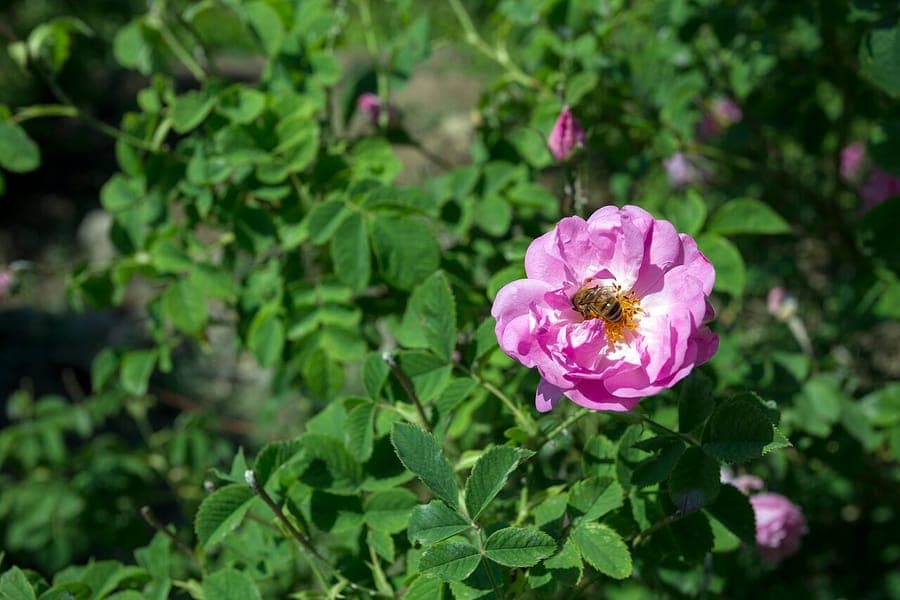
Mostafameraji / CC BY-SA 4.0, via Wikimedia Commons
Damask rose: complete guide
Rosa x damascena
Want to see Damask rose: complete guide in your garden?
1 minute, no credit card
Overview
The Damask rose (Rosa x damascena) is one of the oldest and most celebrated roses in the world. Its cultivation stretches back to antiquity, with evidence of its use in the ancient Middle East, likely originating near Damascus in Syria - the city that gave the rose its name. Through the Crusades and the trade routes of the Arab world, it reached Europe in the medieval period, where it quickly found a permanent home in monastery gardens, manor gardens and the cultivated spaces of towns and cities.
This shrub rose is famous above all for its scent. The fragrance of the Damask rose forms the basis of traditional rose oil and rosewater, still harvested in quantity in Bulgaria's Rose Valley and in Turkey. Whoever has encountered genuine rose attar will recognise the Damask's perfume immediately: deep, warm, complex and unmistakably rosy. In the perfume industry it remains the gold standard against which all other rose scents are measured.
For the gardener, the Damask rose is a choice with genuine character. It blooms only once a year, it grows vigorously, and it needs proper care - but what it delivers during those few weeks of bloom in June is incomparable. For garden design inspiration that includes historic roses and fragrant planting schemes, gardenworld.app is a useful starting point.
Appearance and bloom cycle
The Damask rose is an arching shrub growing 150 to 200 cm tall and at least as wide. The stems are sturdy, lightly arched and well-armed with strong, curved thorns and smaller hooked prickles. The leaves are matt grey-green, with five to seven leaflets per leaf, slightly wrinkled and a little rough to the touch - quite different from the glossy foliage of modern roses.
The flowers are the reason gardeners have grown this rose for centuries. They are full and densely petalled, with dozens of petals folding inward layer upon layer. Colour varies by cultivar from white through blush to mid-pink. The petals are thin and silky. The blooms appear in a brief but overwhelming flush in June, with some cultivars - notably the repeat-flowering Autumn Damask (Rosa x damascena var. semperflorens) - producing a smaller second flush in late summer.
Fragrance is the Damask rose's most extraordinary quality. It releases its perfume most strongly in the morning, when dew still rests on the petals and the temperature has not yet risen. On a quiet June morning in a garden full of Damask roses, the scent is present and powerful without being sharp.
After flowering, the plant develops attractive pear- to bottle-shaped rose hips that ripen to red in autumn, adding ornamental interest well into the season.
Ideal location
Open, sunny positions with good air movement suit the Damask rose best. At least six hours of direct sun daily promotes generous flowering and helps keep the foliage dry, which reduces the risk of fungal diseases. In partial shade the plant grows well but flowers less freely and becomes more prone to powdery mildew.
Good air circulation is always important with roses. Avoid planting the Damask rose hard against walls or dense hedges that restrict airflow. A moderately open position, with some shelter from the harshest winds but enough movement to keep the foliage dry, is ideal.
In traditional gardens the Damask rose suits the romantic cottage garden, the walled garden and the historic garden. Its naturally loose, arching habit does not suit clipping into a tight formal shape; it needs room to express its elegant silhouette.
Soil requirements
Roses generally, and the Damask rose in particular, have certain soil requirements. A rich, moist but free-draining soil is ideal. Heavy clay is problematic unless thoroughly improved with organic matter and grit; pure sand holds too little water and nutrition.
A slightly acid to neutral pH of 6.0 to 7.0 suits the Damask rose well. At lower pH, nutrients are poorly available; at higher pH, trace elements such as iron become locked up, causing yellowing leaves and poor growth.
Improve the soil generously before planting by working in garden compost, well-rotted manure or bark-based compost. Dig a planting hole at least 50 cm wide and 50 cm deep, backfill with a mix of excavated soil and compost, and firm in well. Roses are long-term garden residents, so time spent on soil preparation at planting pays dividends for years.
Watering
The Damask rose needs regular watering during dry periods but must not sit in wet soil. The aim is a consistently moist but well-drained root zone. Water once a week with a generous amount - at least 10 litres per plant - delivered directly at the base of the shrub rather than overhead. Wetting the foliage encourages fungal diseases including black spot and powdery mildew, which are the Damask rose's main health challenges.
In the first year after planting, consistent watering is especially important to help the roots establish deep into the soil. Thereafter the plant can manage somewhat better during dry spells, though it never becomes truly drought-tolerant. In the increasingly dry summers of recent years, supplementary watering remains necessary throughout the growing season.
A mulch layer of bark, compost or straw at the base of the rose helps retain moisture, stabilise soil temperature and suppress weeds. Keep the mulch clear of the stem itself to avoid collar rot.
Free design
Want to see Damask rose: complete guide in your garden? Make a free design now.
Deadheading and pruning
Pruning the Damask rose requires understanding its growth habit. As a once-flowering rose, it blooms on wood formed the previous season. The critical pruning moment is immediately after the main June flowering: cut back the flowered stems to a strong outward-facing sideshoot or back to one of the main framework branches. This encourages the plant to produce the new wood that will carry next year's flowers.
Remove any dead, diseased or weak stems at the same time. Leave the main framework - the strong, multi-year branches that form the structure of the shrub - as intact as possible.
In late winter or early spring (February to March), a light tidying cut is appropriate: remove any wood killed by frost and shorten any stems that have become untidy. Hard cutting in spring removes the season's flowering wood and should be avoided except when full rejuvenation of an overgrown plant is the goal.
Every three to five years, an established Damask rose can be cut back more severely to renew the structure. It recovers well, though it will sacrifice one season's flowering in the process.
Maintenance calendar
January to February: dormancy. No action needed beyond checking supports if the rose is trained against a wall or fence.
March: light spring tidy-up. Remove dead or frost-damaged wood. Apply a generous top-dressing of well-rotted compost around the base. Apply a rose-specific fertiliser according to the manufacturer's instructions - garden centres carry suitable products.
April to May: strong growth. Inspect regularly for aphids and powdery mildew, which can appear in warm, dry conditions. Treat with insecticidal soap or appropriate garden products if needed.
June: the main flowering. Enjoy the blooms and the fragrance. Deadhead spent flowers if you prefer a tidy appearance, but leave some in place if you want the autumn display of rose hips.
July: post-flowering pruning. This is the single most important pruning moment of the year for once-flowering roses. Cut back flowered wood to encourage new growth that will carry next year's flowers.
August to September: the plant builds new flowering wood. Do not apply high-nitrogen fertiliser now; it stimulates soft growth that will not harden before winter.
October: rose hips develop and ripen red. No pruning in this period.
November to December: dormancy. Apply a 10 to 15 cm mulch layer of compost or bark around the base to protect the roots and graft union during frost.
Winter hardiness
The Damask rose is reasonably winter-hardy, tolerating temperatures to around -20 degrees Celsius, which corresponds to USDA zone 5. In the UK, Netherlands, Belgium and Germany, the plant rarely suffers serious frost damage in normal winters. Exceptional cold snaps may damage the tips of young shoots, but established plants recover without difficulty.
The best frost protection is a generous mulch layer of 10 to 15 cm of compost or bark around the base of the shrub, applied before the first hard frosts. This insulates the roots and protects the graft union where the rose was budded onto its rootstock. Newly planted shrubs are more vulnerable than well-established ones.
In colder climates (zone 4 and below), wrapping the entire shrub in horticultural fleece or hessian during hard frosts may be needed. In most of western Europe, this level of protection is not normally required.
Companion plants
The Damask rose sits beautifully within a romantic planting scheme alongside other perennials that share its June-July flowering season. Classic companions include lavender (Lavandula angustifolia), catmint (Nepeta x faassenii), cranesbill (Geranium x cantabrigiense) and delphiniums, which reinforce the warm, fragrant atmosphere of a traditional rose border.
The grey-blue tones of lavender and catmint make a classic contrast with the rose's pink flowers while amplifying the scent. Salvia nemorosa 'Caradonna' with its deep purple flower spikes is another excellent pairing.
White-flowered plants bring freshness and elegance: white geraniums, white foxglove (Digitalis purpurea 'Alba') and white lupines. For a fully historic character, combine the Damask rose with other old rose classes: Rosa gallica, Rosa centifolia and Rosa alba were all grown alongside the Damask in the gardens of medieval Europe.
For more ideas on designing fragrant, romantic borders with historic roses, explore gardenworld.app.
Closing thoughts
The Damask rose is a rose with history, depth and genuine character. It blooms briefly but overwhelmingly, and its fragrance is like nothing else in the garden. It demands more attention than modern repeat-flowering varieties, but it gives back more in sheer beauty and romantic atmosphere. For a garden that needs to be filled in June with the scent of real rose perfume, it is the first choice. Give it the right spot, the right soil and the right pruning, and it will reward you for generation after generation.
Want to see Damask rose: complete guide in your garden? Make a free design now.
Upload a photo, pick a style, and get a photorealistic design with plant list in under a minute.
10,000+ gardens designed already
No credit card required


Similar plants
Siberian crab apple: complete guide
Malus x robusta
Complete guide to the Siberian crab apple (Malus x robusta): location, soil, pruning, winter hardiness and the best companion plants for your garden.
Chinese flowering crabapple (Malus x spectabilis): complete guide
Malus x spectabilis
Meet the Chinese flowering crabapple (Malus x spectabilis): a classic spring bloomer with carmine buds and pink blossom.
Potentilla crassinervia: complete guide
Potentilla crassinervia
Potentilla crassinervia, the Corsican cinquefoil, grows wild on Corsica and Sardinia's peaks. Discover how to grow this hardy alpine rock garden gem.