
Wikimedia Commons / PD, via Wikimedia Commons
Curve-pod yellow cress: complete guide
Rorippa curvisiliqua
Want to see Curve-pod yellow cress: complete guide in your garden?
1 minute, no credit card
Overview
Curve-pod yellow cress (Rorippa curvisiliqua) is an annual to biennial herbaceous plant in the Brassicaceae family, the mustard or cabbage family. First formally described in 1894 by Bessey and Britton, based on earlier material gathered by botanist Hooker, its botanical name directly references the plant's most distinctive feature: curvisiliqua translates as curved pod or curved silique, referring to the characteristically curved seed pods that develop after flowering.
The species is native to the western coast of North America, ranging from Alaska south to Baja California in northwestern Mexico. Its natural range includes Alaska, British Columbia, California, Idaho, Montana, Nevada, Oregon, Washington, and Wyoming. In the wild, Rorippa curvisiliqua typically occupies wet to moist habitats: stream banks, ditch margins, marshy meadows, damp disturbed ground, and periodically flooded flats. The species is adaptable and grows from coastal lowlands to considerable mountain elevation.
While curve-pod yellow cress is not a classic ornamental garden plant in Europe, it is well-suited to ecological gardens, pond and stream margins, and naturalised plantings featuring North American or ecologically functional species. On gardenworld.app you can find inspiration for designing wet garden zones and streamside plantings where species like Rorippa curvisiliqua play a valuable ecological role.
The species has carried several names in botanical literature, including Nasturtium curvisiliquum, Radicula curvisiliqua, and Rorippa nuttallii. All refer to the same plant. The currently accepted name Rorippa curvisiliqua is registered in international plant databases including WFO and POWO.
Within the Brassicaceae family, the species shares close ecological kinship with common watercress (Nasturtium officinale), which occupies similar wet habitats. Both are herbaceous, flower with small blooms, and produce elongated seed pods. Rorippa curvisiliqua is distinguished by the characteristic curve of its ripened seed pods, the easiest identification feature alongside the small yellow flowers.
Appearance & bloom cycle
Rorippa curvisiliqua is a low to mid-height herb reaching 15 to 60 cm in height depending on growing conditions. Under rich, moist conditions it may grow to 80 cm. Stems are angular, hollow inside, and tend to recline or ascend. They branch little at the base but may spread considerably in the upper half.
Leaves are fine-textured with a slightly hairy surface, pinnate or deeply lobed. Basal leaves are larger, reaching 5 to 15 cm in length; stem leaves diminish in size upwards and grade into bracts near the flower clusters. Leaf colour is light to mid-green; margins are irregularly toothed or lobed.
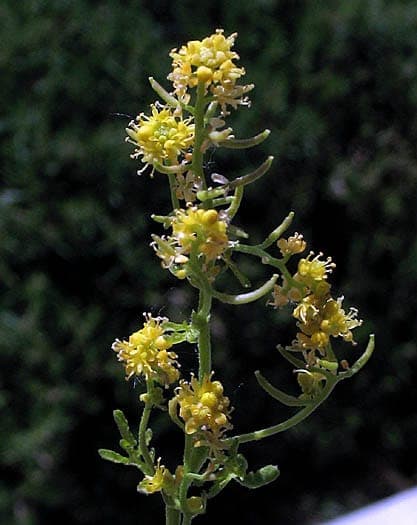
Flowers are classic Brassicaceae: four small yellow petals arranged in a cross, surrounded by four sepals. Each individual flower is just 2 to 4 mm across, but they are held in dense upright racemes that create an attractive yellow display across the plant. Bloom period runs from April to August depending on elevation and climate, and in wet years with sustained moisture can last considerably longer.
The most distinctive feature after flowering is the seed pod. Each silique measures 6 to 14 mm long, strikingly slender, and bends characteristically upward or to the side as it ripens. This curved shape gives the species its common name and distinguishes it from related species with straight pods such as Rorippa palustris or Rorippa islandica.
The plant grows rapidly and in favourable conditions can complete its full life cycle - from seed to seed set - within a single growing season. Under less favourable conditions or with late germination, it behaves as a biennial. Seed production is typically abundant, which supports reliable naturalisation in suitable wet habitats.
Ideal location
Rorippa curvisiliqua thrives best in wet to moist positions in full sun to light partial shade. The plant is naturally a pioneer of disturbed, wet habitats: it rapidly colonises newly exposed stream banks after flooding, wet arable margins, ditch edges, and muddy riverbanks where competition from other plants is limited.
In the garden, the best positions are a sunny marginal zone beside a pond or stream, a wet meadow area, the edge of a bog or water feature, or a permanently moist bed. The plant tolerates temporary flooding well, making it suitable for zones that stand under water during winter or early spring.
Although the plant prefers full sun, it can also grow in light shade, though with less lush flowering and more compact stems. Avoid deeply shaded locations where the plant becomes etiolated and blooms poorly.
For European gardens, the plant is well suited to wet garden areas too moist for most conventional perennials. It can be combined with other marginal plants such as bulrush (Typha), arrowhead (Sagittaria), water mint (Mentha aquatica), and common reed (Phragmites). When designing a marginal zone for your garden, gardenworld.app offers extensive inspiration and personalised garden designs for water features and wet plantings.
Soil requirements
The soil requirements of Rorippa curvisiliqua follow directly from its native habitat on wet, periodically flooded sites. The plant prefers a mineral-rich, moist to wet soil with good nutrient availability. Soil pH can range from 6.0 to 7.5, corresponding to a preference for neutral to slightly acidic or slightly alkaline conditions.
Unlike many plants, Rorippa curvisiliqua is not particularly selective about soil texture: it grows on heavy clay soils as well as sandy loam, provided that sufficient moisture is available. On poor, dry sandy soils the plant will grow poorly or fail to establish.
For garden cultivation, the best approach is to provide the marginal zone with an organically rich base layer. At planting, apply 5 to 8 cm of mature compost or leaf mould on the surface. Heavy clay soils do not necessarily need amendment; the plant thrives on clay as long as no prolonged drought occurs.
For cultivation in containers or pond-edge planters, a clayey topsoil-compost mixture (70:30 ratio) works well. Keep the container consistently moist. Aquatic baskets with permeable liners also work effectively: the plant can stand partially in water with its base at the margin.
Avoid strongly alkaline soils with pH above 7.5, as the plant may show leaf yellowing (chlorosis) due to poor iron and manganese uptake.
Free design
Want to see Curve-pod yellow cress: complete guide in your garden? Make a free design now.
Watering
Watering is generally minimal concern for Rorippa curvisiliqua: as a wetland and marginal plant it thrives with constant soil moisture and tolerates temporary flooding. In a wet marginal zone beside a pond or stream, groundwater or surface water supplies sufficient moisture without supplemental watering.
If Rorippa curvisiliqua is grown in a somewhat drier location, such as a moist border not directly adjacent to open water, regular watering during dry periods is necessary. In such cases, water two to three times per week during dry, warm weather to keep the soil consistently moist at 5 cm depth. Hard tap water is generally not a problem for this species, though rainwater is always preferable.
In summer, when temperatures rise, moist ground dries quickly. Mulching with a 5 cm layer of organic material - compost or shredded leaf - helps retain soil moisture longer and suppresses competing vegetation. Mulching is less necessary when the plant is at an actual water margin.
During extended drought periods the plant may enter early summer dormancy, with above-ground parts yellowing and dying back, but the seed bank in the soil remains intact for regrowth or germination when moisture returns.
Pruning
Rorippa curvisiliqua is an annual to biennial plant that requires no pruning in the conventional sense. Management consists primarily of directing seed dispersal and removing dead plant material at end of season.
If the plant is a deliberate feature of your ecological marginal planting, leave a proportion of ripe seed pods in place at season's end - September or October - so the plant can self-renew through seed. Seeds fall from the pods and germinate the following spring on the moist soil surface.
To limit excessive self-seeding, remove the seed pods before they fully ripen and split open. This is done easily by clipping the uppermost flowering stems once the pods have taken on their characteristic curved shape but are still green and closed. This keeps the planting under control without removing the entire stand.
At the end of the growing season, dead stems can be removed. Where practical, leave them in place as mulch and a food source for soil organisms, or add them to the compost heap for reuse as organic fertiliser.
Maintenance calendar
January and February: No active measures needed. Check that the marginal zone has not become overgrown by competitor species that might crowd out Rorippa. Water container-grown plants if the substrate has dried.
March: Seed can be sown at temperatures of 8 degrees Celsius and above. Press seed lightly onto moist soil surface, do not cover with soil - light is needed for germination. On warm, sheltered spots, seeds that fell in autumn may already be germinating.
April: Germination and early plant development. Ensure consistent moisture. Thin seedlings to 20 to 30 cm spacing if you want well-developed cultivated plants.
May: Rapid vegetative growth. First flowers appear on early-sown plants. Water regularly during dry spells.
June: Full flowering period for early-sown plants. Monitor for insect damage. No supplemental feeding needed: the plant grows vigorously without additional fertiliser.
July: Ongoing flowering and start of seed set. Decide whether to collect seed or limit spread. Curved but still-green pods can be collected for storage and later sowing.
August: Ripe pods split and release seeds. If self-seeding is desired, leave pods alone; if managed cultivation is preferred, remove pods before they open.
September and October: End of the growth cycle for annual specimens. Remove dead stems or leave in place as mulch.
November and December: Dormant period. Seed overwinters in the ground and germinates the following spring. No active measures required.
Winter hardiness
As an annual to biennial herbaceous plant, Rorippa curvisiliqua is not winter-hardy in the conventional sense: above-ground parts die at the first hard frost. The plant overwinters as seed in the soil, not as a living plant.
Seeds of Rorippa curvisiliqua withstand cold conditions and overwinter reliably in the ground at temperatures down to around minus 15 to minus 20 degrees Celsius. In early spring, as soil temperatures rise above 8 degrees Celsius, seeds germinate and a new growing cycle begins.
In mild winters with few frost days, biennial specimens may survive as old plant material and continue growing into a second season. This is variable and depends on local winter temperatures; plan plantings as annual rather than relying on biennial overwintering.
For USDA zones 5 to 9 the species is suitable as an annual or biennial marginal plant. In zones 8 and 9, covering most of the Netherlands, Belgium, and coastal western Europe, seeds germinate reliably each spring after overwintering in the ground. In zones 5 and 6 (higher-altitude areas, northern latitudes) germination occurs slightly later but remains reliable.
The species is naturally adapted to the cold winters of its North American native range, which includes the severe winters of Montana and Wyoming reaching minus 30 degrees Celsius. Seeds are consequently exceptionally cold-tolerant.
Companion plants
Rorippa curvisiliqua suits combinations with other marginal and water-loving plants sharing a preference for wet to moist positions:
- Mentha aquatica (water mint): an aromatic, low-growing marginal plant occupying the same wet to moist soils. The combination is ecologically valuable and attracts pollinators.
- Veronica beccabunga (brooklime): a low, creeping marginal plant with blue flowers that creates an attractive colour contrast with the yellow blooms of Rorippa.
- Caltha palustris (marsh marigold): a classic European marginal plant with large yellow flowers that blooms early in season, with Rorippa curvisiliqua continuing the yellow flowering theme later.
- Glyceria maxima (reed sweet-grass): a tall-growing marginal grass providing a good backdrop to the lower-growing Rorippa. Note that reed sweet-grass can spread vigorously.
- Lythrum salicaria (purple loosestrife): a beautiful native marginal plant with bright pink flower spikes that complement the yellow Rorippa beautifully. Both thrive in the same wet to moist conditions.
Avoid combinations with drought-tolerant plants such as lavender, rosemary, or other Mediterranean species that require entirely different soil conditions.
Closing
Curve-pod yellow cress is a distinctive and ecologically valuable marginal plant that finds its home in wet, moist positions beside watercourses, ponds, and boggy areas. Its rapid growth, rich yellow flowering, and characteristic curved seed pods make it an interesting choice for naturalistic gardens and ecologically functional streamside plantings.
The small yellow flowers are an important nectar source for small bees and hoverflies, adding biodiversity value beyond purely aesthetic considerations.
Plan your pond margin and water garden with professional advice via gardenworld.app and discover which plants best suit your specific wet or moist garden zone. More plant profiles and garden ideas are available at gardenworld.app.
Want to see Curve-pod yellow cress: complete guide in your garden? Make a free design now.
Upload a photo, pick a style, and get a photorealistic design with plant list in under a minute.
10,000+ gardens designed already
No credit card required


Similar plants
Brassica cretica: complete guide
Brassica cretica
Brassica cretica, the Cretan cabbage, grows wild on Aegean cliffs. Discover how to grow this drought-tolerant, yellow-flowered Mediterranean perennial.
Corsican cabbage: complete guide
Brassica insularis
Corsican cabbage is a rare Mediterranean rock cabbage with white flowers and blue-green leaves. Location, soil and winter protection.
Prostrate cabbage: complete guide
Brassica procumbens
Prostrate cabbage is a creeping North African cliff plant with yellow flowers. Discover location, soil type and winter protection.