
Attribution information, such as the author's name, e-mail, website, or signature, that was once visible in the image itself has been moved into the image metadata and/or image description page. This makes the image easier to reuse and more language-neutral, and makes the text easier to process and search for. Commons discourages placing visible author information in images. / CC BY-SA 3.0, via Wikimedia Commons
Rhodotypos scandens: complete guide
Rhodotypos scandens
Want to see Rhodotypos scandens: complete guide in your garden?
1 minute, no credit card
Overview
Rhodotypos scandens, also known by its common name Jetbead or white Kerria, is an elegant flowering shrub native to central and eastern Asia. This plant naturally thrives in the mountain forests of China, Korea, Japan, and Manchuria. In Europe, the Jetbead is a frost-hardy shrub that is perfect for gardens seeking a plant with dual season interest: white flowers in spring and glossy black fruits throughout fall and winter.
The Jetbead reaches heights of 1.5 to 3 meters depending on climate and growing conditions. This shrub is ideal for mixed borders, hedging plants, and screening plants. Its versatility and attractiveness to birds make it a popular choice among garden designers.
Appearance and bloom
The leaves of Rhodotypos scandens are coarse-textured and dark green, with a distinctive ribbed pattern. The foliage grows alternately along the branches and gives the plant an open, airy appearance. In autumn, the leaves turn yellow to yellowish-brown before dropping.
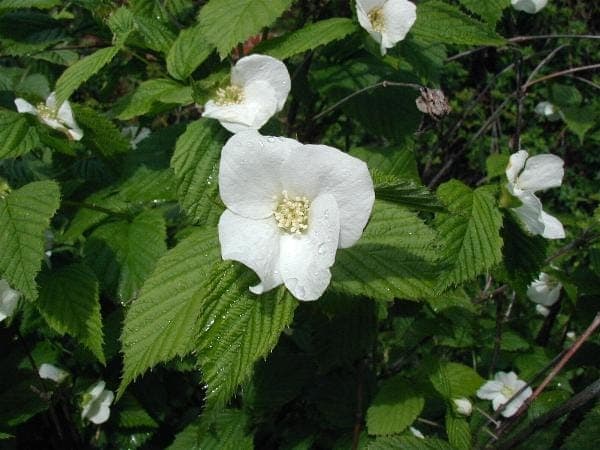
Flowers appear in May and June at the branch tips in clusters of approximately 3 to 5 white blooms. Each flower measures about 2 to 3 cm in diameter, with four delicate white petals creating an elegant look. After flowering, glossy black fruits form, measuring about 1 to 1.5 cm across. These fruits are the most striking feature of the plant and remain on the plant deep into winter, providing extra value during the season when most other plants have disappeared.
Ideal location
Rhodotypos scandens grows well in both full sun and partial shade. For best flowering results, however, choose a location receiving at least 6 hours of direct sunlight daily. In warm climates, some afternoon shade can be beneficial.
The plant is highly tolerant of wind and can be planted without difficulty in exposed locations. This makes it ideal for gardens along windy shores or open terraces. Ensure good drainage to prevent water accumulation.
Soil
Rhodotypos scandens is very tolerant of most soil types. The plant grows in both acidic and neutral to slightly alkaline soils. Once established, the plant tolerates dry conditions, although it grows more lushly in normally moist soil.
Heavy soils can be improved with sand and organic material to enhance drainage. The plant has no special nutritional requirements and grows well without extra fertilization. Mulching around the plant helps maintain moist conditions.
Free design
Want to see Rhodotypos scandens: complete guide in your garden? Make a free design now.
Watering
Rhodotypos scandens requires regular watering in the first growing season after planting. Ensure the soil remains moist without becoming waterlogged. Once established, the plant tolerates dry periods, although regular watering promotes growth and flowering.
Water at the base of the plant in the morning. Avoid spraying water over the foliage, which may be susceptible to fungal issues. In dry summers, watering twice per week is recommended.
Pruning
Rhodotypos scandens requires minimal pruning. The plant naturally grows in a well-structured form. After flowering, damaged or weak branches can be removed. If the plant becomes too large, the main branches can be cut back to desired size after flowering.
The plant should not be pruned too aggressively as this can lead to reduced flowering in the following season. Pruning should be done after flowering.
Maintenance calendar
Spring (March-April): Check for winter damage, remove dead branches, and begin regular watering.
Late spring (May-June): The plant flowers abundantly. Enjoy the white blooms and water regularly.
Summer (July-September): Black fruits form. Check for pests and reduce watering if sufficient rainfall occurs.
Autumn (October-November): Foliage turns yellow. Fruits remain spectacular on the plant.
Winter (December-February): The plant rests. Minimal watering is required.
Winter hardiness
Rhodotypos scandens is very winter-hardy to approximately minus 20 degrees Celsius. This means the plant grows well in most parts of Europe. In the most severe winter regions, young plants can be protected with mulch or snow screens.
The plant is not susceptible to late frosts as it flowers late in spring, after all frost is likely past.
Companion plants
Rhodotypos scandens grows well alongside other spring-flowering shrubs such as forsythia, spirea, and weigela. The black fruits in autumn combine beautifully with yellow or orange-leaved plants.
The plant attracts birds that eat the fruits, so you might plan it with other bird-friendly plants to support biodiversity.
Closing
Rhodotypos scandens is an excellent choice for garden owners seeking a plant with two-season interest: beautiful white flowers in spring and glossy black fruits in fall and winter. With minimal maintenance needs and excellent winter hardiness, it is a valuable addition to any garden design. Find your plant at quality garden centers. Discover more inspiration and design your own garden on gardenworld.app with hundreds of other plant varieties.
Want to see Rhodotypos scandens: complete guide in your garden? Make a free design now.
Upload a photo, pick a style, and get a photorealistic design with plant list in under a minute.
No credit card required


Similar plants
Siberian crab apple: complete guide
Malus x robusta
Complete guide to the Siberian crab apple (Malus x robusta): location, soil, pruning, winter hardiness and the best companion plants for your garden.
Chinese flowering crabapple (Malus x spectabilis): complete guide
Malus x spectabilis
Meet the Chinese flowering crabapple (Malus x spectabilis): a classic spring bloomer with carmine buds and pink blossom.
Potentilla crassinervia: complete guide
Potentilla crassinervia
Potentilla crassinervia, the Corsican cinquefoil, grows wild on Corsica and Sardinia's peaks. Discover how to grow this hardy alpine rock garden gem.