
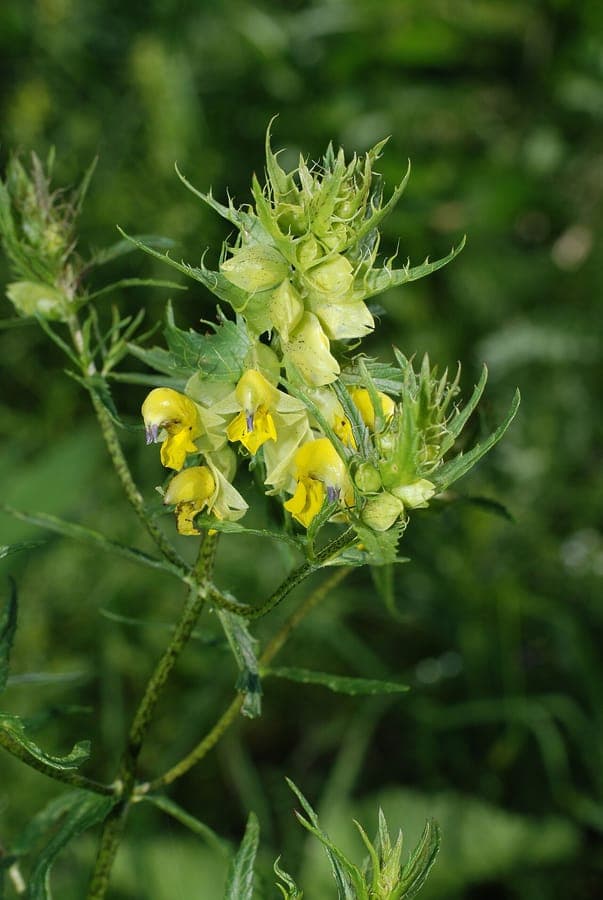
User:Tigerente / CC BY-SA 4.0, via Wikimedia Commons
Glacier rattle (Rhinanthus glacialis): complete guide
Rhinanthus glacialis
Want to see Glacier rattle (Rhinanthus glacialis): complete guide in your garden?
1 minute, no credit card
Overview
Rhinanthus glacialis, commonly known as glacier rattle or awned rattle, is a rare annual semi-parasite belonging to the family Orobanchaceae. The species was first described in 1863 by Personnat and is native to the Alps and adjacent mountain ranges of south-eastern France, Switzerland, Austria, Italy, and the Balkan Peninsula. The epithet 'glacialis' refers to the plant's proximity to glaciers and high alpine zones. Like all rattles, Rhinanthus glacialis is hemiparasitic: it photosynthesises independently but simultaneously extracts water and nutrients from neighbouring grasses via underground haustorial connections. This remarkable lifestyle makes it both an ecologically significant species and a challenging but rewarding plant to establish in naturalistic garden settings. On gardenworld.app you can explore how flowering meadow designs featuring unusual botanicals like this rattle can be incorporated into a thoughtful garden plan.
Appearance and bloom cycle
Glacier rattle is an erect annual herb reaching between 10 and 40 cm in height depending on growing conditions. The stems are simple or lightly branched, often dark-spotted or streaked. The leaves are narrow and lance-shaped, roughly 2 to 4 cm long, with a clearly toothed margin. The flowers are yellow, tubular, and two-lipped in the typical rattle fashion. The upper lip is pale yellow and gently curved, tipped with two small blue-violet teeth. The calyx is inflated and bladder-like, trapping air inside - this is the 'rattle' that gives the genus its name: as ripe seeds loosen, they rattle audibly inside the swollen calyx when the plant is disturbed. Flowering occurs in June and July, sometimes as early as May at lower elevations. Being annual, the plant sets seed and dies each year, relying on self-sown seed for the following season.
Ideal location
In the wild, Rhinanthus glacialis grows on sunny to lightly shaded mountain meadows, slope grasslands, and rocky open areas in the subalpine and alpine zones, typically between 1000 and 2500 metres altitude. The plant requires the presence of suitable host grasses growing close by, as it cannot complete its life cycle without them. In garden cultivation, it is best grown in a wildflower meadow or naturalistic grassland setting with low-growing grasses such as red fescue (Festuca rubra) or common bent (Agrostis capillaris). Full sun to light partial shade is ideal; deep shade prevents normal development. Thin, poor-quality turf is far more suitable than fertile garden soil.
Soil
Rhinanthus glacialis has clear soil preferences: it thrives on poor, well-drained ground with low to moderate nutrient levels. Rich, heavily fertilised garden soil is unsuitable; under such conditions, grasses and other competitors overwhelm the rattle before it can establish. The pH range is slightly to mildly acidic, around 5.0 to 5.5 based on available data, though in the wild it is also found on calcareous soils. Excellent drainage is essential: standing water at the roots is not tolerated. If establishing a meadow patch, removing the existing fertile topsoil and replacing with poor subsoil or gravel-mixed material greatly improves the chances of success.
Moisture
The moisture requirements of Rhinanthus glacialis are moderate. In its natural mountain habitat, the plant benefits from reliable rainfall and meltwater, but it also withstands dry spells thanks to water uptake via its grass hosts. In the garden, normal rainfall at most locations is sufficient. Additional watering is generally unnecessary; in fact, too much moisture can compromise drainage and harm the plant. In dry summers, light watering can assist seed germination, but established plants manage well without supplemental irrigation.
Free design
Want to see Glacier rattle (Rhinanthus glacialis): complete guide in your garden? Make a free design now.
Trimming
As an annual, Rhinanthus glacialis requires no trimming in the conventional sense. Management consists of allowing the seeds to ripen fully: leave plants standing until the calyces are completely brown and seeds rattle audibly, so they can self-sow for the following growing season. If you wish to limit spread, cut before seed ripening, but bear in mind that an annual without seed dispersal will quickly disappear from your garden. In a wildflower meadow setting, the best approach is to mow after seed ripening, in late summer or early autumn, and always remove the cuttings to prevent nutrient accumulation in the soil.
Maintenance calendar
March to April: sow directly on site among host grasses, or rely on self-sowing from the previous year. May: first seedlings emerge as tiny plantlets. June to July: flowering period; plants reach their full height. July to August: seeds ripen; the rattling is audible when brushing against the plants. August to September: mow the meadow after seed ripening; remove all cuttings from the site. October to February: the plant has died as an annual; the population persists as dormant seed in the soil. Visit gardenworld.app to design a naturalistic grassland or wildflower meadow with botanically interesting species.
Winter hardiness
As an annual plant, Rhinanthus glacialis does not survive winter in its vegetative form. The plant dies after setting seed and persists exclusively as seed in the soil bank. The seeds are well adapted to freezing and actually require a cold period to germinate - a process known as cold stratification. USDA hardiness zone ratings are less meaningful for annuals than for perennials, but the seeds survive reliably in zones 4 to 8. In mild climates, the plant is sometimes sown in late autumn to undergo natural cold stratification outdoors and germinate early the following spring.
Companion plants
Because Rhinanthus glacialis is a hemi-parasite, the host grasses are the most critical 'companion plants'. Suitable hosts include red fescue (Festuca rubra), common bent (Agrostis capillaris), smooth meadow grass (Poa pratensis), and timothy (Phleum pratense). Beyond the host grasses, the rattle combines beautifully with other wildflower meadow species: ox-eye daisy (Leucanthemum vulgare), common knapweed (Centaurea jacea), common bird's-foot trefoil (Lotus corniculatus), yellow rattle (Rhinanthus minor), and meadow clary (Salvia pratensis). By weakening the grasses through parasitism, the rattle indirectly creates space for other flowering plants that would otherwise struggle to compete with vigorous turf. This makes it an ecological keystone species in meadow habitats.
Closing thoughts
Rhinanthus glacialis is not a garden plant in the conventional sense - it demands the right ecological context, namely a species-rich, low-fertility meadow with suitable host grasses. Those willing to create these conditions are rewarded with a fascinating plant that not only flowers attractively but also fulfils a unique ecological role. A wildflower meadow containing rattles typically supports far more plant species than bare lawn ever could. Curious to discover how to design such a naturalistic garden landscape? Visit gardenworld.app for personalised design inspiration tailored to your own plot.
Want to see Glacier rattle (Rhinanthus glacialis): complete guide in your garden? Make a free design now.
Upload a photo, pick a style, and get a photorealistic design with plant list in under a minute.
10,000+ gardens designed already
No credit card required


Similar plants
Yellow-rattle: complete guide
Rhinanthus minor
Yellow-rattle (Rhinanthus minor) is a delicate yellow-flowering herb with semi-parasitic properties. Discover the growth, cultivation and ecological importance of this valuable wildflower.
European yellow rattle: complete guide
Rhinanthus alectorolophus
European yellow rattle (Rhinanthus alectorolophus) is a fascinating semi-parasitic herb with yellow flowers. Learn about its growth, ecology and value for pollinators.