
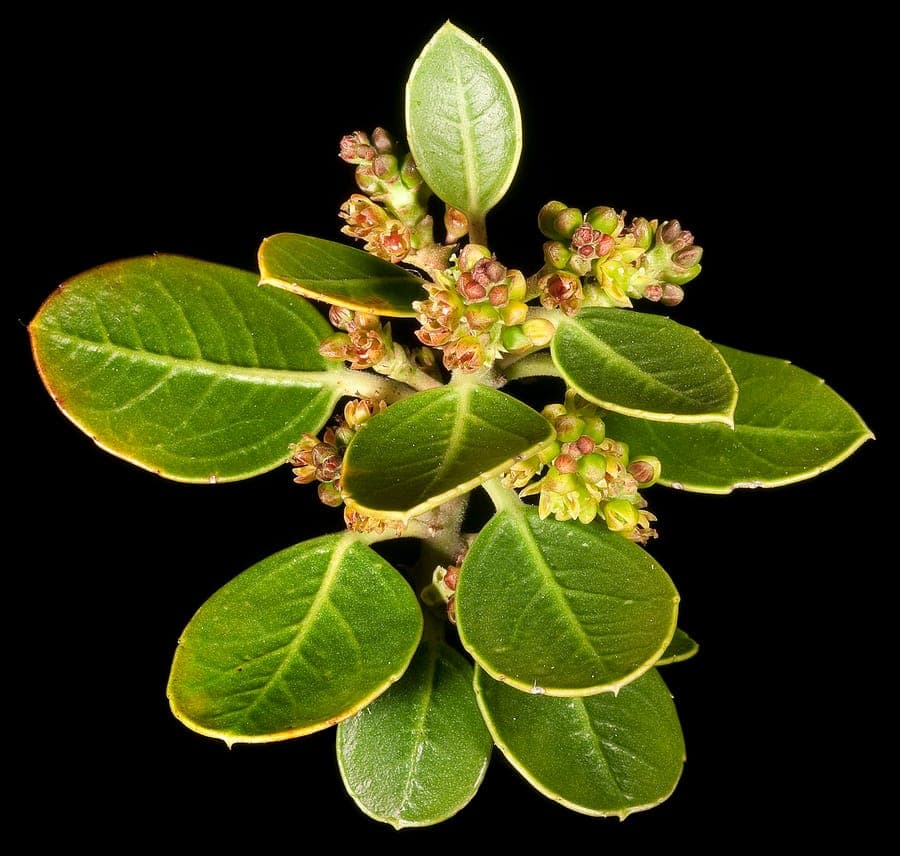
Kevin Thiele from Perth, Australia / CC BY 2.0, via Wikimedia Commons
Rhamnus alaternus: complete guide
Rhamnus alaternus
Want to see Rhamnus alaternus: complete guide in your garden?
1 minute, no credit card
Overview
Rhamnus alaternus, commonly known as Mediterranean buckthorn or alaternus, is an evergreen shrub from the Rhamnaceae family. This Mediterranean native grows wild from southern Europe to North Africa and the Middle East. As a low-maintenance, compact shrub, it's perfect for Mediterranean gardens, hedges, and as a specimen in mixed borders.
Mediterranean buckthorn is robust, fast-growing, and attractive year-round.
Appearance and bloom
Mediterranean buckthorn grows as a compact, densely-foliaged shrub, typically 1.5 to 3 meters tall and broad. Foliage is grass-green, elongated, firm, and glossy, remaining evergreen through winter. Flowers are small, inconspicuous, greenish-yellow, appearing in spring March-April.
After bloom, small round berries appear turning red, later becoming black, attractive to birds. Berries persist long and provide autumn color.
Ideal location
Mediterranean buckthorn grows well in full sun to light partial shade. Ideal is at least four hours direct sun daily. The plant also thrives in shade, though growth is somewhat slower and lighter. Place the shrub in warm, sunny locations for best appearance.
Soil requirements
Mediterranean buckthorn grows well in virtually any well-draining soil. Heavy clay can be improved with sand. The plant prefers moderately fertile soil - too much feeding can encourage excessively vigorous growth. Ideal pH is around 6.0 to 7.0.
Watering
Mediterranean buckthorn tolerates drought well once established. In the first season, water regularly to establish. After that, watering can be considerably reduced. The plant tolerates both dry and somewhat moist conditions well.
In warm, dry areas, some summer watering can help keep the plant fresher. Avoid waterlogging in winter.
Free design
Want to see Rhamnus alaternus: complete guide in your garden? Make a free design now.
Pruning and maintenance
Mediterranean buckthorn can be pruned to control shape and size. The plant responds well to pruning and can be regenerated in spring. Pruning can make the plant fuller.
Normal maintenance is minimal - an annual prune in spring is sufficient. Old, stiff branches can be removed to encourage new growth.
Maintenance calendar
March to April: Prune; flowers appear. May to June: Berries begin to form; water regularly. July to October: Berries ripen from red to black. November to February: Minimal care; pruning can occur in late winter.
Winter hardiness
Mediterranean buckthorn is reasonably cold-hardy in many European areas, to approximately USDA zones 7-8 (to -15 to -10 degrees Celsius). In harsh, cold areas (northern Netherlands, Germany, Belgium), it tolerates frost periods well, though severe cold can damage the tips.
In less favorable zones, plant against south-facing walls or protected locations. In warm Mediterranean zones (USDA 9-11), it grows prolifically.
Companion plants
Mediterranean buckthorn combines well with other Mediterranean plants:
- Lavandula: purple flowers and silver-gray foliage
- Rosmarinus: complementary forms and aromatic texture
- Cistus: white flowers in contrast
- Helichrysum: silvery foliage and golden-yellow flowers
Closing
Rhamnus alaternus is an essential plant for Mediterranean gardens. With its evergreen foliage, fast growth, and bird-feeding berries, this is an indispensable choice. Available at major plant nurseries and online suppliers. For more Mediterranean garden inspiration, visit gardenworld.app.
Want to see Rhamnus alaternus: complete guide in your garden? Make a free design now.
Upload a photo, pick a style, and get a photorealistic design with plant list in under a minute.
No credit card required


Similar plants
Point Reyes ceanothus: complete guide
Ceanothus gloriosus
The Point Reyes ceanothus is an evergreen Californian groundcover with blue flowers. Location, soil and pruning explained in detail.
Santa Barbara ceanothus: complete guide
Ceanothus impressus
Ceanothus impressus rewards a sunny wall with deep blue flowers in March-May. Location, soil, pruning and winter protection explained.
Redstem ceanothus: complete guide
Ceanothus sanguineus
Ceanothus sanguineus is a hardy, deciduous shrub with reddish stems and creamy white flower clusters in June. Care and companions.