
Stickpen / Public domain, via Wikimedia Commons
Prairie coneflower: complete guide
Ratibida columnifera
Want to see Prairie coneflower: complete guide in your garden?
1 minute, no credit card
Overview
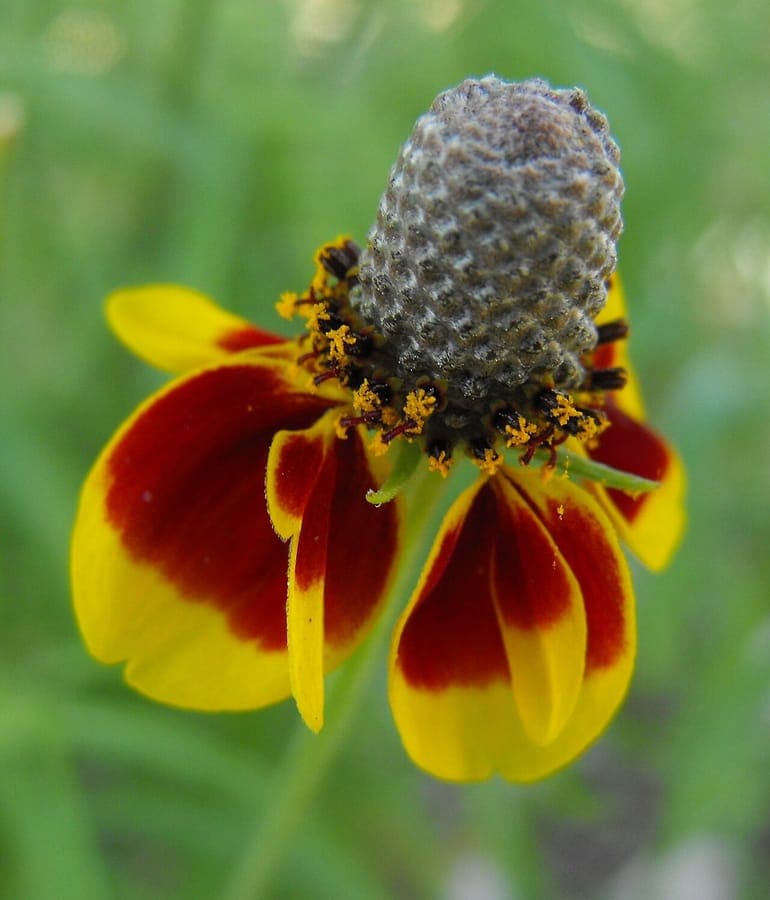
Ratibida columnifera, commonly called prairie coneflower or Mexican hat, is one of the most iconic wildflowers of the North American Great Plains. A member of the Asteraceae family, it earned its colloquial name from the striking shape of its flower heads: a tall, thimble-like central cone rising 2 to 5 cm above a ring of drooping ray flowers that resemble the brim of a Mexican sombrero. The ray flowers are bright golden-yellow in the typical form, or deep purplish-red in the variety known as var. pulcherrima.
Native to a vast territory stretching from Alberta and Saskatchewan in Canada south through the central United States to Texas and Mexico, this plant is adapted to open, wind-swept grasslands and rocky slopes. It thrives on lean soils where competitors struggle, making it an excellent choice for low-maintenance naturalistic plantings in European gardens.
In cultivation, prairie coneflower grows 45 to 90 cm tall, with deeply pinnate leaves and branching stems that carry multiple flower heads over a very long season - from June until September or even October. Cultivars worth knowing include 'Red Midget', a compact form to 30 cm with predominantly reddish-brown ray flowers, and 'Buttons & Bows', which features double rays in yellow and red-brown. The straight species is equally garden-worthy and often easier to source.
The plant self-seeds freely on suitable sites, so over a few years it naturalises into colonies that look as though they have always been there. In a gravel garden, a dry sunny slope, or a prairie-style planting, Ratibida columnifera brings long-season colour and attracts an impressive range of pollinators.
Appearance & bloom cycle
The foliage of prairie coneflower is deeply pinnate, with five to nine narrow leaflets per leaf. Leaves are grey-green and slightly rough to the touch due to fine hairs. Basal leaves can be 20 to 30 cm long; stem leaves become progressively smaller toward the top of the plant. The overall effect is feathery and light, making it a good see-through plant at the back of a border.
Flowering begins in June and continues in waves until September. The characteristic central cone starts green, turns brown as it matures, and elongates steadily during blooming. The drooping ray flowers unfurl from the base of the cone upward over a period of weeks, extending the effective display time of each flower head. This unusual bottom-up blooming sequence is one of the plant's most charming features.
After flowering, the cone dries to a dark brown, seed-covered head that persists well into winter. Goldfinches, chickadees, and other seed-eating birds seek out these heads for food. The dried stems and cones add skeletal structure to the winter garden. Where birds don't strip the seeds, the plant self-sows reliably, especially on bare or gravelly ground.
Prairie coneflower is an exceptional pollinator plant. Honeybees, bumblebees, sweat bees, and native solitary bees visit the flowers in large numbers. Monarch butterflies and painted ladies are frequent visitors during migration. Planting a cluster of five to seven plants ensures continuous bloom and keeps pollinators coming back all summer.
Ideal location
Full sun is essential: at least six hours of direct sunlight per day. In partial shade the stems become floppy and flowering is reduced. Prairie coneflower is a plant of wide-open grasslands, and it performs best when given a similarly exposed position. South-facing and west-facing aspects in the garden suit it perfectly.
It handles wind well and does not normally need staking, especially on lean soils. On fertile soils, tall-growing plants may lean after heavy rain, but this is an indication to reduce soil fertility rather than to stake the plants. In a mixed perennial border, give it space: a planting distance of 40 to 50 cm between plants allows good air circulation and prevents fungal issues.
For a low-maintenance front garden or a dry sunny strip alongside a path, prairie coneflower is among the best choices available. Design your own prairie-inspired planting using gardenworld.app, where you can visualise plant combinations before committing to a scheme.
Soil requirements
Poor to moderately fertile, well-drained soil with a pH between 5.9 and 7.0 suits prairie coneflower best. It tolerates sandy loam, rocky soils, and dry chalk or limestone substrates without difficulty. Heavy clay soils that remain waterlogged in winter are the main enemy; if your soil is clay-based, incorporate plenty of sharp sand and fine gravel to a depth of 40 cm before planting.
Avoid adding compost, manure, or general fertilisers to the planting area. On rich soils the plant becomes tall and floppy, produces more leaves than flowers, and may be short-lived. In lean conditions it stays compact, self-supports, and blooms prolifically for years. A mulch of gravel or grit around the plant helps maintain good drainage and suppresses weeds without adding nutrients.
The deep taproot that develops in established plants is what gives Ratibida columnifera its exceptional drought tolerance. It penetrates subsoil layers in search of moisture, so surface conditions matter less once the plant is established. Avoid disturbing the taproot: like all taprooted perennials, this plant resents being moved once settled.
Free design
Want to see Prairie coneflower: complete guide in your garden? Make a free design now.
Watering
In the first season after planting, water regularly to help the taproot establish. Water deeply once a week during dry spells, ensuring the soil is moistened to at least 20 cm depth. Avoid light, frequent watering as this encourages shallow root development and makes the plant more vulnerable to drought.
From the second season onward, established plants are highly drought-tolerant and generally need no supplemental watering in the UK and northwestern Europe, where rainfall is usually sufficient. In prolonged summer droughts (three or more weeks without rain), a single deep watering every two to three weeks is adequate.
Overwatering is the more common mistake and the more damaging one. Consistently wet soil causes root rot and crown rot, which quickly kill the plant. Drip irrigation, if used, is far preferable to overhead watering: it delivers moisture directly to the root zone without wetting the foliage, reducing the risk of fungal diseases.
Pruning
Prairie coneflower requires minimal maintenance pruning. The standard approach is to leave the flowering stems standing through winter, for both the wildlife value of the seed heads and the structural interest in the garden. In late winter or early spring, as new basal growth begins to emerge, cut the old stems down to ground level.
For more floriferous, bushier plants, the Chelsea chop technique works well: in late May, when stems have reached about 30 cm, cut them back by one-third. This delays flowering by two to three weeks and produces more branched stems with more flower heads. On poor soils the plant is naturally compact and this technique may not be necessary.
Deadheading (removing spent flower heads) extends the blooming season by preventing the plant from setting seed, but eliminates the winter bird-food value and the self-seeding that naturalises the plant. A compromise is to deadhead some stems and leave others, getting both extended blooming and some self-sown seedlings.
Maintenance calendar
March-April: Remove the previous year's stems as new basal shoots emerge. Check for any frost damage; the plant is very hardy but a late hard frost can catch early shoots.
May: Optional Chelsea chop to create more compact, multi-stemmed plants. Begin watering if the soil is very dry.
June-September: Main flowering period. Enjoy the blooms and the pollinator activity. Water only during prolonged droughts.
October: Optionally cut back stems to 10 cm if tidying the garden. Otherwise leave standing for birds and winter structure.
November-February: No care required. The plant is dormant and fully hardy without protection.
Winter hardiness
Prairie coneflower is exceptionally hardy. It is rated USDA zones 3 to 9, tolerating temperatures to -40 °C. For gardens in the UK, the Netherlands, Belgium, France, and Germany, winter hardiness is never a concern. The above-ground stems die back in autumn, but the crown and deep taproot survive unscathed through the coldest winters.
Young plants in their first winter are slightly more vulnerable and benefit from a light mulch of coarse gravel, but even this is rarely strictly necessary. On well-drained soil, the crown stays dry enough in winter to avoid the rotting that can occasionally affect Asteraceae family members.
In areas with warm, wet winters - such as parts of maritime western Europe - the main risk is not frost but prolonged soil saturation. Ensure good drainage and the plant will overwinter without problems every year.
Companion plants
Prairie coneflower belongs in the company of other North American prairie natives and drought-tolerant perennials:
- Echinacea purpurea (purple coneflower): classic prairie companion, blooming at the same time in pink-purple tones that complement the yellow rays of Ratibida beautifully. Space plants 40 cm apart.
- Rudbeckia fulgida 'Goldsturm': golden-yellow flowers from July to October, sharing the same soil preferences and drought tolerance. Together these two create a stunning late-summer display.
- Salvia nemorosa 'Caradonna' or 'Ostfriesland': deep violet-blue flower spikes contrast sharply with the yellow Ratibida rays. Combine at the front of the border for a cool-warm colour scheme.
- Schizachyrium scoparium (little bluestem grass): an ornamental grass 60-80 cm tall with blue-green summer foliage turning copper-red in autumn; it bridges perfectly between the flowering perennials and adds movement.
- Penstemon digitalis (foxglove beard-tongue): earlier-flowering, white to pale-pink spikes that extend the border season before the Ratibida comes into bloom.
- Gaura lindheimeri: airy, wand-like stems with white-pink flowers that create a light, naturalistic backdrop to the bolder Ratibida.
For more plant combination ideas and ready-made design plans for prairie and meadow borders, explore gardenworld.app.
Closing
Prairie coneflower is a plant that rewards the gardener with very little in return for very little effort. It asks for sun, lean soil, and reasonable drainage - nothing more. In exchange it gives months of colour, attracts dozens of pollinator species, provides seed for birds through autumn and winter, and builds year on year into an increasingly impressive colony. For naturalistic, low-maintenance, ecologically valuable gardens, few perennials can match Ratibida columnifera as a reliable backbone planting.
Want to see Prairie coneflower: complete guide in your garden? Make a free design now.
Upload a photo, pick a style, and get a photorealistic design with plant list in under a minute.
10,000+ gardens designed already
No credit card required


Similar plants
Calendula stellata: complete guide
Calendula stellata
Complete guide to Calendula stellata, the star-flowered marigold from Sicily: location, soil, watering and companion planting tips.
Korean chrysanthemum: complete guide
Chrysanthemum x rubellum
Chrysanthemum x rubellum is a hardy autumn perennial with single pink to copper flowers from August to November. Care and combinations.
Helianthus divaricatus: complete guide
Helianthus divaricatus
Helianthus divaricatus is a North American woodland sunflower with yellow summer blooms, ideal for naturalistic borders and shady edges.