
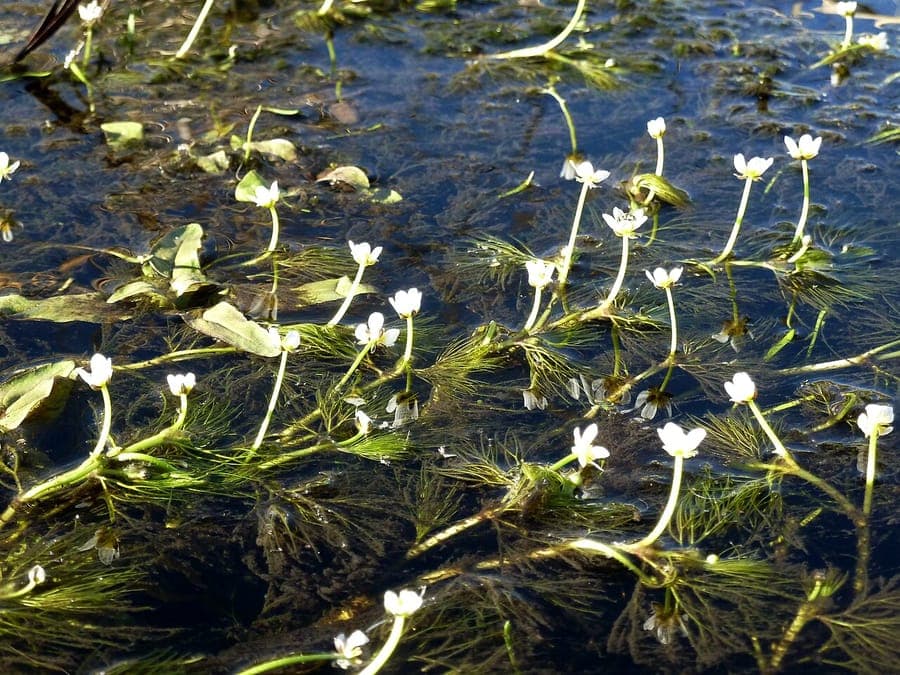
JMK / CC BY-SA 3.0, via Wikimedia Commons
Water crowfoot (Ranunculus rionii): complete guide
Ranunculus rionii
Want to see Water crowfoot (Ranunculus rionii): complete guide in your garden?
1 minute, no credit card
Overview
Ranunculus rionii, commonly known as Rion's water crowfoot or small water crowfoot, is a fascinating aquatic plant belonging to the buttercup family, Ranunculaceae. First described in 1848 by the Swiss botanist Lagger, the species is named after the botanist Rion. Unlike the better-known common water crowfoot (Ranunculus aquatilis), this species is notably smaller in both stature and flower size, making it particularly suitable for smaller garden ponds and shallow watercourses. Its native range spans a wide arc from temperate Europe through the Middle East and Central Asia all the way to the Himalayan foothills, a distribution that speaks to its remarkable ecological versatility. On gardenworld.app you can discover how aquatic plants like this crowfoot can be integrated beautifully into a complete garden design.
Appearance and bloom cycle
The plant grows either fully submerged or with floating stems just beneath the water surface. The submerged leaves are finely dissected into thread-like segments that wave gracefully in the current, a classic adaptation that minimises hydraulic drag. Where the plant produces floating leaves, these take on a distinctly different rounded and lobed shape, somewhat resembling tiny ivy leaves. The flowers are white with five petals arranged around a central cluster of yellow stamens, typical of the ranunculus genus. They emerge a few centimetres above the water surface and bloom from May through August, depending on water temperature and exposure. The flowers are relatively small, measuring only about 0.5 to 1 cm across, which helps distinguish this species from its larger relatives. After flowering, the plant produces small achene fruits that are dispersed by water currents.
Ideal location
Ranunculus rionii thrives best in shallow, clear, and slightly calcareous water. In the wild, it is found in slowly moving streams, ditches, small ponds, and temporarily flooded meadows. Water depth can vary from just a few centimetres to about 50 cm, with the plant adjusting its stem length accordingly. Full sun or partial shade is required: this species is light-loving and will bloom poorly in heavily shaded positions. In a garden pond, place it in the shallowest, sunniest zone. It tolerates gentle water movement and performs well in slowly moving streams. In still water, maintaining good water quality is essential to prevent algal growth that could smother the plant.
Soil and substrate
The plant is not demanding when it comes to substrate composition. Sandy loam, light clay, or standard pond soil all work well. More important is water quality: excessive nutrients encourage algal blooms that reduce the light available to the water crowfoot. A neutral to slightly alkaline pH of 6.5 to 7.5 is ideal. Ranunculus rionii tolerates temporarily brackish conditions poorly; it is strictly a freshwater plant. Provide a layer of two to five centimetres of sediment on the pond bottom to anchor roots. In clear, low-nutrient water the plant performs best, similar to conditions found in calcareous mountain streams.
Watering and moisture
As a true aquatic plant, Ranunculus rionii always needs water. It can survive a temporary drying out of a few days as long as the substrate remains moist, but prolonged drought is not tolerated. In a garden pond, no additional watering is required - the plant manages itself. During extended dry spells, maintaining the water level is important, especially in summer. The plant does best with a stable water level; fluctuations of more than 20 to 30 cm can disrupt its growth cycle. In wet years, it spreads readily via water-dispersed seeds and vegetative fragments.
Free design
Want to see Water crowfoot (Ranunculus rionii): complete guide in your garden? Make a free design now.
Trimming and management
A water crowfoot like Ranunculus rionii requires very little deliberate trimming. The plant largely self-regulates. However, some management is sensible to prevent it from growing too vigorously and crowding out other aquatic plants. In autumn, around October or November, remove dead stems using a rake or by hand. This improves water quality by removing organic matter that would otherwise decompose and cloud the water. If the plant becomes too dense in one spot, simply tear off sections and remove or relocate them elsewhere in the pond. Scissors are often inconvenient underwater; the hand-tearing method works better for this species.
Maintenance calendar
March to April: check whether the plant has survived winter; after hard frosts it may have died back to the pond bottom. May to August: flowering period; check regularly for algal growth that could overwhelm the plant. June: thin out if growth becomes too exuberant. August to September: fruits ripen and disperse via water; decide whether to limit the spread. October: remove dead material before winter arrives. November to February: the plant is largely dormant but overwinters as a submerged plant beneath ice, provided the water does not freeze solid. On gardenworld.app, you can visualise your entire garden design, including water features, before any construction begins.
Winter hardiness
Ranunculus rionii is winter hardy in northern and western Europe. The species tolerates frosts down to approximately -15 degrees Celsius and falls within USDA hardiness zones 5 to 9. As long as the pond does not freeze solid - meaning an ice-free section remains or the pond is deep enough - the plant survives without issues. In a shallow container that could freeze completely, it is advisable to bring the plant indoors in a bucket of pond water and store it in a frost-free location. After winter it recovers quickly once water temperatures rise above 8 degrees Celsius. In mild winters, the plant may remain partially green throughout.
Companion plants
In and around the pond, Ranunculus rionii combines well with other aquatic and marginal plants. Good companions include water violet (Hottonia palustris), pondweed species (Potamogeton), yellow flag iris (Iris pseudacorus) at the water's edge, and lesser bulrush (Typha angustifolia) for a natural reed margin. As a submerged groundcover, it works well alongside various pondweed relatives. In an ornamental pond, it pairs attractively with white water lily (Nymphaea alba) and marsh marigold (Caltha palustris) at the margins. Avoid aggressive species in large quantities, as these can quickly overwhelm the smaller crowfoot. Assembling a small community of native aquatic plants creates the best ecological balance.
Closing thoughts
Ranunculus rionii is a modest but ecologically valuable aquatic plant that belongs in any naturalistic garden water feature. It requires minimal care, attracts insects with its white flowers, and contributes to a clear and healthy water ecosystem. For the enthusiast of native European flora in the garden, it is an excellent choice. Looking for further inspiration for a complete garden design with water features? Visit gardenworld.app for personalised design ideas based on your own garden.
Want to see Water crowfoot (Ranunculus rionii): complete guide in your garden? Make a free design now.
Upload a photo, pick a style, and get a photorealistic design with plant list in under a minute.
10,000+ gardens designed already
No credit card required


Similar plants
Water-crowfoot: complete guide
Ranunculus aquatilis
Discover water-crowfoot aquatic plant for ponds and water gardens. Growth care overwintering and expert planting advice on gardenworld.app here.
Ranunculus acris: complete guide
Ranunculus acris
Discover the Meadow buttercup, a shiny yellow wildflower. Growing, care, and integration into natural gardens and meadows.
Bulbous buttercup: complete guide
Ranunculus bulbosus
Discover bulbous buttercup a meadow plant with corms for grazing land. Growth multiplication care and planting guidance experts here now.