
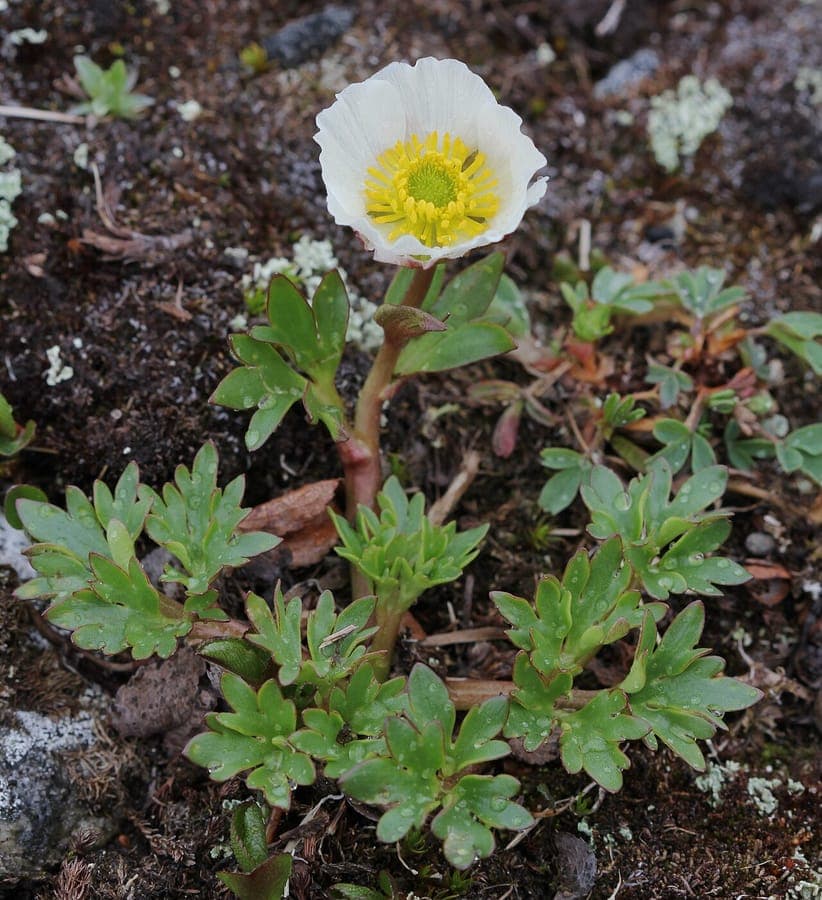
Alinja / CC BY-SA 3.0, via Wikimedia Commons
Glacier buttercup: complete guide
Ranunculus glacialis
Want to see Glacier buttercup: complete guide in your garden?
1 minute, no credit card
Overview
Ranunculus glacialis, the glacier buttercup, is one of the most extraordinary flowering plants in the temperate and arctic world. Described by Linnaeus in 1753 in his Sp. Pl., this member of the Ranunculaceae family grows natively across the high mountain ranges of Europe and into the far north - from the Pyrenees and Alps through Scandinavia, the Faroe Islands, Iceland, Greenland, Svalbard, and across to Alaska. Its distribution spans the subarctic and subalpine zones of Eurasia and northwestern North America.
This compact herb reaches only 5 to 20 cm in height, yet flowers reliably each July and August at elevations that would defeat almost any other plant. In the Alps it has been recorded growing above 4,000 metres, in rock crevices at the very margins of glaciers. The flowers open cream-white and gradually blush to a warm rose-pink as they age - a colour transition that unfolds across a single plant, giving the effect of two flower colours simultaneously.
In cultivation, Ranunculus glacialis is grown as a specialist plant for the alpine or rock garden. It demands precise growing conditions that mirror its wild habitat: outstanding drainage, cool root temperatures, and a mineral-rich, low-nutrient substrate. For gardeners building an alpine or mountain-themed garden corner, gardenworld.app offers planning tools to help compose the right combination of rock garden species with complementary bloom times.
Appearance & bloom cycle
Ranunculus glacialis is a low-growing herbaceous perennial with glossy, dark green, deeply divided leaves. The leaves are palmately lobed into three to five segments, each segment itself finely cut - giving the plant a delicate, almost filigree appearance that is deceptively robust in its alpine environment.
Flowers appear on sturdy 5 to 15 cm stems in July and August. Each flower is 2 to 3 cm across, with five rounded petals and a central cluster of yellow stamens. Newly opened flowers are cream to pale yellow, sometimes with a pink blush. As the flower ages and is pollinated, the petals deepen progressively through pink to a rich rose-red. A single plant in full flower will carry newly opened white blooms alongside older pink and red ones simultaneously - a striking visual effect that distinguishes Ranunculus glacialis from most other white-flowered alpines.
After flowering, small achene fruits develop, each tipped with a short beak. The seeds disperse via wind and occasionally via meltwater streams. The plant forms no runners, staying in tight clumps up to 15 to 20 cm in diameter. In autumn it dies back fully to ground level, overwintering as a compact rootstock protected in deep rock crevices or under insulating snowpack.
Ideal location
In cultivation, Ranunculus glacialis demands conditions that approximate its alpine habitat as closely as possible. In the wild it grows in rock crevices and scree with exceptional meltwater drainage, a cool root zone, and intense overhead light. In the garden, translate these requirements as: full sun or very light afternoon shade, perfect drainage, and a cool microclimate at root level.
A traditional alpine garden or tufa rock garden is the most appropriate setting. Position the plant on a slightly north- or east-facing slope so it receives morning sun but is shaded from the hottest afternoon light, which dries the substrate too rapidly in summer. Between large boulders, the roots can penetrate deep into cool, shaded cavities - closely mimicking the crevice habitat.
Avoid rich, warm garden soil, container compost, and any position where standing water can collect. Warm, fertile conditions encourage lush, weak growth that collapses to fungal disease within a season. Heavy clay or poorly drained loam is incompatible with this species.
Soil requirements
The substrate for Ranunculus glacialis must be extremely free-draining. Mix two parts coarse horticultural grit or pumice (1 to 3 mm grain size) with one part peat or fine leaf mould and one part granite or basalt grit. The resulting substrate should drain completely within 30 seconds of watering - if water lingers, add more grit. Target a pH of approximately 5.5 to 6.5, slightly acidic, which reflects the mineral-rich but lime-free rock faces the plant typically occupies in nature.
Avoid lime-rich substrates, clay, heavy compost, or any material that retains warmth and moisture for extended periods. Rich organic matter encourages soft, fast growth that becomes susceptible to botrytis and root rot. Refresh the substrate around each plant every two to three years to prevent organic matter accumulation.
In containers, use very shallow terracotta pans (no deeper than 10 cm) with multiple drainage holes. Fill with the grit mix described above and top-dress with a layer of fine granite chips to keep the collar of the plant dry.
Watering
Watering Ranunculus glacialis requires careful balance. In its natural environment, a constant trickle of cold meltwater keeps roots lightly moist throughout the growing season from July to August. In the garden, replicate this with small, frequent waterings that keep the substrate barely moist but never wet.
In warm dry weather, water every two to three days, applying 0.5 to 1 litre per plant. Always water in the morning so the foliage and crown dry before evening. Use rainwater or soft tap water where possible: hard, calcareous tap water gradually raises the substrate pH over time, which this species does not tolerate. Drip irrigation at substrate level works well for rock garden beds.
In autumn, reduce watering progressively as the plant dies back. Through winter in open outdoor cultivation, natural rainfall usually provides sufficient moisture. The critical point is to ensure that winter rain and snowmelt drain away freely rather than sitting around the crown. Standing water at 0 to 5 °C causes crown rot even in this extremely cold-tolerant species.
Free design
Want to see Glacier buttercup: complete guide in your garden? Make a free design now.
Pruning
Ranunculus glacialis requires almost no active pruning. After flowering in August to September, the spent flower stalks can be removed neatly at the base to maintain a tidy appearance and prevent dead material from harbouring fungal disease. In early spring, carefully remove any dead or damaged leaves as the new growth emerges.
Do not cut back healthy green foliage: the leaves store the carbohydrate reserves that fuel the following year's growth and flowering. Individual diseased or damaged leaves should be removed by hand rather than with a general cut.
Clump division for propagation is possible but rarely needed. If required, divide in early spring when new growth is just visible but the substrate is still cool. Ensure each division retains at least two to three rosettes with intact roots, and replant immediately into the prepared grit substrate. Keep divisions out of direct sun for the first week after replanting.
Maintenance calendar
January–February: Dormancy under snow or dry grit mulch. No maintenance required. Check for unexpected thaw waterlogging.
March: Carefully remove winter mulch as temperatures reliably rise above 0 °C. Check substrate drainage.
April–May: New shoots emerge. Maintain light moisture. Apply a small amount of slow-release, low-nutrient alpine fertiliser if the substrate has been in place for more than two years.
June: Pre-bloom growth phase. Increase watering frequency slightly. Monitor for slug damage on emerging shoots.
July–August: Full bloom. Water every two to three days during hot dry spells. Enjoy the white-to-pink flower colour transition.
September: Seed setting. Allow seeds to ripen if propagation is intended. Gradually reduce watering.
October: Foliage dies back. Remove dead material. Apply a light top-dressing of fine granite grit around the crown.
November–December: Apply a protective mulch of dry coarse grit or pine bark to prevent crown waterlogging over winter. In snowless regions, a small glass cloche offers useful protection.
Winter hardiness
Ranunculus glacialis is exceptionally cold-hardy, surviving temperatures well below -30 °C in its arctic and alpine natural habitat. USDA hardiness zones 3 to 6 encompass its native range. The plant is fully hardy across all of northern and central Europe provided the drainage requirements are met.
In the Netherlands, Belgium, and the UK - zones 8 to 9 - the winters are not cold enough to harm this species. The real threat in mild, wet climates is not freezing temperatures but prolonged autumn and winter waterlogging: if roots sit in saturated, unfrozen substrate at 0 to 5 °C, crown rot sets in rapidly. A perfectly drained grit substrate and a dry mulch around the crown are the most effective protective measures.
In hot, dry continental climates - southern Germany, Austria, the warmer parts of France - the plant may struggle through summer if root temperatures become too high. Positioning between large boulders, which insulate the roots and maintain a cooler microclimate, is the single most effective technique for growing this species successfully at lower altitudes.
Companion plants
In the alpine garden, Ranunculus glacialis combines best with other high-alpine or subarctic species sharing similar drainage, cool root zone, and low-nutrient requirements:
- Saxifraga oppositifolia (purple mountain saxifrage): blooms early in the season with violet-purple flowers on tight cushions; similar rock crevice habitat and drainage needs.
- Androsace alpina (alpine rock jasmine): small cushion-forming plant with pale pink flowers; an excellent companion at the same altitude range.
- Dryas octopetala (mountain avens): low creeping sub-shrub with white flowers and decorative feathery seed heads; strong alpine character.
- Silene acaulis (moss campion): dense green cushions studded with small pink flowers; identical drainage requirements.
- Gentiana verna (spring gentian): cobalt-blue flowers in April to May, providing a bloom sequence that leads into the July–August display of Ranunculus glacialis.
- Sempervivum montanum (mountain houseleek): rosette-forming succulent that tolerates warmer, drier conditions and provides attractive structural contrast.
Careful planning of the planting composition ensures a dynamic, season-long display across the rock garden. Plan your alpine garden layout using gardenworld.app, where you can visualise plant combinations and explore design options before committing to planting.
Conclusion
Ranunculus glacialis is not a plant for the conventional border, but for the alpine enthusiast it represents a remarkable achievement: the opportunity to grow one of the world's highest-altitude flowering plants in a carefully prepared rock garden. Its transitioning flower colour, extraordinary cold tolerance, and fascinating arctic-alpine provenance make it one of the most botanically distinctive species in the world of rock garden cultivation.
With the right conditions - free-draining mineral substrate, a cool microclimate at root level, and attentive but restrained watering - the glacier buttercup will reward you every July and August with blooms that echo the grandeur of its glacial homeland. For further inspiration on alpine garden design and plant combinations, visit gardenworld.app and explore the full range of specialist planting ideas available.
Want to see Glacier buttercup: complete guide in your garden? Make a free design now.
Upload a photo, pick a style, and get a photorealistic design with plant list in under a minute.
10,000+ gardens designed already
No credit card required


Similar plants
Drummond's anemone: complete guide
Anemone drummondii
Discover Drummond's anemone (Anemone drummondii): a silvery-grey mountain plant for cool rock gardens and alpine troughs.
Korean clematis: complete guide
Clematis serratifolia
Clematis serratifolia is a hardy climber with fragrant yellow bell flowers in August-September. Pruning group 3, location and care tips.
Aquilegia brevistyla: complete guide
Aquilegia brevistyla
Discover Aquilegia brevistyla, the elegant North American columbine. Growing tips, shade tolerance, and design ideas for woodland and shadowed gardens.