
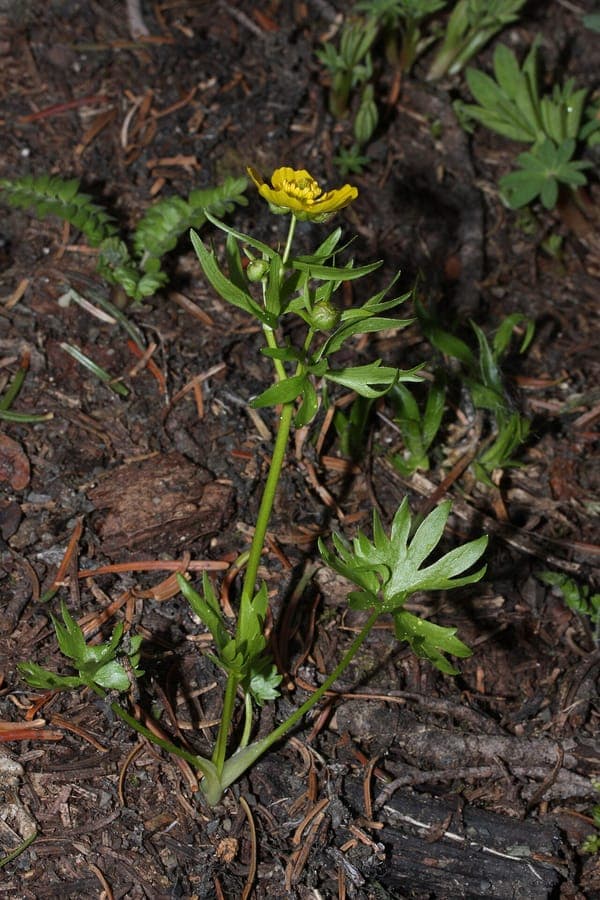
Walter Siegmund (talk) / CC BY-SA 3.0, via Wikimedia Commons
Mountain buttercup: complete guide
Ranunculus eschscholtzii
Want to see Mountain buttercup: complete guide in your garden?
1 minute, no credit card
Overview
The mountain buttercup (Ranunculus eschscholtzii) is a resilient, low-growing alpine perennial native to subalpine and alpine zones across western North America and the Russian Far East. First described in 1820 by botanist Schlechtendal and named after the German-Russian naturalist Johann Friedrich von Eschscholtz, this species naturally inhabits elevations from 1,500 to 3,500 metres, colonising snowmelt edges, moist rocky slopes, and subalpine meadows from Alaska south to California, Colorado, Wyoming, and Nevada.
What distinguishes the mountain buttercup from other Ranunculus species is its exceptional adaptation to extreme conditions. Where most plants struggle in thin soils and prolonged cold, Ranunculus eschscholtzii thrives. The plant forms compact tufts of 10 to 25 cm height, with deeply divided leaves and striking large golden-yellow flowers that appear as soon as snowmelt exposes the ground in spring.
For gardeners in temperate climates, this plant is a rewarding addition to a rock garden, alpine trough, or cool streamside border. Given appropriate soil preparation, it can be grown successfully in garden settings far from its mountain homeland. At gardenworld.app you will find design inspiration for incorporating alpine species like mountain buttercup into your own garden.
The species belongs to the Ranunculaceae family, which includes familiar garden favourites such as columbine (Aquilegia), larkspur (Delphinium), and hellebore (Helleborus). Like other family members, Ranunculus eschscholtzii contains mild irritants, but presents no hazard during normal handling.
Appearance & bloom cycle
Ranunculus eschscholtzii forms compact clumps typically 10 to 25 cm in height and spread. The leaves are palmately divided into three to five deeply lobed segments, glossy green in colour and slightly leathery in texture. Leaf stalks reach 5 to 15 cm in length. The overall effect is a carpet of finely cut, bright green foliage that provides attractive ground cover even when not in flower.
The flowers are the plant's most outstanding feature. Each bloom reaches 2 to 4 cm in diameter with five glossy, waxy yellow petals that reflect light brilliantly - a characteristic trait of the buttercup family. Bloom time begins shortly after snowmelt, which in alpine settings falls between May and August depending on elevation and yearly conditions. In cultivated garden settings at lower elevation, flowering typically occurs in April and May, occasionally extending into June in cool seasons.
After flowering, small clusters of achene fruits develop. Seeds are lightweight and dispersed by wind and water. The plant spreads gradually through short underground rhizomes, forming wider clumps over time without becoming invasive. No named cultivars are currently commercially available in European garden centres, but specialist alpine nurseries occasionally stock this species from seed-grown stock.
In autumn, the foliage dies back to the rootstock. In mild winters, some leaves may persist. The plant is a true perennial, reliably resprouting each spring when conditions are suitable.
Ideal location
In nature, mountain buttercup grows in full sun to light partial shade. At altitude, solar radiation is intense but temperatures remain cool and air humidity high from adjacent snowfields. In the garden, this translates to a preference for a sunny to lightly shaded spot with a cool root zone.
Ideal siting in the garden is a north or north-east facing slope in a rock garden, protected from the most intense afternoon sun in summer. Alternatively, plant beside a garden pond or small stream where the soil remains consistently moist. In combination with stones that keep the root zone cool, the plant performs particularly well.
Avoid full south-facing exposure in warm continental climates where summer temperatures regularly exceed 28 to 30 degrees Celsius. In such conditions the plant may enter a summer dormancy during which the foliage yellows and partially dies back until cooler autumn temperatures arrive. This is a normal physiological response, not a sign of disease or poor health.
Plant spacing of 20 to 30 cm between individuals allows each clump adequate room to develop over the first few seasons. Clumps can be divided every three to four years to rejuvenate the planting.
Soil requirements
Ranunculus eschscholtzii has specific soil requirements derived from its mountain habitat. In the wild it grows on mineral-rich, freely draining soils with a pH of 6.2 to 8.0. The soil must never become waterlogged, yet should retain sufficient moisture to sustain growth through the dry season - an apparent contradiction resolved by excellent soil structure.
The ideal growing medium combines 50 percent coarse grit or sharp sand, 25 percent leaf mould or mature compost, and 25 percent standard garden soil or loam. This mixture provides free drainage combined with adequate moisture retention. When constructing a rock garden, a drainage layer of coarse rubble or gravel at least 20 cm deep beneath the growing medium prevents water accumulation at the root zone.
On heavy clay soils, thorough soil improvement is necessary. Excavate the planting area to a minimum depth of 40 cm, remove the clay, and backfill with the mixture described above. Sandy soils need less drastic amendment but benefit from the addition of extra leaf mould or compost to improve moisture retention.
At planting time, incorporate a small quantity of slow-release fertiliser such as bone meal or a specialist alpine plant feed. Thereafter, annual maintenance feeding consists of a light application of potassium-rich fertiliser in early spring to support flowering.
Watering
Watering mountain buttercup is a matter of balance. The plant originates from habitats where snowmelt flows steadily through the soil, meaning roots are always somewhat moist but never standing in stagnant water. This principle applies equally in the garden.
During the growing season from April through September, water regularly: once weekly in normal summer conditions, more frequently during prolonged dry spells and high temperatures. Check soil moisture regularly by inserting a finger 5 cm into the soil. If the soil feels dry at that depth, watering is needed.
During the flowering period in April and May, adequate moisture is critical for rich, long-lasting blooms. Drought stress at this time can lead to premature flower wilt and reduced flower diameter. Use rainwater or softened tap water where possible to avoid calcium build-up in the soil, as the plant prefers a slightly acidic to neutral growing medium.
In winter the plant requires virtually no water. Watering during frost is actively harmful. Ensure the soil drains freely enough to carry away winter rainfall, as standing water around the crown in winter is the leading cause of root rot in alpine plants.
Apply a 3 to 5 cm mulch of coarse grit around the base of the plant to moderate moisture balance: it retains soil moisture during summer heat and prevents waterlogging at the crown during wet winters.
Free design
Want to see Mountain buttercup: complete guide in your garden? Make a free design now.
Pruning
Mountain buttercup requires minimal pruning. The plant largely manages its own growth and does not need the regular cutting back associated with shrubs or hedging plants.
In early spring, once new growth begins to emerge, remove any dead or dried foliage from the previous season. This is also the right time to cut away any frost-damaged or broken stems. Use sharp, clean scissors or pruning shears and cut stems as close to the crown as possible.
After flowering, spent blooms can be removed to maintain a tidy appearance and redirect energy from seed production back into the rootstock. This may slightly extend the flowering period or encourage occasional autumn flowers. However, leave a proportion of seed heads if you wish to encourage natural self-seeding within the rock garden.
In summer, when the plant may enter dormancy and the foliage yellows, it is tempting to cut everything back. Wait until the foliage has completely died before doing so, as still-green portions continue to feed the rootstock. Remove only the brown, fully dead material.
Clump division every three to four years, carried out in early spring or early autumn, keeps the planting vigorous. Lift the entire clump carefully, separate it into portions each with a healthy root system, and replant immediately.
Maintenance calendar
January and February: No active maintenance needed. Check that the mulch layer is intact and providing protection. During severe frost spells, additional protection with conifer branches or a straw layer can be applied.
March: Start of the garden season. Remove winter mulch carefully. First new green shoots become visible. Monitor for slugs, which can damage young emerging growth.
April: Peak growth phase and start of flowering. Ensure adequate water supply. Remove weeds carefully from around the plant. Apply a light potassium-rich feed if needed to support bloom.
May: Full bloom period. Enjoy the golden flowers. Remove spent blooms to extend the season. Monitor moisture levels regularly.
June: End of bloom period in warmer summers. The plant may enter summer dormancy at temperatures above 28 degrees Celsius. Gradually reduce watering if foliage begins to yellow.
July and August: Rest or summer dormancy period in warm seasons. Minimal watering. Roots remain active but above-ground growth is reduced.
September: Regrowth as temperatures cool. Good time for division and replanting. Apply fresh compost around the plant.
October and November: Prepare for winter. Apply a mulch layer of grit or coarse gravel around the crown. Remove fully dead foliage.
December: Winter dormancy. No active measures needed other than monitoring for waterlogging.
Winter hardiness
Ranunculus eschscholtzii is exceptionally cold-tolerant. In its natural habitat the plant survives temperatures below minus 30 degrees Celsius under deep snow that protects the crown. In garden cultivation in Europe it is reliably hardy in USDA zones 4 to 8.
In the UK, Netherlands, and Belgium, which fall mainly within USDA zone 8, the plant is hardy without supplemental protection. In northern or higher-altitude areas (zone 7), a protective mulch of dry straw, conifer branches, or coarse grit 5 to 10 cm deep provides additional security against temperatures below minus 15 degrees Celsius.
The greater threat in Atlantic European winters is not cold but persistent wetness. Standing water around the crown causes root rot far more readily than frost. Good drainage and a grit mulch that channels moisture away from the crown are the most important winter protection measures in a temperate European climate.
During prolonged frost, a dry mulch also prevents deep soil freezing around the crown, keeping the rootstock intact. Remove protection only after the final hard frost, when night temperatures are reliably above zero.
Companion plants
Ranunculus eschscholtzii combines well with other alpine and rock garden plants that share its preference for well-drained, cool, mineral-rich conditions:
- Dryas octopetala (mountain avens): a low-growing, white-flowered alpine that occupies similar subalpine habitats and appreciates the same freely draining soil profile. Together they create a naturalistic alpine scene.
- Pulsatilla vulgaris (pasque flower): blooms slightly earlier in the season, providing beautiful purple flowers that precede the golden mountain buttercup. Soil pH preferences and moisture preferences overlap strongly.
- Saxifraga species (saxifrages): excellent low groundcovers for rock gardens that prefer the same freely draining, mineral-rich soil. Their compact size complements the mountain buttercup's clumping habit.
- Gentiana acaulis (stemless gentian): the deep blue flowers create a spectacular colour contrast with the golden buttercup. Both thrive in similar alpine soils with a pH around 6.5.
- Veronica prostrata (prostrate speedwell): a low blue-flowered plant that works well as ground cover around the mountain buttercup. Blooms in May and June, nicely overlapping with or following the buttercup's season.
Avoid combining with moisture-loving plants such as hostas or astilbes, which prefer a richer, wetter soil type incompatible with the mountain buttercup's needs.
Closing
Ranunculus eschscholtzii is a beautiful and resilient alpine perennial that brings a distinctive character to any rock garden or alpine planting. With its large, gleaming yellow flowers in the early season, its cold tolerance, and its modest maintenance requirements, it rewards the discerning gardener who takes time to meet its specific soil and siting needs.
The mountain buttercup asks for well-drained, mineral-rich conditions and a cool root zone that mimics its mountain homeland. For gardeners willing to make this investment, the plant will deliver a rich flowering display year after year.
Visit gardenworld.app for professional garden advice and a personalised design that can feature alpine plants like mountain buttercup. Discover more plant profiles and garden inspiration at gardenworld.app.
Want to see Mountain buttercup: complete guide in your garden? Make a free design now.
Upload a photo, pick a style, and get a photorealistic design with plant list in under a minute.
10,000+ gardens designed already
No credit card required


Similar plants
Drummond's anemone: complete guide
Anemone drummondii
Discover Drummond's anemone (Anemone drummondii): a silvery-grey mountain plant for cool rock gardens and alpine troughs.
Korean clematis: complete guide
Clematis serratifolia
Clematis serratifolia is a hardy climber with fragrant yellow bell flowers in August-September. Pruning group 3, location and care tips.
Aquilegia brevistyla: complete guide
Aquilegia brevistyla
Discover Aquilegia brevistyla, the elegant North American columbine. Growing tips, shade tolerance, and design ideas for woodland and shadowed gardens.