
Hans Hillewaert / CC BY-SA 3.0, via Wikimedia Commons
Almond-leaved pear: complete guide
Pyrus spinosa
Want to see Almond-leaved pear: complete guide in your garden?
1 minute, no credit card
Overview
Pyrus spinosa, commonly known as the almond-leaved pear or almond-leaf pear, is a wild pear species native to the Mediterranean basin, belonging to the rose family (Rosaceae). The species epithet spinosa refers to the characteristic thorns borne on the branches - a feature that immediately distinguishes it from the common pear (Pyrus communis). Its native range covers Albania, Bulgaria, Corsica, France (chiefly the south), Greece, Italy, Sardinia, Sicily, Spain, Turkey and the former Yugoslav territories, with a secondary, introduced population in Hungary.
In gardens, Pyrus spinosa is increasingly admired as an ornamental pear for Mediterranean gardens, gravel gardens and drought-tolerant planting schemes. It offers spectacular early spring blossom in pure white, fine silvery-grey foliage, autumn interest from its small fruits and year-round structural value from its dense, thorny branching. On gardenworld.app you can find design examples that combine this species with lavender, cistus, sage and rosemary for contemporary, water-wise garden schemes.
The species is a genuine survivor on dry, calcareous soils: in its natural habitat along Mediterranean coasts and hillsides it endures summer heat, stony substrates and months without rainfall. This tough constitution makes it particularly suitable for the increasingly hot and dry summers experienced in western European gardens.
Appearance and bloom cycle
Pyrus spinosa grows as a broad, densely branched shrub or small tree, typically reaching 2 to 5 metres in height, occasionally more in sheltered, favourable positions. The branches are stiff, greyish and armed with sharp, robust thorns up to 2 cm long - a character that gives the plant both its specific epithet and its value as a wildlife-friendly structural plant.
The leaves are relatively narrow, oval to lance-shaped, 2 to 6 cm long, and conspicuously covered with grey-silver silky hairs on both surfaces when young - particularly on the underside, where the hairs persist into summer. This silvery-grey leaf colour is one of the most distinctive ornamental features of the species and explains the common name, alluding to the similar narrow, greyish leaves of the almond tree (Prunus dulcis).
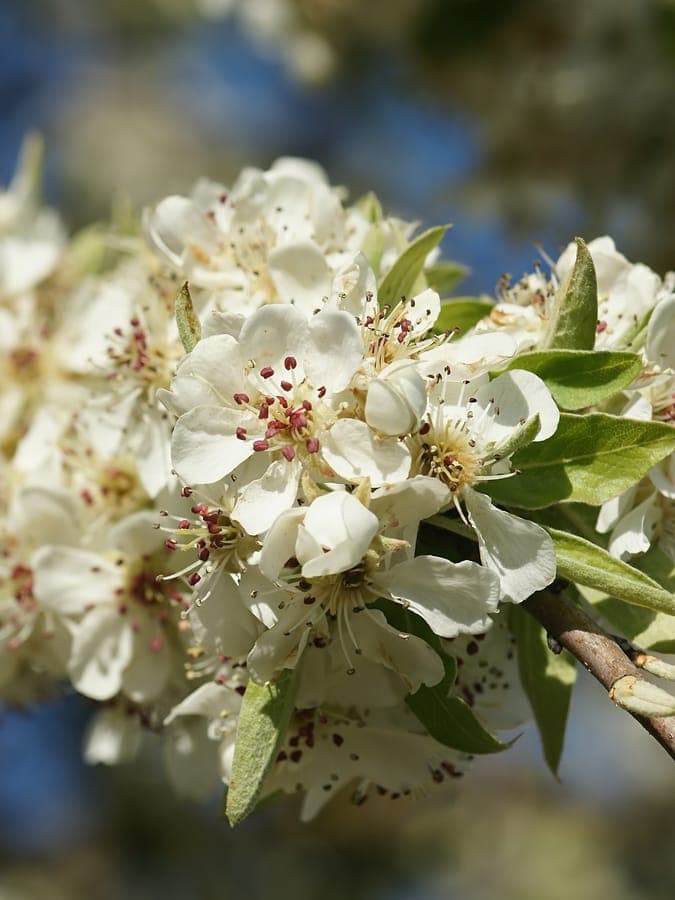
Flowering takes place in early spring, typically March to April, before or as the leaves unfold. The flowers are white, five-petalled, 2 to 3 cm across, borne in clusters of 5 to 12 blooms with a light, pleasant scent. The display is spectacular on mature plants, covering the thorny branches in dense white clusters. After flowering, small fruits develop: 1 to 2 cm across, roundish to pyriform, yellow-green ripening to brown-speckled, inedible to humans but a valuable food source for birds and small mammals through autumn and winter.
Ideal location
Full sun is non-negotiable for Pyrus spinosa. The light requirement scores 8 out of 10 in botanical classifications. In its native habitat it grows on open, south-facing rocky slopes and in garrigue or maquis scrubland receiving intense summer sunlight. In the garden, choose the sunniest, warmest position available: a south-facing wall, a raised gravel bed, a Mediterranean border or any aspect sheltered from cold north and east winds.
The species tolerates wind well, including salt-laden coastal wind, making it an excellent choice for exposed maritime gardens in mild-climate areas. The atmospheric humidity requirement is only moderate (5 out of 10), confirming its preference for relatively dry growing conditions with low ambient humidity.
In north-western European climates - the Netherlands, Belgium, northern France - success depends on choosing a genuinely warm, sheltered microclimate: the south-facing wall of a house, a sheltered courtyard or the sunward slope of a garden bank. Heat-storing hard surfaces such as stone terraces and gravel mulches significantly improve the plant's performance in cooler climates.
Soil requirements
The soil preferences of Pyrus spinosa reflect its limestone-dominated Mediterranean origin. It performs best at a pH of 6.5 to 7.0 - neutral to slightly alkaline - although it will grow adequately on slightly acid soils around pH 6.0. On high-pH calcareous substrates that might harm other species, Pyrus spinosa typically thrives.
Drainage is paramount. This species will not tolerate waterlogged or consistently wet soil: root rot develops rapidly in stagnant conditions. Stony, gravelly, sandy loam and well-structured limey soils are ideal. Compacted clay is entirely unsuitable unless radically improved. For garden planting in heavier soils, excavate a generous planting area (60 cm diameter, 50 cm deep) and backfill with a mixture of 50% topsoil, 25% coarse grit and 25% sharp sand to create the free-draining conditions the plant requires.
Nutrient requirements are moderate (5 out of 10). Rich, heavily fertilised soils are not needed and in fact can be counterproductive: on very fertile soils the plant grows more lushly and loses the compact, architectural form that makes it ornamentally valuable. A modest annual top-dressing of grit and a little balanced slow-release fertiliser in spring is all that is needed.
Free design
Want to see Almond-leaved pear: complete guide in your garden? Make a free design now.
Watering
Once established, Pyrus spinosa is extremely drought-tolerant. In its native Mediterranean range it endures four to five months of virtually no summer rainfall. This makes it an excellent choice for water-saving gardens and low-maintenance planting schemes.
In the first year after planting, regular watering is essential to establish a strong root system. Water weekly during the first summer, increasing frequency to twice weekly during prolonged heat above 25°C. From the second year, watering can be substantially reduced. By the third year, established plants in suitable soils require no supplemental watering except during exceptional drought.
Overwatering is more dangerous than underwatering: wet soil promotes root rot, which is rapidly fatal to this species. Winter watering is almost never needed, as the plant is dormant and winter rainfall in north-western Europe is generally sufficient. If planting in a container, ensure drainage holes are large and unobstructed.
Pruning
As an ornamental shrub, Pyrus spinosa can be left to develop its naturally broad, somewhat irregular form with minimal intervention. The thorns and dense branching create an attractive structural specimen that also provides excellent nesting sites for birds. Light, corrective pruning to remove crossing or congested branches can be carried out in April immediately after flowering.
To train as a small tree, gradually remove the lowest branches and competing stems over the first three years, aiming to establish a clean trunk of 50 to 80 cm. Carry this out in April after flowering or in late August. Pruning into the early winter dormant period is also feasible but best avoided in cold-winter areas as it may increase frost damage to cut surfaces.
For use as a thorny, informal hedge, Pyrus spinosa is excellent - its spines make it virtually stock-proof and intruder-resistant. Clip the hedge twice yearly: once in April after flowering and again in July or August. Use robust hedging shears and heavy leather gloves given the sharp thorns. The plant responds well to clipping and maintains a dense, impenetrable growth habit.
For design ideas on integrating Pyrus spinosa into a contemporary garden framework - whether as a specimen, hedge or part of a mixed Mediterranean border - gardenworld.app offers professional planting layouts and visual inspiration.
Maintenance calendar
March to April: Flowering period. Avoid pruning during bloom. Enjoy the spectacular white blossom. Check for frost damage on young shoots from any late frosts.
April to May: Leaf emergence. Corrective pruning immediately after flowering if needed. Begin weekly watering for first-year plants.
June to August: Growing season. First-year plants: water weekly. Mature plants: no supplemental water needed in most seasons. Second hedge clip in August if desired.
September to October: Fruit ripening and bird feeding. No garden tasks required.
November to February: Dormancy. No watering, no pruning. In the first two winters, protect young plants at the root base with a layer of straw if severe frost (below -15°C) is forecast.
Winter hardiness
Pyrus spinosa is reliably hardy to USDA zones 6 to 9, tolerating temperatures down to approximately -23°C when fully established in freely draining soil. In wet-winter areas, the species is more susceptible to frost damage because waterlogged soil increases cold damage to roots and causes bark splitting at the base.
In the Netherlands and Belgium, established specimens on sheltered, south-facing, well-drained positions are generally hardy through normal winters. Young plants in their first two winters are more vulnerable and benefit from a protective base wrapping of hessian or frost fleece and a deep straw mulch over the root zone during periods of severe frost below -12°C.
Mature specimens three years and older are usually fully resistant to normal north-western European winters. Any frost damage is typically limited to the most recent season's soft growth tips, which are replaced naturally in spring. The hard wood, thorns and bark are highly frost-resistant.
Companion plants
Pyrus spinosa is most at home in Mediterranean and dry-climate planting schemes alongside species with similar requirements for sun, drainage and drought tolerance. Lavender (Lavandula angustifolia 'Hidcote', 'Munstead'), rosemary (Salvia rosmarinus), sage (Salvia officinalis), cistus (Cistus x purpureus, Cistus salviifolius) and Spanish broom (Spartium junceum) are natural companions that require the same conditions and extend the ornamental season from late spring through summer.
For a richer structural planting, combine with Cotoneaster horizontalis for ground-level horizontal branching, Viburnum tinus for evergreen screening, Phillyrea latifolia for its elegant narrow leaves and Pistacia lentiscus for aromatic foliage. Together these form a dense, wildlife-rich planting that requires virtually no supplemental watering once established.
In a gravel garden, pairing Pyrus spinosa with Stipa tenuissima, Phlomis fruticosa, Verbena bonariensis and Salvia nemorosa 'Caradonna' creates a planting that bridges early-spring blossom (from the pear) through summer (salvia, stipa) into early autumn (verbena). All are available from good garden centres across Britain, and many are now stocked alongside drought-tolerant planting at specialist nurseries.
Closing
Pyrus spinosa is a plant of genuine distinction: tough enough to endure Mediterranean summers, beautiful enough to justify a prominent position in the garden, and ecologically valuable enough to sustain a range of pollinators, birds and small mammals throughout the year. Its demanding requirements - full sun, excellent drainage, a neutral to calcareous soil - limit its suitability to the warmest, driest corners of north-western European gardens, but in those spots it repays the gardener's investment many times over with decades of increasing beauty and wildlife value.
Want to see Almond-leaved pear: complete guide in your garden? Make a free design now.
Upload a photo, pick a style, and get a photorealistic design with plant list in under a minute.
10,000+ gardens designed already
No credit card required


Similar plants
Siberian crab apple: complete guide
Malus x robusta
Complete guide to the Siberian crab apple (Malus x robusta): location, soil, pruning, winter hardiness and the best companion plants for your garden.
Chinese flowering crabapple (Malus x spectabilis): complete guide
Malus x spectabilis
Meet the Chinese flowering crabapple (Malus x spectabilis): a classic spring bloomer with carmine buds and pink blossom.
Potentilla crassinervia: complete guide
Potentilla crassinervia
Potentilla crassinervia, the Corsican cinquefoil, grows wild on Corsica and Sardinia's peaks. Discover how to grow this hardy alpine rock garden gem.