
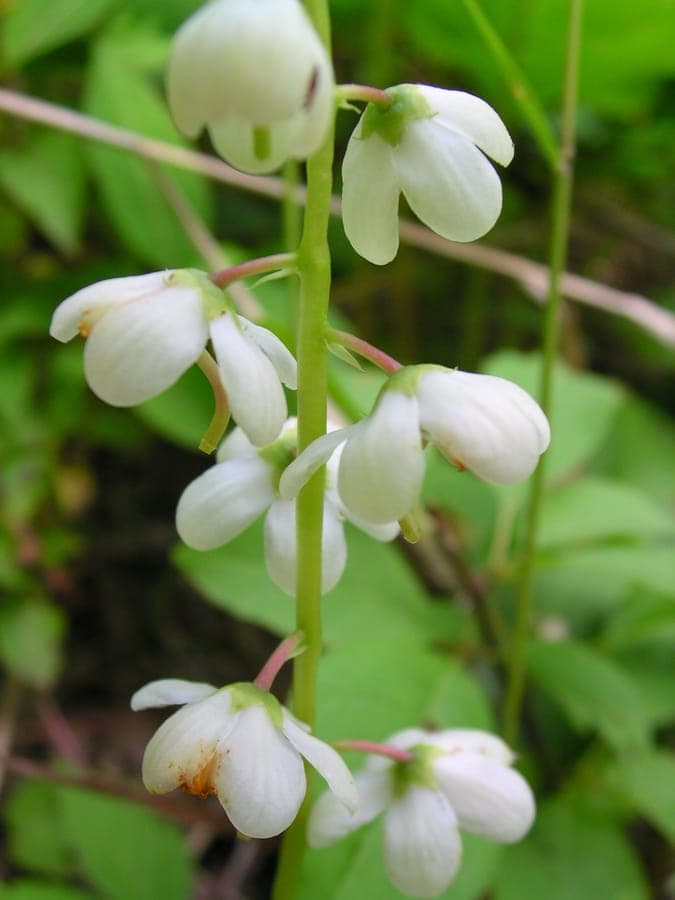
Superior National Forest / CC BY 2.0, via Wikimedia Commons
Shinleaf wintergreen: complete guide
Pyrola elliptica
Want to see Shinleaf wintergreen: complete guide in your garden?
1 minute, no credit card
Overview
Shinleaf wintergreen, known botanically as Pyrola elliptica, is a native perennial herb belonging to the family Ericaceae - the heather family. First described by the botanist Thomas Nuttall in 1818, it grows naturally across a broad sweep of North America: from the Canadian provinces of Alberta, British Columbia and Quebec eastward to Nova Scotia and Newfoundland, and south through much of the northern and eastern United States - including New York, Pennsylvania, Michigan, Wisconsin, Minnesota and as far as North Carolina in the Appalachians. The species is also documented in several western states including Idaho, Montana and Wyoming.
In its native range, Pyrola elliptica inhabits lightly shaded to moderately shaded deciduous and coniferous forests, growing on well-drained, humus-rich, acidic soils. The plant lives in close association with soil fungi (mycorrhizal partners), which makes it particularly suited to naturalised woodland gardens where mature trees are already present. Its common name 'shinleaf' comes from a historical folk medicine use - the leaves were reportedly applied as a poultice to skin conditions or 'shins'. Another widely used common name is 'waxflower shinleaf', a reference to the waxy, slightly translucent appearance of the flowers.
For gardeners seeking authentic woodland floor planting, gardenworld.app provides design tools to compose shade borders and woodland gardens tailored to your specific conditions.
Appearance and bloom cycle
Pyrola elliptica is a low-growing plant, typically 10 to 25 cm tall when in flower. Its most distinctive feature outside the blooming season is its leaf rosette: leaves are broadly elliptic to ovate, 3 to 7 cm long and 2 to 4 cm wide, with finely toothed margins and a leathery, semi-glossy upper surface. The colour is a deep, rich green, and the basal rosette sits elegantly just above the soil surface. Leaves persist through winter - the 'wintergreen' aspect of the common name - and may take on purplish-red tones in cold winters due to anthocyanin production.
The blooming period is June through July. From the centre of the rosette rises a slender flowering stem (scape) 15 to 25 cm tall, bearing a loose raceme of 5 to 15 downward-nodding flowers. Each flower has five white to creamy-white petals, measures 1 to 1.5 cm across, and the style - the extension of the pistil - protrudes distinctively from the corolla and curves slightly downward. This curved style is a hallmark of the genus Pyrola. The flowers emit a delicate, pleasant fragrance and attract bumblebees and various wild bee species as pollinators.
After flowering, small capsular seed pods develop. The plant spreads slowly by underground rhizomes and by wind-dispersed dust-like seeds. Given ideal conditions, it gradually forms a dense, weed-suppressing groundcover.
Ideal location
Pyrola elliptica strongly prefers partial shade to full shade. It thrives beneath the canopy of deciduous or coniferous trees that allow filtered, dappled light to reach the ground. Direct midday sun is detrimental, leading to leaf scorch and rapid soil drying.
The ideal garden position mimics a woodland floor: cool, sheltered from drying winds and with a steady supply of slowly decomposing leaf litter. In the garden, placement beneath an oak, beech or birch works excellently. The shaded north or east side of a fence or building is also suitable, provided drainage is adequate.
Climatically, shinleaf wintergreen is adapted to cool, moist conditions. It does not perform well in hot, dry summers without some relief. In urban gardens, mulching with leaf compost helps stabilise soil temperature and retain moisture.
Soil
Soil requirements are the most critical factor for success with Pyrola elliptica. The plant demands acidic conditions (pH 4.5 to 6.0), a high organic matter content and free-draining structure. Heavy clay soils or alkaline soils (high in lime) are unsuitable and will cause the plant to decline.
An ideal substrate consists of woodland soil or moorland soil supplemented with well-rotted leaf mould or composted pine needles. In a raised bed or container, use a mix of ericaceous compost (available at garden centres) with a proportion of perlite for drainage. Ready-made rhododendron and heather compost from most garden centres is a practical starting point.
The mycorrhizal relationship is critically important: Pyrola elliptica depends on specific soil fungi for nutrient uptake. In a garden with established trees, the necessary fungal communities are often already present. When planting in a new bed, incorporating mycorrhizal inoculant (available as powder or granules) can significantly improve establishment success.
Free design
Want to see Shinleaf wintergreen: complete guide in your garden? Make a free design now.
Watering
Shinleaf wintergreen prefers consistently lightly moist soil without waterlogging. Drought is its greatest threat, particularly in the first two years after planting when roots are not yet deeply established.
Water when the top 2 to 3 cm of soil feel dry. Use rainwater or lime-free water, since calcareous tap water raises soil pH above the plant's tolerance. During summer droughts, water weekly and apply a mulch of leaf compost or pine needle mulch to reduce evaporation.
In winter, additional watering is rarely necessary unless conditions are exceptionally dry. The plant is frost-hardy and enters a low-activity phase during the cold months.
Pruning
Pyrola elliptica requires minimal pruning. In early spring (February-March), remove any damaged or discoloured leaves that did not survive the winter well. Use a clean, sharp blade and cut as close to the base as possible.
After flowering, spent flower stems may be removed to prevent seed dispersal if you want to limit spread, or left in place to allow self-seeding across the garden. Leaving the stems standing into winter provides structural interest and potential food for small seed-eating birds.
Maintenance calendar
January-February: Plant is fully winter-hardy in its zone. No action required unless the soil is extremely dry. A protective leaf compost mulch over the root zone is beneficial in harsher areas.
March-April: Remove any damaged leaves. Top-dress lightly with slow-release acidic plant fertiliser or well-rotted leaf mould. Renew the mulch layer if it has decomposed.
May: Pre-bloom period. Flower stems begin to emerge. Monitor soil moisture during any warm, dry spells.
June-July: Flowering season. Water regularly during dry weather. Avoid pesticides nearby to protect pollinating bumblebees and wild bees.
August-September: Late summer. Keep soil from drying out. Seed capsules may be collected and scattered in suitable spots elsewhere in the garden.
October-December: Plant enters winter rest. Apply or renew mulch layer. For broader woodland planting inspiration, visit gardenworld.app to explore naturalised shade-garden designs.
Winter hardiness
Pyrola elliptica is an exceptionally cold-hardy plant, rated for USDA zones 3 to 7. This means it can survive temperatures as low as -40 degrees Celsius. For gardens in the UK, the Netherlands and Belgium (USDA zones 7-8), it overwinters without any protection.
Leaves sometimes take on purplish-red tones in cold winters as a result of anthocyanin accumulation - this is a normal physiological response to cold and not a sign of disease. Once temperatures warm in spring, the green colour is restored. A light mulch of leaf compost over the root zone during harsh winters is helpful but generally not essential.
Companion plants
Because of its preference for acidic, humus-rich woodland soil and partial shade, Pyrola elliptica combines beautifully with many classic woodland floor plants. Good companions include Maianthemum bifolium (May lily), Oxalis acetosella (wood sorrel), Trientalis europaea (chickweed-wintergreen), Linnaea borealis (twinflower) and low-growing ferns such as Dryopteris filix-mas or Athyrium filix-femina.
In a larger shade border or woodland garden, Hosta varieties complement the compact rosettes of Pyrola nicely. The glossy, elliptic leaves of Pyrola elliptica contrast well against the larger ribbed leaves of Hosta and the feathery texture of ferns.
For a complete woodland feel, pair shinleaf wintergreen with low shrubs such as Vaccinium myrtillus (bilberry) or Vaccinium vitis-idaea (cowberry), and with moss as a ground layer. This creates a habitat that also benefits woodland insects and small songbirds.
Closing
Shinleaf wintergreen is a fascinating and underappreciated plant for naturalistic gardens and shade borders. Its modest but elegant June-July bloom, the attractive evergreen leaf rosette and its ecological value as a nectar source for wild bees make it a rewarding addition to any woodland garden. The mycorrhizal dependency requires some attention at planting time, but once established the plant grows independently with very little maintenance.
Want to see how shinleaf wintergreen fits within a broader shade planting scheme? Visit gardenworld.app to design naturalistic garden compositions based on your specific site conditions, soil type and climate zone. Give this quiet woodland beauty a chance and it will reward you year after year with its delicate, fragrant bloom.
Want to see Shinleaf wintergreen: complete guide in your garden? Make a free design now.
Upload a photo, pick a style, and get a photorealistic design with plant list in under a minute.
10,000+ gardens designed already
No credit card required


Similar plants
Lesser wintergreen: complete guide
Pyrola minor
Explore Pyrola minor, a very delicate alpine flower with beautiful pink-white blooms. Ideal for shaded woodland settings and compact garden spaces overall.
Round-leaf wintergreen: complete guide
Pyrola rotundifolia
Discover Pyrola rotundifolia featuring distinctive round glossy leaves and beautiful white flowers. Ideal for moist shaded sites in garden landscapes.
Orthilia secunda: complete guide
Orthilia secunda
Discover Orthilia secunda, a delicate shade-loving plant from the Ericaceae family. Guide to cultivation, care, and ideal growing conditions for this forest dweller.