
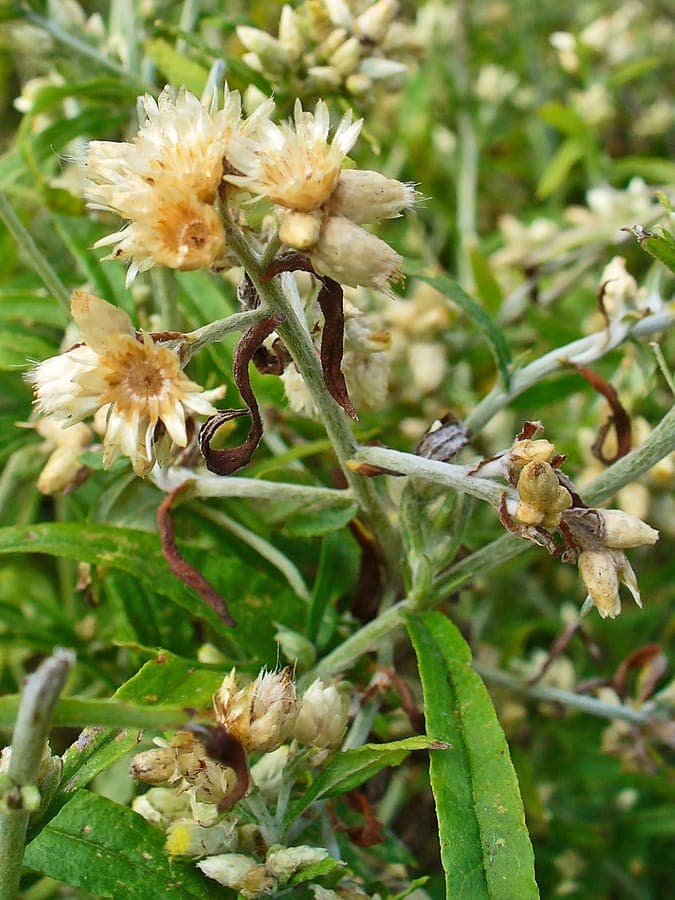
H. Zell / CC BY-SA 3.0, via Wikimedia Commons
Sweet everlasting: complete guide
Pseudognaphalium obtusifolium
Want to see Sweet everlasting: complete guide in your garden?
1 minute, no credit card
Overview
Pseudognaphalium obtusifolium is an elegant herbaceous annual or short-lived biennial in the daisy family (Asteraceae). It is known by a pleasing variety of common names in English: sweet everlasting, fragrant everlasting, rabbit-tobacco, catfoot, fragrant cudweed and eastern cudweed. In French it is gnaphale a feuilles obtuses; in German, stumpfblattriges Scheinruhrkraut. The species name obtusifolium describes the blunt-tipped leaves that distinguish this species from its relatives.
Native to eastern North America, it ranges from the Canadian Maritime Provinces and Quebec through the entire eastern United States, from Maine and Minnesota in the north to Florida and Texas in the south. It grows on poor, sandy soils in open pine forests, dry meadows, roadsides and heathland - environments where competition from taller, more vigorous plants is limited by nutrient poverty and drought.
Taxonomically, the plant was long classified as Gnaphalium obtusifolium; it was reclassified into the genus Pseudognaphalium in 1981 by Hilliard and Burtt. You will still find it listed under the older name in older reference books. At gardenworld.app you will find designs for naturalistic wildflower borders that incorporate fragrant, low-maintenance species like this one alongside better-known prairie plants.
Appearance and bloom cycle
The plant begins as a flat basal rosette of leaves pressed to the ground. As temperatures warm it sends up an erect, branched stem that ultimately reaches 30 to 90 cm in height. The stem and leaves are clothed in a dense white wool that gives the whole plant a silvery, frosted appearance. Leaves are oblong to lance-shaped, 3 to 8 cm long, with a blunt tip and slightly revolute (inrolled) margins. The upper surface is green and slightly sticky; the underside is white-felty.
Flowering begins in August and continues through October. The numerous small flower heads are borne in branched, flat-topped clusters at the tips of the stems and branches. Each individual head is only 5 to 7 mm across but the heads are produced in abundance, so the plant makes a strong visual impact when in full flower. The florets are creamy-white to pale yellow, tubular, and surrounded by shining, papery bracts that give the classic "everlasting" texture.
The fragrance is the plant's most memorable quality: sweet, vanilla-like and gently spicy. On warm summer days it drifts over a considerable distance. Indigenous peoples in North America used the dried leaves and stems in pillow stuffings and smoking preparations for the lasting fragrance.
Ideal location
Sweet everlasting is a full-sun plant. It needs at least six hours of direct sunlight daily and will sulk in shade, producing few flowers and becoming prone to mildew. In its natural habitat it colonises open, sunny ground where taller vegetation cannot gain a foothold.
In the garden, it suits a sunny wildflower border, a prairie-style bed, a dry gravel garden or any informal planting in a warm, well-ventilated spot. It does not suit formal beds where neatness is paramount, as its loose, branching habit looks best when allowed to grow naturally. Space plants 30 cm apart to allow air circulation. It can also be grown in pots (at least 25 cm deep) on a sunny patio, where its fragrance can be appreciated at close range.
Plant it near a path or seating area to make the most of the sweet vanilla scent through late summer and autumn.
Soil
This plant is a natural pioneer of impoverished sandy soils and does not want rich conditions. In its native range it grows on some of the poorest, driest sandy ground in the eastern United States, thriving where more demanding plants struggle. Rich, heavily composted garden soil is counterproductive: it produces floppy, overly leafy plants with fewer flowers.
A pH of 5.0 to 7.0 suits it well. Slightly acid to neutral soils, as found in pine forest or heathland conditions, are ideal. On heavy clay, improve drainage by working in coarse grit or horticultural sand. A surface mulch of coarse grit helps keep the crown dry and prevents the woolly foliage from trapping moisture against the soil.
During the seedling stage, a moist but well-drained seed bed is needed. Once the plant is established, it readily adapts to lean conditions and essentially looks after itself. Fertilising is rarely useful and usually harmful.
Free design
Want to see Sweet everlasting: complete guide in your garden? Make a free design now.
Watering
Sweet everlasting is notably drought-tolerant once established. In warm, dry summers water once a week; in wetter periods little or no additional water is needed. Always allow the soil to dry between waterings.
The critical period is the first few weeks after sowing or planting out: keep the seedbed evenly moist until seedlings are well established. After that, the plant's tolerance of drought increases as the root system develops.
Avoid wetting the foliage: the woolly indumentum holds moisture and can encourage fungal problems. Water at the base or use drip irrigation if available. Standing water around the roots is the most reliable way to harm or kill the plant.
Pruning
As an annual or short-lived biennial, Pseudognaphalium obtusifolium needs very little conventional pruning. The main management task is controlling self-seeding: if you want to keep the plant within a defined area, remove the flower heads before they shed their seeds in late autumn.
After the main flowering period in October-November, you can either cut the whole plant down and compost it, or leave the dry stems standing through winter as habitat for overwintering insects and a food source for seed-eating birds. Remove the dry stems in late winter.
For use as a dried flower, harvest the flower clusters at the moment when they are fully open but still fresh - this is the stage at which they retain the best shape and scent for months after drying. Hang stems upside down in a warm, dry, airy place for two to three weeks.
No tip-pruning during the growing season is needed. Remove any yellowing lower leaves if they detract from the plant's appearance.
Maintenance calendar
March-April: sow seeds directly on the final site or start indoors in small modules. Seeds require light for germination (do not cover with compost) and a temperature of 18 to 22 degrees Celsius.
May-June: thin seedlings or plant out at 30 cm spacing. Water regularly for the first few weeks after transplanting.
July: rapid upward growth. Very little maintenance needed.
August-September: full flowering, sweet fragrance, attraction of butterflies and bees. Harvest flower clusters for drying.
October-November: flowering ends. Leave stems standing or cut down and compost.
December-February: no maintenance needed. Consider planning seed order for the next season.
Winter hardiness
Pseudognaphalium obtusifolium is typically treated as an annual or short-lived biennial. Plants die back after setting seed and do not persist as perennials in most climates. However, the plant self-seeds freely where conditions allow, and seedlings often appear reliably each spring from seed shed the previous autumn.
In its native range spanning USDA zones 5 to 9 it occasionally behaves as a biennial in mild winters. In the UK, Belgium and the Netherlands (zone 7 to 8) you can expect self-seeding to provide new plants year after year without replanting, provided the site remains open and undisturbed. The seeds need no cold stratification and germinate readily when the soil warms in spring.
For a guaranteed annual display, sow fresh seed in spring or purchase seed from wildflower specialists. Look for it under the names Gnaphalium obtusifolium or sweet everlasting at specialist nurseries and online seed houses, as it is not commonly stocked in mainstream garden centres.
Companion plants
Sweet everlasting fits naturally into prairie-style and wildflower borders alongside other eastern North American natives. Echinacea purpurea adds bold pink, Rudbeckia hirta provides warm gold and yellow, and Solidago species bring a haze of late-season yellow. Ornamental grasses such as Andropogon gerardii or Schizachyrium scoparium add movement and texture.
For a planting focused on drought-tolerant species, Liatris spicata, Monarda fistulosa and Baptisia australis are excellent companions. The white fluffy heads of sweet everlasting contrast beautifully with deeper-toned purple coneflowers and the warm red-gold of Helenium. The flowers are also attractive to a wide range of late-season butterflies, bees and specialist insects.
Gardenworld.app can help you build a complete planting design that celebrates the charm of wild, fragrant plants while ensuring a considered colour sequence and structure across the seasons.
Closing
Pseudognaphalium obtusifolium is an unassuming plant with outsized charm. Its white, woolly flower plumes catch the late-summer light, its sweet vanilla fragrance lingers on the air, and the dried flower clusters remain decorative for months in arrangements. It asks little: lean sandy soil, full sun and infrequent watering. For gardeners who want to introduce more wild beauty and scent into their outdoor space, this is a plant well worth seeking out.
If you are looking for a complete garden design that weaves fragrant, naturalistic plants into a coherent and beautiful scheme, gardenworld.app offers personalised design support with photorealistic previews of your future garden.
Want to see Sweet everlasting: complete guide in your garden? Make a free design now.
Upload a photo, pick a style, and get a photorealistic design with plant list in under a minute.
10,000+ gardens designed already
No credit card required


Similar plants
Calendula stellata: complete guide
Calendula stellata
Complete guide to Calendula stellata, the star-flowered marigold from Sicily: location, soil, watering and companion planting tips.
Korean chrysanthemum: complete guide
Chrysanthemum x rubellum
Chrysanthemum x rubellum is a hardy autumn perennial with single pink to copper flowers from August to November. Care and combinations.
Helianthus divaricatus: complete guide
Helianthus divaricatus
Helianthus divaricatus is a North American woodland sunflower with yellow summer blooms, ideal for naturalistic borders and shady edges.