
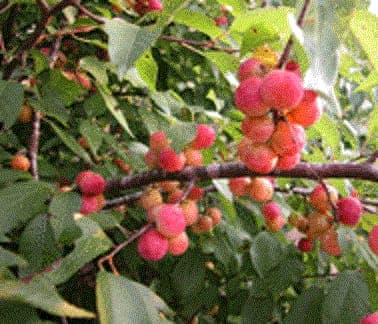
Amirza360 / CC BY-SA 3.0, via Wikimedia Commons
Wild-goose Plum: complete guide
Prunus rivularis
Want to see Wild-goose Plum: complete guide in your garden?
1 minute, no credit card
Overview
Prunus rivularis, commonly called Wild-goose Plum, Creek Plum, or Hog Plum, is a native shrub naturally distributed across much of central and eastern North America from Texas to Pennsylvania. This water-loving species grows wild along streams, in wetlands and other moist habitats, thriving in USDA zones 4-9. It is highly tolerant of wet conditions and is valued for wildlife food, erosion control, and naturalistic landscaping.
Appearance and Bloom
Wild-goose Plum is a deciduous shrub that produces abundant white flowers in loose clusters during April-May. The blooms are modest in individual size but prolific overall. Foliage consists of elongated, smooth, bright green leaves that persist well into autumn. Following bloom, small round fruits develop, ripening from red to deep orange-red by July-August. These fruits, approximately 1-1.5 cm in diameter, are edible (though tart) and are greedily consumed by birds. Mature height typically reaches 2-3 meters with a suckering, often multi-stemmed form.
Ideal Location
This shrub thrives in full sun (5-6 hours direct sunlight daily) but tolerates light shade reasonably well. It is remarkably flexible regarding site conditions. In nature, it favors low-lying, moisture-rich areas along watercourses but establishes readily in typical garden soils. Wind protection aids young plants but is not essential. In warmer southern climates, afternoon shade is beneficial.
Soil Requirements
Wild-goose Plum is exceptionally tolerant of soil composition and pH levels (5.5-7.5). It flourishes in heavy clay, sandy loam, and everything in between. It naturally colonizes moist, well-drained soils but adapts to seasonal flooding and temporary saturation. Added organic matter improves water retention in drought years. It tolerates slight salinity, making it suitable for coastal plain areas.
Free design
Want to see Wild-goose Plum: complete guide in your garden? Make a free design now.
Watering
Once established, Prunus rivularis is remarkably drought-tolerant and remains productive. Young plants benefit from regular watering during the first growing season. Apply approximately 20-25 liters weekly during the first year under dry conditions. After establishment, the plant requires minimal supplemental water, especially in regions with normal rainfall. In arid climates, mulch helps retain soil moisture.
Pruning
Prune with caution: the plant fruits on previous year's growth, so pruning is best performed after bloom ends (late June-July). Remove only dead, diseased, or crossing branches. Light thinning maintains an open, bushy form without reducing fruit production. Young plants can be lightly shaped to encourage spreading habit.
Maintenance Calendar
APRIL-MAY: Flowering period; light feeding optional. MAY-JUNE: Growth phase; water during dry spells. JULY-AUGUST: Fruit ripening; careful pruning after bloom. SEPTEMBER-OCTOBER: Fall cleanup; observe bird visits. NOVEMBER-MARCH: Dormancy; minimal intervention. Monitor for pests and disease.
Winter Hardiness
Wild-goose Plum is extremely cold-hardy (USDA zones 4-9, withstanding -30C). Its origins in the cold regions of the central USA ensure excellent continental winter adaptation. In snow-rich regions, no winter protection is necessary; the plant tolerates snow load well. Young plants may benefit from frost protection in their first winter.
Companion Plants
Plant with other moisture-loving species: Sambucus nigra (American Elder), Ilex verticillata (Winterberry). Underplant with moisture-tolerant groundcovers like Lobelia cardinalis. Combine with additional wildlife food plants for greater biodiversity. Avoid aggressive competitors in moist zones.
Closing
Wild-goose Plum is a valuable addition to native plant gardens and wildlife landscapes throughout North America. With edible fruit, bird attraction, and native heritage, it delivers ecological value for decades. Obtain plants from native plant specialists. Perfect for naturalistic gardening!
Want to see Wild-goose Plum: complete guide in your garden? Make a free design now.
Upload a photo, pick a style, and get a photorealistic design with plant list in under a minute.
No credit card required


Similar plants
Siberian crab apple: complete guide
Malus x robusta
Complete guide to the Siberian crab apple (Malus x robusta): location, soil, pruning, winter hardiness and the best companion plants for your garden.
Chinese flowering crabapple (Malus x spectabilis): complete guide
Malus x spectabilis
Meet the Chinese flowering crabapple (Malus x spectabilis): a classic spring bloomer with carmine buds and pink blossom.
Potentilla crassinervia: complete guide
Potentilla crassinervia
Potentilla crassinervia, the Corsican cinquefoil, grows wild on Corsica and Sardinia's peaks. Discover how to grow this hardy alpine rock garden gem.