
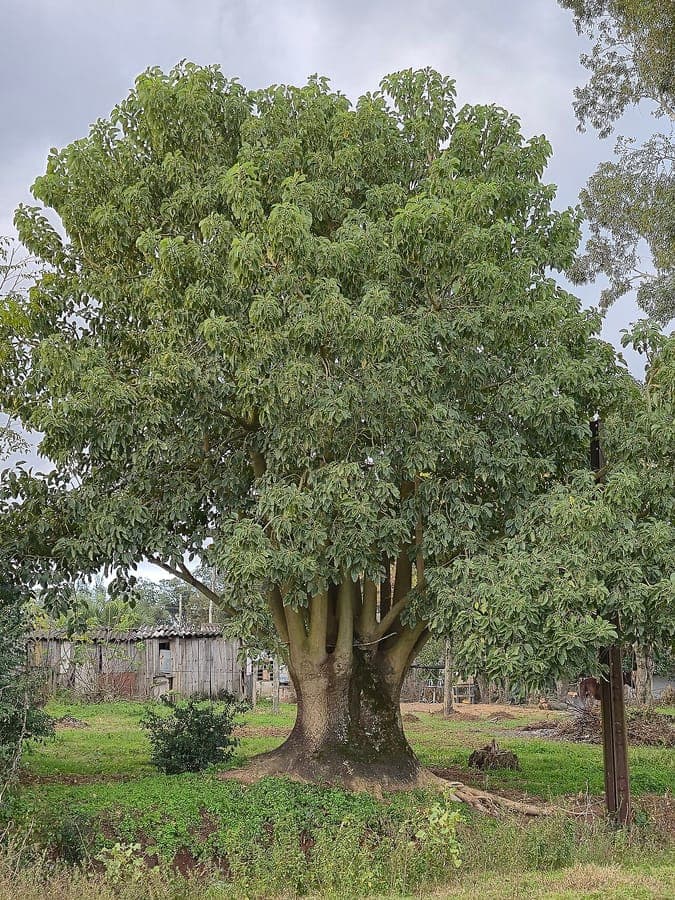
Gabriel Collares / CC BY 4.0, via Wikimedia Commons
Phytolacca dioica: complete guide
Phytolacca dioica
Want to see Phytolacca dioica: complete guide in your garden?
1 minute, no credit card
Overview
The Phytolacca dioica, commonly known as the Ombu, is a spectacular South American tree that commands attention through its massive trunk and broad canopy. These trees grow in Colombia, Brazil, Argentina and Paraguay, where they serve as symbols of shade and protection. With their lush growth and remarkable appearance, Ombu trees are ideal for landscape designers who want to create a statement tree in warm climates.
Appearance and bloom
The Ombu grows into a colossal tree, sometimes 10-15 meters tall, with a thick, drooping trunk featuring gray, flaking bark. The leaves are oval, large and vaguely poplar-like, but their drooping form distinguishes them. Flowers appear in small clusters, mostly white or pale yellow with reddish tinges, and bloom across multiple months. Female trees bear black berries that are highly toxic to humans and animals.
Ideal location
The Ombu grows best in warm, temperate climate zones. It tolerates full sun well but appreciates half-shade in extremely hot areas. Give this tree plenty of space: minimum 5-6 meters distance from buildings, patios and underground utilities. The exceptionally broad, shallow root system can damage sidewalks and foundations.
Soil
Ideal soil is well-draining, loamy sand to clay, pH 6.5 to 7. The Ombu tolerates dry soil types once established but flowers better in moderately fertile ground. Preference for soils that do not remain waterlogged; drainage is essential to prevent root rot.
Watering
Seek a stable moisture pattern. Young trees need regular water until fully established (first 2-3 years). Once mature, the Ombu tolerates drought periods without issue. Avoid waterlogging, especially in cooler seasons. In regions with significant seasonal rains, it adapts itself; supplementary water is usually unnecessary.
Free design
Want to see Phytolacca dioica: complete guide in your garden? Make a free design now.
Pruning
Pruning is generally unnecessary except for removing dead or broken branches. The tree's natural form is already attractive. Prune in early spring before new growth starts. Very large branches are best removed in sections to prevent trunk damage.
Maintenance calendar
Spring: Check for winter damage; remove dead branches. Summer: Monitor watering needs; watch for pest damage. Fall: Keep up with leaf cleanup and maintain clean grounds. Winter: Provide protection in temperate climates; prevent water from freezing around the trunk.
Winter hardiness
The Ombu is suitable for USDA zones 9-11. In zone 8 it can survive but deserves protection against severe frost. Very young trees should be protected in their first winters. In zone 7 and higher, it is only suitable for containers indoors.
Companion plants
Do not plant the Ombu close to other large trees; it dominates the landscape. Underplanting is difficult due to shade and shallow roots. Consider other drought-tolerant species at distance, such as pine trees or Mediterranean shrubs.
Closing
The Ombu is not an easy tree for ordinary gardens but for those with space and patience, this exotic giant offers true spectacle. Consult local nurseries for seedlings; add professional support to young plantings. With proper location and care choices, this is a tree that provides generations of enjoyment. Start with small specimens; large trees are difficult to transplant. Visit gardenworld.app for more information about exotic trees in your climate. This monument to South American beauty deserves a prominent place where its growth is unrestricted. Gardenworld.app helps you correctly incorporate this unique specimen. Discover more tropical and subtropical trees at gardenworld.app for diverse garden designs.
Want to see Phytolacca dioica: complete guide in your garden? Make a free design now.
Upload a photo, pick a style, and get a photorealistic design with plant list in under a minute.
No credit card required


Similar plants
Phytolacca esculenta: complete guide
Phytolacca esculenta
Indian pokeweed is an impressive shrub with black fruits and interesting shapes. Learn everything about growing and maintaining this Asian plant.
Indian pokeweed: complete guide
Phytolacca acinosa
Discover Phytolacca acinosa, the Indian pokeweed. Learn cultivation tips, care requirements and how to incorporate this Asian plant into your garden.
Phytolacca americana: complete guide
Phytolacca americana
Spectacular American plant mit eye-catching purple-black berries from June to October. Discover this remarkable botanical wonder......................