
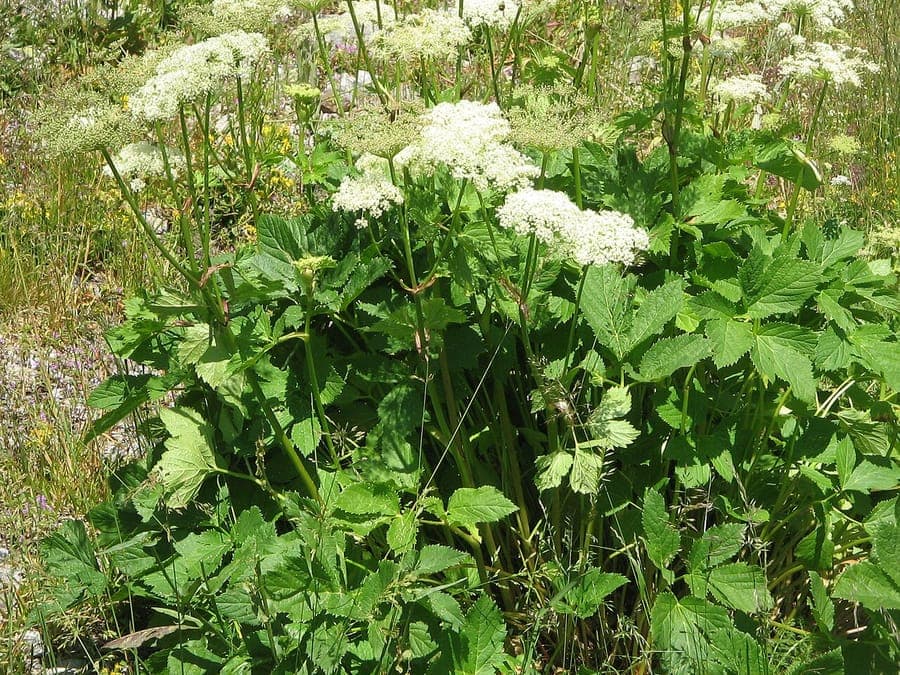
Meneerke bloem / CC BY-SA 3.0, via Wikimedia Commons
Masterwort: complete guide
Peucedanum ostruthium
Want to see Masterwort: complete guide in your garden?
1 minute, no credit card
Overview
Peucedanum ostruthium, commonly known as masterwort or hogfennel, is an ancient European perennial deeply rooted in mountain woodlands and meadows from Switzerland to Italy. This Apiaceae member was long cultivated as a medicinal herb but is now prized primarily for its bold architectural foliage, reliable hardiness, and refined white flower clusters. An excellent choice for woodland shade borders and wild gardens.
Appearance and bloom time
Masterwort forms dense, upright perennial clumps reaching 60-90 cm tall and 50-70 cm wide. The roots are deep-delving, robust, and persistent. Foliage is the star: triternately compound, intricately lobed and subdivided, creating finely feathered leaflets. Dark green leaves measure 30-40 cm long and form elegant crowns on stiff, upright stems. Flowers appear in June-July as white, flat-topped umbels (clusters), each head 3-5 cm wide and invaluable for bees and butterflies.
Ideal location
Masterwort excels in dappled to partial shade. Three to four hours of daily sun suits it well in woodland settings. Full sun works equally, provided soil remains consistently moist. A sheltered spot protects the refined, feathery foliage from harsh winds. Beneath linden, beech, or oak canopies, masterwort makes superior understory planting. Avoid dense shade where air circulation is poor.
Soil
Masterwort favors moderately moist to wet, humus-rich soil with neutral to slightly alkaline pH (7.0-7.5). In drier gardens, substantial soil enrichment is required: incorporate peat moss, compost, or leaf mold to improve moisture retention. Heavy clay is acceptable if waterlogging is prevented. Sandy soils require significant humus addition. Avoid prolonged dryness.
Watering
Moisture-loving but not aquatic, masterwort requires regular watering from May through October, especially during dry spells. Soil may dry slightly at the surface between waterings but should never completely desiccate. Established plants tolerate brief dry periods better than young specimens. Summer rainfall is often insufficient; supplemental watering in July-August is prudent. Water at the base, not overhead.
Free design
Want to see Masterwort: complete guide in your garden? Make a free design now.
Pruning
Masterwort requires minimal pruning. After flowering concludes in July-August, cut spent flower stems back above young, green foliage to maintain tidy plant form. In autumn, leave dead foliage in place as winter protection. In early spring, remove all dead foliage to within a few centimeters of soil level. Pruning demands a gentle hand.
Maintenance calendar
April: Spring cleanup - remove dead foliage. Apply organic fertilizer. May: Growth accelerates. Begin regular watering. June-July: Flowering peaks. Pollinators visit abundantly. August: Bloom concludes. Remove damaged flower stems. September-October: Autumn tints appear. November-March: Dormancy.
Winter hardiness
Masterwort is exceptionally winter-hardy throughout the Netherlands, Belgium, and most of Europe. USDA zones 4-8 pose no hardship. The plant dies back to soil level but reliably resprouts each spring. Established plants tolerate wet, snow-laden winters without injury. Young plants may benefit from light protection.
Companion plants
Masterwort harmonizes beautifully with other shade-to-part-shade residents. Pair with ferns, hellebores, Bergenia, Anemone, and Hosta. For foliage contrast: silvery Lamium, purple Heuchera, or golden Origanum. For flower: purple Digitalis, pink Astilbe, white Aruncus, or red Geum. In naturalistic plantings, masterwort anchors robust, self-sustaining landscapes.
Conclusion
Masterwort is the refined gardener's answer: architecturally intriguing foliage, elegant white flowers, unflinching hardiness, and minimal maintenance demands. Its preference for dappled shade makes it ideal for challenging spots beneath tree canopies. Once established, it thrives for decades with modest care. Centre masterwort in your moist, shady garden corners.
Want to see Masterwort: complete guide in your garden? Make a free design now.
Upload a photo, pick a style, and get a photorealistic design with plant list in under a minute.
No credit card required


Similar plants
Whorled carrot: complete guide
Daucus involucratus
Daucus involucratus is a Mediterranean umbellifer with white flower heads framed by lacy bracts. Growing this gravel garden gem.
Daucus muricatus: complete guide
Daucus muricatus
Daucus muricatus, the spiny wild carrot, grows wild on Mediterranean coasts. Discover sowing, June-July bloom, and wildflower meadow use.
Daucus pumilus: complete guide
Daucus pumilus
Daucus pumilus is a dwarf wild carrot relative with white lacy umbels, thriving on dunes and coastal rock in poor, fast-draining soil.