
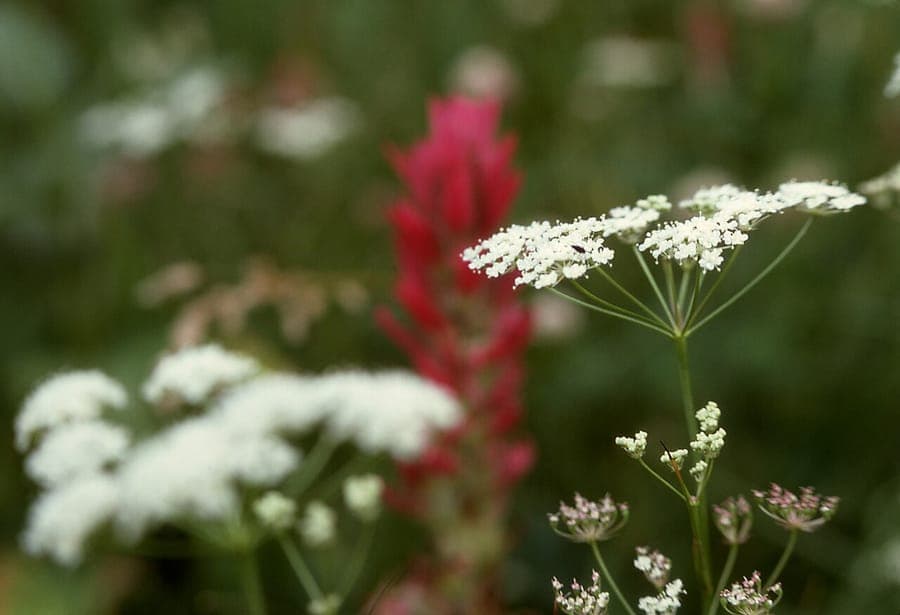
J Schmidt / Public domain, via Wikimedia Commons
False caraway: complete guide
Perideridia gairdneri
Want to see False caraway: complete guide in your garden?
1 minute, no credit card
Overview
False caraway (Perideridia gairdneri), also widely known as yampah, Indian caraway, or Gardner's yampah, is a slender native wildflower in the carrot family (Apiaceae). It is indigenous to western North America, where it grows across an extensive range stretching from British Columbia and Alberta in Canada south through Washington, Oregon, Idaho, Montana, Nevada, California, Utah, Wyoming, Colorado, and into South Dakota. In its natural habitat it occupies open mountain meadows, moist to seasonally dry grassy slopes, and stream-side grasslands from sea level to elevations above 2,500 metres.
Historically, false caraway was one of the most important food plants for many indigenous peoples of the western Plateau and Great Basin regions. The small, parsnip-like tubers were eaten raw, boiled, or roasted; the seeds were used as a spice with a flavour reminiscent of caraway or anise. The name yampah comes from the Shoshone language and reflects the plant's cultural significance. Lewis and Clark documented the plant during their famous expedition and noted its dietary importance to Native American populations along their route.
For the garden designer, false caraway is a refined and ecologically valuable addition to prairie plantings, native meadow gardens, and dry wildflower borders. Its delicate white umbel flowers attract a wide range of specialist pollinators including hoverflies, short-tongued bees, and small butterflies throughout summer. Plan your prairie or native wildflower planting at gardenworld.app and explore how false caraway fits alongside other western native species.
The plant grows 30 to 90 cm tall from a small, fleshy tuber and has a lifespan that varies by population from biennial (rosette in year one, bloom in year two) to short-lived perennial. It spreads primarily by seed in suitable dry, well-drained soils.
Appearance & bloom cycle
False caraway is an upright, slender herb with simple, unbranched to lightly branched stems. The leaves are almost twice to three times pinnately divided, producing a fine, feathery texture comparable to dill or fennel. Basal leaves are 10 to 30 cm long with narrow, lance-shaped leaflets of 2 to 8 cm; stem leaves are progressively smaller and simpler. The overall foliage colour is light to medium green, sometimes with a slight blue-green cast. The entire plant has a faintly anise-like or caraway scent when leaves are bruised.
Flowering begins in June at lower elevations and continues into August at higher altitudes. The compound umbels are flat to slightly convex, 3 to 8 cm across, with numerous small rays. Each individual flower has five tiny white petals and measures only 2 to 3 mm across. The flat flower heads are landing platforms perfectly designed for a wide variety of small pollinating insects. Specialist umbel visitors - hoverflies of the Syrphidae family, masked bees (Hylaeus), and various small moths - are frequent and enthusiastic visitors.
After pollination, small oval to elliptical fruits (schizocarps, typical of the carrot family) develop. Each schizocarp is 3 to 5 mm long, brown at maturity, with fine ridging. They split into two single-seeded mericarps and are dispersed by wind, animals, and rain splash. Once the seed is shed in August to September, the aerial parts die back and the plant enters dormancy, surviving as a dormant tuber underground until the following spring.
Ideal location
False caraway thrives in full sun to very light partial shade, replicating the open mountain meadow conditions of its natural range. Full sun is optimal and produces the sturdiest stems and best flowering. Light shade for part of the day is acceptable but may result in taller, weaker stems and reduced bloom density.
Choose a dry to moderately moist, well-drained site. Good air circulation is important to prevent fungal disease on the feathery foliage. Avoid persistently wet, heavy soils. A gentle slope, a raised bed, or a gravel garden with excellent drainage suits the plant perfectly.
False caraway is best suited to prairie borders, native wildflower meadows, dry hillside plantings, and naturalistic gravel gardens. It pairs beautifully with native western grasses such as blue grama (Bouteloua gracilis) and Idaho fescue (Festuca idahoensis). In European gardens it can anchor a dry prairie-inspired border alongside European natives and cultivated prairie-type perennials. For design ideas featuring native wildflowers in a structured garden, visit gardenworld.app.
Soil requirements
False caraway grows naturally on a range of soils but strongly favours free-draining, moderately lean substrates. The optimal pH range is 6.0 to 7.5 (neutral to slightly acidic or slightly alkaline). In over-enriched, fertile garden soil, the plant grows lush vegetative growth but flowers poorly and becomes prone to lodging (falling over).
Sandy loam, rocky soils, and gravelly substrates are excellent. Loamy soil with good drainage also works well. On heavy, poorly draining clay, drainage improvement is essential: incorporate coarse sand (at least 30% by volume) and fine gravel at 20 to 30 cm depth before planting. Add little or no compost; the plant is adapted to lean conditions, and excessive organic matter stimulates competing grasses and forbs more than the Perideridia itself.
The fleshy tuber makes the plant tolerant of summer drought: it stores water and carbohydrates to bridge the dry dormancy period that naturally follows seed set in its native range. A mineral, well-drained substrate without water-retaining organic matter at depth is entirely appropriate.
Free design
Want to see False caraway: complete guide in your garden? Make a free design now.
Watering
Once established, false caraway is moderately to well drought-tolerant. In its natural western habitat it endures a dry summer period after snowmelt, surviving the dormancy using reserves stored in its tuber. In garden cultivation, supplemental watering after the bloom and seed-set period in late summer is not needed and may actually be harmful.
During the spring growth period (March to June), moderate moisture is beneficial. Water once per week during dry, warm spells; in a normal temperate spring, rainfall is generally sufficient. Overwatering, particularly in combination with poor drainage, causes tuber rot and is the principal cause of failure in cultivation. The plants are far more likely to die from too much water than from drought.
Avoid overhead watering: the feathery foliage dislikes wet conditions and persistent leaf wetness promotes mildew. Water at the base of the plant or use targeted drip irrigation. Morning watering allows the foliage to dry before cooler evening temperatures arrive.
Pruning
False caraway requires minimal pruning. After seeds ripen in August to September, the stems can be cut to ground level if desired. If you want to encourage self-seeding and natural colony spread, allow the seed heads to dry completely and split before removing stems. Seed falls naturally and the plant self-sows readily in appropriate lean, well-drained soils.
During the growing season, no cutting back is required. Remove individual damaged or diseased leaves if necessary. Keep the tuber and basal leaf rosette intact as long as possible: the plant needs all its available leaf area to recharge the tuber for the following growing season.
In autumn, all aerial parts die back naturally. You may leave the dry stems standing as fine-textured winter decoration and remove them in early spring, or cut them to 5 cm in autumn for a tidier appearance.
Maintenance calendar
February–March: First new growth from the tuber. Remove remaining dry stems from the previous year if not already done. Check site drainage.
April–May: Active leaf and stem growth. Water once per week during dry spells. No fertilisation.
June–August: Flowering period. Enjoy the white umbels. Water only in extreme drought. Seed formation follows in late July to August.
August–September: Seeds ripen; decide whether to allow natural dispersal or collect. Remove stems after seed shed if desired.
October–November: Plant dies back to tuber. Optional: cut stems or leave as winter structure.
December–January: Full dormancy. Tuber overwinters safely. No action needed. Hardy to USDA zone 4 (-30 °C).
Winter hardiness
False caraway is reliably winter hardy in USDA zones 4 through 9. The dormant tubers withstand temperatures of -25 to -30 °C without damage, provided the soil is well-drained and tubers are not sitting in frozen standing water. Across the UK, northern France, Belgium, the Netherlands, and most of Germany, the plant overwinters without any protection.
The combination of good drainage and a slightly lean soil is more important than insulation against cold. Tubers in poorly drained, waterlogged clay that freezes solid are at greater risk than those in freely draining sandy loam. In very exposed sites or regions experiencing temperatures below -20 °C with little snow cover, a light mulch of 3 to 5 cm of coarse bark or straw applied in November provides additional protection.
Late emergence in spring is normal for this species. In cool springs, new leaf rosettes may not appear until late April or even May. Patience is required: do not assume the tuber has failed until the end of May. Once growth begins, it progresses rapidly.
Companion plants
False caraway integrates naturally into western North American prairie plantings and dry wildflower gardens. Choose companions that share its preference for lean, well-drained, sunny sites.
Recommended companions:
- Blue grama (Bouteloua gracilis) - compact native prairie grass, drought-tolerant, excellent textural pairing
- Idaho fescue (Festuca idahoensis) - fine blue-green grass, same dry sunny conditions
- Lomatium dissectum (fern-leaf biscuitroot) - related native Apiaceae, earlier bloom season
- Erigeron speciosus (showy fleabane) - purple-pink daisies in summer, same dry prairie habitat
- Penstemon strictus (Rocky Mountain penstemon) - blue-purple flowers in June-July, same lean soil preference
- Allium cernuum (nodding onion) - pink flowers in summer, bulb companion for lean dry soil
- Sporobolus cryptandrus (sand dropseed) - fine-textured warm-season grass, natural companion in dry grassland
Avoid combining with vigorous, moisture-loving ground covers that outcompete the relatively slender false caraway. Maintain a planting distance of 20 to 30 cm between the Perideridia and its immediate neighbours, and leave some open, mineral soil for self-seeding.
Closing
False caraway is a botanical gem for the gardener drawn to western North American prairie flora. Its delicate feathery foliage, its flat white umbels buzzing with specialist pollinators, and its remarkable historical importance as a food plant make it a genuinely special addition to any prairie-style or native wildflower garden. It is undemanding, drought-tolerant, and rewards proper placement with a long season of bloom from June through August. Given the right lean, sunny, well-drained conditions alongside native grasses and companion forbs, Perideridia gairdneri will naturalise gracefully and return season after season, filling its corner of the garden with a quiet, authentic wildflower spirit.
Want to see False caraway: complete guide in your garden? Make a free design now.
Upload a photo, pick a style, and get a photorealistic design with plant list in under a minute.
10,000+ gardens designed already
No credit card required


Similar plants
Whorled carrot: complete guide
Daucus involucratus
Daucus involucratus is a Mediterranean umbellifer with white flower heads framed by lacy bracts. Growing this gravel garden gem.
Daucus muricatus: complete guide
Daucus muricatus
Daucus muricatus, the spiny wild carrot, grows wild on Mediterranean coasts. Discover sowing, June-July bloom, and wildflower meadow use.
Daucus pumilus: complete guide
Daucus pumilus
Daucus pumilus is a dwarf wild carrot relative with white lacy umbels, thriving on dunes and coastal rock in poor, fast-draining soil.