
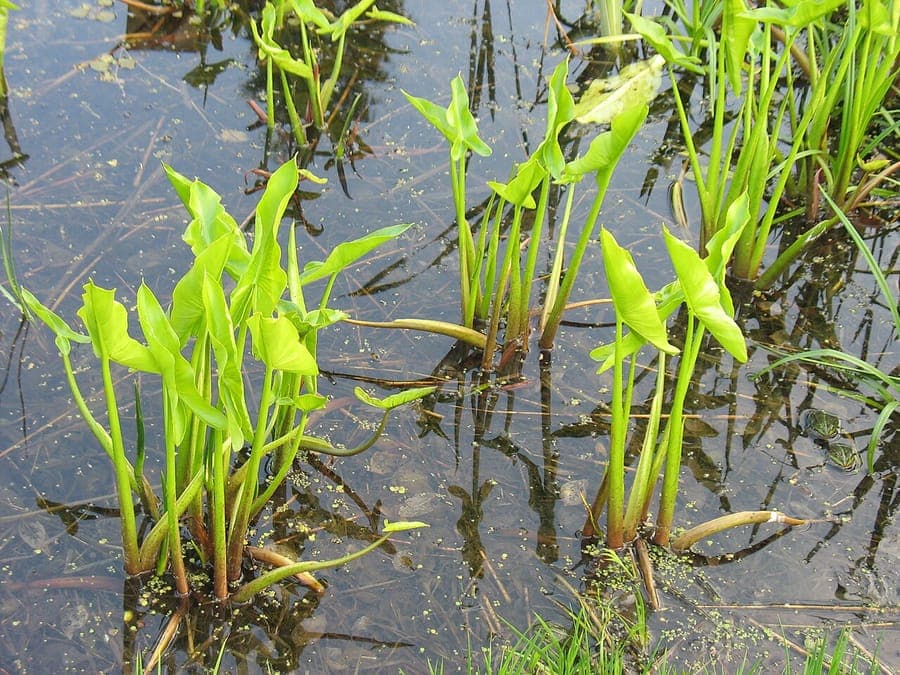
Miguel Andrade / Public domain, via Wikimedia Commons
Green arrow arum: complete guide
Peltandra virginica
Want to see Green arrow arum: complete guide in your garden?
1 minute, no credit card
Overview
Green arrow arum (Peltandra virginica) is a bold, architectural native wetland plant from the arum family (Araceae), native to eastern North America from southern Ontario and Quebec south to Florida and Texas, with an additional population in Cuba. In its natural range it colonises freshwater marshes, swamp edges, shallow lake margins, and slow-moving streams, often forming extensive stands that stabilise muddy banks and provide critical habitat for waterfowl and aquatic wildlife.
For the garden owner with a pond, bog garden, or reliably wet area, green arrow arum is one of the most rewarding native aquatic perennials available. Its intensely glossy, deep-green arrow-shaped leaves can reach 60 to 90 cm in length, creating lush, majestic clumps at the water's edge. The plant is robust, largely pest-free, and ecologically valuable: its berries are an important late-summer and autumn food source for wood ducks, mallards, and painted turtles.
Green arrow arum belongs to the same family as calla lily and common cuckoo pint. It produces a characteristic spathe-and-spadix inflorescence, though in a more understated, entirely green form. While the flowers are not showy, the subsequent green berry clusters ripen to yellowish-brown and are eagerly consumed by wetland wildlife. Incorporate green arrow arum into your water garden design at gardenworld.app for a striking naturalistic look.
The plant reaches 60 to 120 cm in height depending on water depth and soil fertility. It does not spread by runners; instead it expands slowly through seed and by the gradual enlargement of its rhizome clump. In a small pond it remains manageable; in a larger water feature it will build an impressive stand over time.
Appearance & bloom cycle
Green arrow arum produces large, heart-shaped to sagittate (arrow-shaped) leaves with two distinctive backward-pointing basal lobes, supported by long, fleshy petioles. Individual leaves measure 60 to 90 cm long and 20 to 30 cm across. The leaf surface is intensely glossy and deep green, with a leathery, stiff texture and prominent veining. The overall appearance is bold and tropical, making the plant a strong architectural element in any water garden design.
Blooming occurs from May through July. Each flower stem carries a spathe - an elongated, narrow, green bract that wraps around the central spadix. Unlike the broad white spathe of calla lily, the Peltandra spathe is narrow and greenish, giving the inflorescence a subtle, elegant look. The spadix carries numerous tiny, greenish-white flowers. Pollination is assisted by specialist insects that enter the spathe tube.
After pollination, clusters of glossy green berries form along the lower spadix. These ripen from green through yellowish to brown between August and October. The berries are mucilaginous and slightly toxic to humans in large quantities but are a premium food source for dabbling ducks and aquatic reptiles. Seed dispersal occurs via water and through animal digestion.
By late autumn the foliage dies back completely and the plant enters winter dormancy, with the rhizomes remaining alive underground or beneath the water surface. New growth resumes in April to May as water temperatures rise.
Ideal location
Green arrow arum thrives in full sun to partial shade, planted directly in shallow water or in permanently saturated soil at the water's edge. Optimal water depth above the rhizome crown ranges from 0 cm (moist soil planting at the edge) to 30 cm. Deeper planting is possible but generally reduces vigour and bloom.
Full sun produces the most vigorous growth and the best berry production. Partial shade is tolerated well - in woodland pond settings the plant remains healthy and attractive, though somewhat less exuberant. Deep shade is not suitable.
In the garden, plant it at pond margins, in bog gardens, along stream edges, or in large aquatic planting baskets submerged in a garden pond. The basket approach simplifies containment and allows easy division or removal if the clump outgrows its allotted space. The plant tolerates light water movement and is suitable for the quiet margins of slow-moving streams.
Soil requirements
Peltandra virginica thrives in rich, clay-loam to heavy clay soils that remain permanently wet. The broad pH range of 5.0 to 8.8 means it adapts to acidic bog conditions as well as neutral to slightly alkaline pond margins. In practice, a fertile, somewhat silty clay loam from a pond or wetland setting is ideal.
For planting in aquatic baskets: use heavy clay-based aquatic compost or a mix of heavy garden loam and clay with no drainage material added. Fine-textured, clay-rich substrate provides the secure anchorage needed to support the substantial leaf mass. Fill the basket 20 to 25 cm deep with the substrate, plant the rhizome horizontally at 5 to 10 cm depth, and top with a layer of pea gravel to hold the substrate in place under water.
For shoreline planting: ensure the soil remains permanently moist to saturated. Occasional brief drought causes wilting and growth setback; prolonged dry periods in summer can kill the plant. Rich silty or clayey soils along river and stream banks are naturally well-suited.
Free design
Want to see Green arrow arum: complete guide in your garden? Make a free design now.
Watering
For a plant installed in or directly beside water, no supplemental irrigation is needed once established. The surrounding water body provides all required moisture. Maintain consistent water levels throughout the growing season.
During the establishment period - the first few weeks after planting - keep aquatic baskets submerged and ensure that plants at the pond margin do not dry out as root contact is being established. After the first full growing season, the plant is self-sufficient.
In bog garden installations or moist border placements without a direct water body: ensure the water table never drops more than 15 cm below the soil surface. In dry summers, supplemental irrigation three to four times per week may be necessary. Drip irrigation targeted at the root zone is more efficient than overhead watering.
Green arrow arum is not suitable for average garden borders or any position that experiences regular summer drought. Its value is precisely in permanently wet conditions where few ornamental perennials thrive.
Pruning
Green arrow arum requires minimal pruning. In late spring (April to May), remove any remaining brown leaf material from the previous year that has not yet decomposed in the water or wet soil. This improves air circulation and makes room for vigorous new growth.
During the growing season, no cutting back is necessary. Remove individual damaged or heavily insect-chewed leaves if desired. In autumn, as foliage yellows and dies back, cut stems to 10 to 15 cm above the water or soil surface to maintain a tidy appearance. Full removal to soil level is not necessary - the remaining stubs act as a light protective mulch over the dormant rhizomes.
Division for size control or propagation is best done in early spring before new growth begins. Lift the entire clump, cut the rhizome into sections each carrying at least two growth buds, and replant immediately in wet substrate or return directly to the pond.
Maintenance calendar
March: Inspect pond margins; remove dead leaf remnants from previous year. Check planting baskets for stability.
April–May: New leaf shoots emerge. No action required. Apply aquatic slow-release fertiliser tablets if growth is very slow in a nutrient-poor pond.
May–July: Flowering period. Enjoy the subtle green spathes. Maintain water levels. No pruning needed.
July–September: Berries ripen; leave them for wildlife value. Monitor for aphids or caterpillars on leaves.
October: Foliage yellowing; cut back to 10 to 15 cm. Check basket integrity before winter.
November–February: Full dormancy. Rhizomes overwinter safely in wet soil or under water. No action needed. Rhizomes tolerate down to -20 °C if kept wet.
Winter hardiness
Green arrow arum is winter hardy in USDA zones 5 through 10. Across the UK, northern France, Belgium, and the Netherlands, it overwinters reliably without any protection as long as the rhizomes remain in moist or wet soil or beneath the water surface. Temperatures of -15 to -20 °C do not harm submerged or continuously waterlogged rhizomes.
The critical risk is not low temperature per se, but desiccation combined with frost: rhizomes exposed at the surface of a dry, frozen bank are more vulnerable than those submerged under 15 cm of pond water. Where the pond or bog margin may dry out in winter, apply 10 to 15 cm of loose leaf mulch over the crown area for added protection. In zone 4 conditions and colder, overwintering the lifted rhizomes in a frost-free shed in moist sand is advisable.
The complete die-back of foliage in autumn is entirely normal. The plant will re-emerge reliably in April to May. A bare pond margin in February is no cause for concern.
Discover how to combine green arrow arum with other wetland and marginal plants at gardenworld.app for design ideas tailored to UK and European gardens.
Companion plants
Green arrow arum combines beautifully with other native North American aquatics and European marginal plants, creating a diverse and ecologically rich pond margin or wetland garden.
Excellent companions:
- Pontederia cordata (pickerelweed) - similar water depth, blue flower spikes through summer and autumn
- Sagittaria latifolia (broadleaf arrowhead) - matching arrow-shaped leaves, white flowers; superb pairing
- Typha angustifolia (narrowleaf cattail) - vertical structural element behind the Peltandra clumps
- Iris pseudacorus (yellow flag) - bright yellow flowers in May-June, same marginal conditions
- Caltha palustris (marsh marigold) - early bright yellow blooms in March-April, lower placement
- Lobelia cardinalis (cardinal flower) - vivid red blooms in late summer, excellent wildlife value
- Carex riparia (greater pond sedge) - textural contrast, similar saturated-soil preference
For best results, plant green arrow arum in groups of three to five individuals at 40 to 60 cm spacing, with the taller structural plants (cattails, large irises) placed behind and smaller flowering marginals (marsh marigold, pickerelweed) in front or to the side.
Closing
Green arrow arum is one of the most visually impressive native aquatic perennials for gardens with permanently wet conditions. Its large, glossy arrow-shaped leaves, its ecologically valuable berries, and its robust, trouble-free nature make it a standout choice wherever there is a pond, bog garden, or reliably wet margin to be planted.
Once established in an appropriate wet site, this plant virtually looks after itself season after season. It stabilises banks, provides wildlife habitat, and delivers year-round structural interest with minimal maintenance demands. For any garden where a pond or water feature plays a central role, Peltandra virginica deserves serious consideration.
Want to see Green arrow arum: complete guide in your garden? Make a free design now.
Upload a photo, pick a style, and get a photorealistic design with plant list in under a minute.
10,000+ gardens designed already
No credit card required


Similar plants
Arrowhead vine: complete guide
Syngonium auritum
Everything about Syngonium auritum, the tropical five-fingers houseplant. Care, location, watering, and pruning explained clearly for beginners and enthusiasts.
Minute duckweed: complete guide to Lemna perpusilla
Lemna perpusilla
Everything about Lemna perpusilla, the minute duckweed: ecology, pond management, water quality and care in garden water features.
Dead horse arum lily: complete guide
Helicodiceros muscivorus
Everything about the dead horse arum lily (Helicodiceros muscivorus): growing conditions, spectacular bloom, thermogenesis, and care for this Mediterranean aroid.