
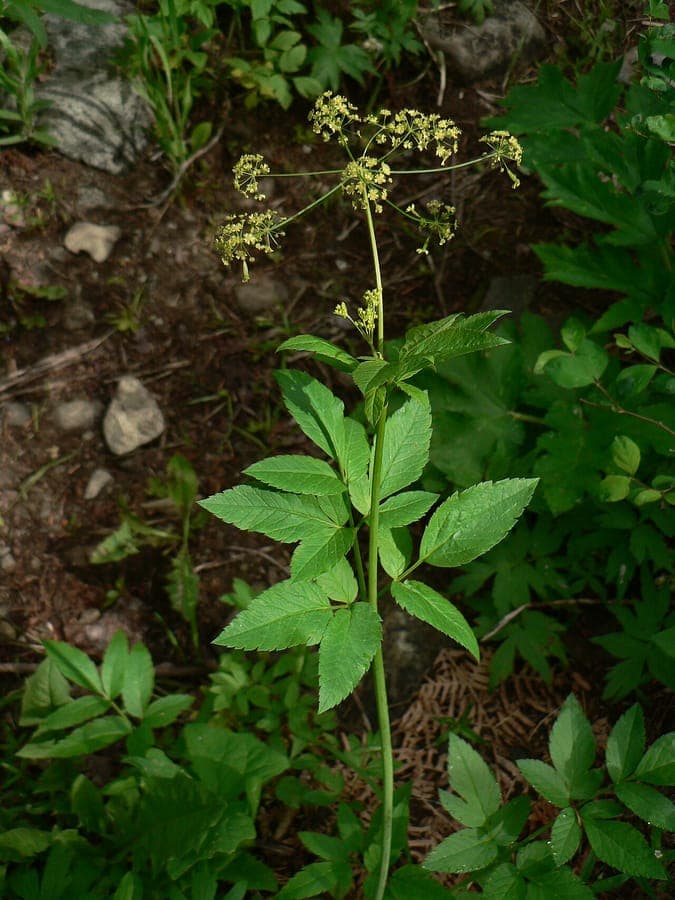
Walter Siegmund (talk) / CC BY 2.5, via Wikimedia Commons
Western sweet cicely: complete guide
Osmorhiza occidentalis
Want to see Western sweet cicely: complete guide in your garden?
1 minute, no credit card
Overview
Osmorhiza occidentalis, commonly known as western sweet cicely or mountain sweet cicely, is a long-lived perennial herb in the family Apiaceae, the carrot family. Native to western North America, the species has a broad distribution extending from Alberta and British Columbia in Canada south through Washington, Oregon, Idaho, Montana, Nevada, California, Colorado, Utah, and Wyoming in the United States. It was formally described in 1858 by John Torrey, working from specimens originally collected by Thomas Nuttall.
The species has been known under several synonyms in older botanical literature: Osmorhiza ambigua, Osmorhiza bolanderi, Washingtonia occidentalis, and others are all now considered the same species. Like its relatives in the Apiaceae family - including carrots, parsley, and angelica - Osmorhiza occidentalis produces characteristic compound umbel flower clusters and anise-scented foliage and roots. The anise-like fragrance released when the leaves or roots are crushed gives the plant its common name 'sweet cicely'.
In its natural habitat Osmorhiza occidentalis grows in moist, shaded mountain forests, along streambanks, and in sheltered ravines at mid to high elevations, typically 800 to 2,500 metres above sea level. For gardeners seeking a graceful, aromatic shade perennial with delicate white flowers, this species offers something genuinely distinctive among the range of woodland plants available from specialist garden centres.
Design a woodland garden layout that incorporates western sweet cicely alongside complementary shade plants using the planning tools at gardenworld.app, where you can visualise how different plant combinations will look in your specific garden space.
Appearance & bloom cycle
Osmorhiza occidentalis is an upright, clump-forming perennial reaching 40 to 120 cm in height, depending on growing conditions. Plants in moist, fertile soil with good shade can reach the upper end of this range, while specimens in drier or more exposed positions tend to be more compact. The hollow stems are characteristic of the Apiaceae family and give the plant a light, graceful structure.
The leaves are large and two to three times pinnately compound, giving the plant an airy, fern-like appearance. Each leaflet is broadly ovate to lanceolate, bright green, and sharply toothed. The foliage texture is medium - neither coarse nor excessively fine - and remains attractive throughout the growing season. When crushed or bruised, the leaves release a distinctive anise or liquorice-like fragrance.
Flowers appear in late spring to early summer, typically May through June. They are borne in small compound umbels - the flat-topped, umbrella-shaped clusters characteristic of the Apiaceae family - with fifteen to thirty tiny white flowers on slender rays. The overall effect is delicate and airy, well suited to a naturalistic or woodland planting style.
After flowering, the plant produces narrow, elongated, ribbed fruits (schizocarps) that also carry the characteristic anise scent when ripe. The growth rate is slow, meaning Osmorhiza occidentalis takes time to establish from seed or young transplants, but once settled it is reliably long-lived. Plant spacing of 40 to 60 cm is recommended to give each individual adequate room.
Ideal location
Osmorhiza occidentalis is a shade-specialist, performing best in partial to full shade. In its mountain forest habitat, it grows under the canopy of mixed deciduous and coniferous trees where direct sunlight reaches the forest floor only briefly or in dappled patterns. In the garden, a position beneath large deciduous trees, on the north or east side of a building, or at the back of a north-facing border provides suitable conditions.
Full sun is detrimental, particularly during warm dry periods: leaves scorch easily, moisture stress develops quickly, and plant vigour declines. Deep shade under dense conifers allows survival but reduces flowering. The optimum light regime is filtered or dappled sunlight for two to four hours daily, combined with bright reflected light during the remainder of the day.
Avoid dry, wind-exposed positions and sites where soil moisture fluctuates dramatically between wet and dry. A sheltered corner of a shade border with consistently moist soil and protection from drying winds is ideal. The plant tolerates light spring frosts on emerging shoots, with no lasting damage.
In a mixed shade border, Osmorhiza occidentalis works well as a mid-border filler, with its delicate leaf texture and white spring flowers providing contrast to bolder-leaved companions such as hostas, rodgersias, or large ferns. It can also be used effectively as a naturalised planting beneath established deciduous trees.
Soil requirements
This species thrives in rich, moisture-retentive but well-drained soils with a pH between 5.2 and 7.5 - tolerating a wide range from mildly acidic to slightly alkaline conditions. In its natural habitat it grows in deep, humus-rich forest soils accumulated over many years from leaf litter, decaying wood, and mycorrhizal activity.
In the garden, replicate these conditions by incorporating generous quantities of well-rotted leaf mould or garden compost: work 8 to 10 cm of organic matter into the top 25 cm of soil before planting. This improves both water retention and soil structure, creating the deep, spongy consistency that Osmorhiza roots appreciate.
On sandy soils with poor water retention, annual top-dressing with a 5 to 7 cm layer of leaf mould or wood chip mulch builds organic matter over time and significantly reduces the plant's watering requirements. On compacted or clay-heavy soils, incorporating coarse horticultural grit along with organic matter improves drainage and prevents the waterlogging that can cause root rot.
Avoid adding excess lime to soils that are already neutral to slightly alkaline, as this can push pH beyond the plant's preferred range. A slightly acidic to neutral soil (pH 5.5 to 6.8) is optimal for this species in garden conditions.
Free design
Want to see Western sweet cicely: complete guide in your garden? Make a free design now.
Watering
Osmorhiza occidentalis prefers consistently moist soil and is less drought-tolerant than many other perennials. In its natural streambank and moist forest habitat, soil moisture remains relatively high throughout the growing season. In the garden, regular watering during dry periods is necessary, particularly in summer.
Water deeply once every five to seven days during normal summer conditions, applying enough to penetrate at least 25 cm into the soil. In hot, dry spells watering twice per week may be needed. Always water at the base of the plant rather than overhead, keeping foliage dry to reduce the risk of fungal diseases.
A generous mulch of 7 to 10 cm of leaf mould or wood chips applied in spring is one of the most effective ways to maintain consistent soil moisture through summer. The mulch insulates the root zone, slows evaporation, and gradually improves soil organic matter as it decomposes. In well-mulched soil, the watering frequency can often be halved compared to unmulched ground.
Avoid waterlogged conditions: despite preferring moisture, Osmorhiza occidentalis does not tolerate standing water around its roots. Good drainage is essential, and the soil should be moist but not saturated. Drip irrigation delivers water efficiently directly to the root zone without wetting foliage.
During winter dormancy, no watering is required. The dormant rootstock has minimal water requirements.
Pruning
Osmorhiza occidentalis requires minimal pruning. The plant has a naturally tidy growth habit that needs no shaping or hard cutting during the growing season. The main pruning tasks are the removal of yellowing or damaged leaves as they appear throughout summer, and cutting all stems back to ground level in autumn after the plant dies back.
If self-seeding in the garden is desired, allow some fruiting stems to remain until the seeds are fully ripe before cutting. Osmorhiza can self-seed modestly in suitable shaded, moist conditions; unwanted seedlings are easy to remove or transplant to new positions. If you wish to prevent self-seeding, cut all stems before the seeds ripen.
In autumn, cut all stems back to ground level after the first frosts have killed the top growth. Remove the cut material from the border and add it to the compost heap. In early spring, as new shoots emerge, remove any remaining dead stems and apply a fresh top-dressing of compost or leaf mould around the base of the plant to feed the new growth.
No division is strictly necessary for plant health, but large clumps can be divided in early spring every four to five years to rejuvenate growth and provide additional plants.
Maintenance calendar
January to February: Plant is dormant. A 8 to 10 cm mulch layer protects the rootstock during hard frosts. No active care required.
March: New shoots begin to emerge as temperatures rise. Remove dead stems from the previous season. Apply fresh compost or leaf mould around the base.
April: Growth accelerates. Begin regular watering if rainfall is insufficient. Watch for slug activity on emerging shoots.
May to June: Main flowering period. Enjoy the white umbel flowers. Water during warm, dry spells. Remove yellowing leaves as needed.
July to August: Peak growing season. Maintain consistent soil moisture. Add mulch if not already in place. Watch for any signs of powdery mildew in poorly ventilated positions.
September: Seeds ripen. Leave some fruiting stems for self-seeding or collect seeds for future sowings. Top growth begins to die back after first frosts.
October to November: Cut stems back to ground level after full die-back. Refresh the mulch layer for winter protection.
December: Full dormancy. No maintenance required.
Winter hardiness
Osmorhiza occidentalis is a fully hardy perennial across a wide range of climates. The above-ground parts die back with autumn frosts, but the robust, fleshy rootstock survives winter temperatures well below freezing. In its native range across mountain regions of Montana, Wyoming, and Colorado, winter temperatures regularly fall to -25 degrees Celsius or colder without harming the dormant rootstock.
In temperate northern European climates - including the Netherlands, Belgium, northern France, and most of Germany - no winter protection is normally needed. The species handles USDA hardiness zones 4 to 8, covering the vast majority of European garden conditions. Only in exceptional winters where soil temperatures drop below -20 degrees Celsius might a protective mulch of 8 to 10 cm be beneficial.
Early emerging shoots in spring can be caught by late frosts, but this causes only temporary cosmetic damage; the plant rapidly produces replacement shoots and recovers fully within two to three weeks. Young plants in their first year after planting benefit from a protective mulch during their first winter.
For complete information on shade planting plans and how to combine Osmorhiza occidentalis with other woodland perennials, visit gardenworld.app and use the interactive garden design tools.
Companion plants
Osmorhiza occidentalis combines naturally with a range of shade-loving, moisture-preferring perennials. Excellent companions include:
- Hosta cultivars: the broad, bold leaves of hostas such as 'Halcyon' (blue-grey, 40 cm), 'Frances Williams' (blue-green with gold margin, 60 cm), or the giant 'Sum and Substance' (chartreuse, 90 cm) contrast beautifully with the delicate, divided foliage of Osmorhiza.
- Athyrium filix-femina (lady fern): a graceful native fern with light green, finely divided fronds that thrives in the same moist, shaded conditions and provides excellent textural harmony.
- Actaea simplex (autumn bugbane): a stately late-season perennial with dark, divided foliage and tall white flower candles that complement the earlier white umbels of Osmorhiza.
- Geranium phaeum (mourning widow): a robust shade-tolerant cranesbill with near-black to deep purple flowers in late spring that coordinates beautifully with the white Osmorhiza blooms.
- Aquilegia vulgaris (common columbine): a classic woodland plant with spurred flowers in purple, blue, pink, or white that thrives in similarly moist, humus-rich shade conditions.
- Polygonatum multiflorum (Solomon's seal): an elegant woodland perennial with arching stems, paired lance-shaped leaves, and hanging white bell-shaped flowers, perfectly at home in the same shaded, moist border.
Avoid combining with drought-tolerant or sun-demanding plants that require fundamentally different watering regimes, as competition for water resources in a consistently moist shade border is rarely an issue.
Conclusion
Osmorhiza occidentalis is an elegant, aromatic, and reliably long-lived perennial that brings grace and delicacy to shade gardens and woodland plantings. Its anise-scented foliage, airy white umbel flowers, and tolerance of deep shade make it a valuable and somewhat unusual choice for gardeners who want something more distinctive than the standard shade border palette.
To explore woodland garden design ideas and find the best plant combinations for your shaded garden areas, visit gardenworld.app and discover how Osmorhiza occidentalis can be woven into a beautiful and naturalistic shade planting scheme.
Want to see Western sweet cicely: complete guide in your garden? Make a free design now.
Upload a photo, pick a style, and get a photorealistic design with plant list in under a minute.
10,000+ gardens designed already
No credit card required


Similar plants
Whorled carrot: complete guide
Daucus involucratus
Daucus involucratus is a Mediterranean umbellifer with white flower heads framed by lacy bracts. Growing this gravel garden gem.
Daucus muricatus: complete guide
Daucus muricatus
Daucus muricatus, the spiny wild carrot, grows wild on Mediterranean coasts. Discover sowing, June-July bloom, and wildflower meadow use.
Daucus pumilus: complete guide
Daucus pumilus
Daucus pumilus is a dwarf wild carrot relative with white lacy umbels, thriving on dunes and coastal rock in poor, fast-draining soil.