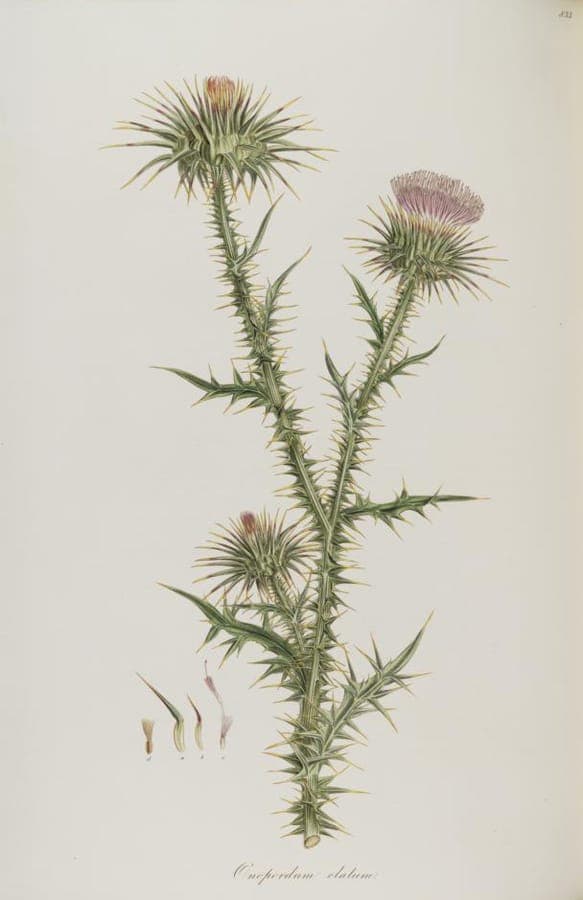
Oceancetaceen - Alice Chodura / Public domain, via Wikimedia Commons
Taurian thistle: complete guide for striking garden accents
Onopordum tauricum
Want to see Taurian thistle: complete guide for striking garden accents in your garden?
Full design in HD: €7.99
Look after your Taurian thistle with the GardenWorld app
Identify plants with your camera and get a care calendar with reminders for this plant.


The Taurian thistle (Onopordum tauricum) is an impressive biennial plant originating from Europe to Turkey. This plant is renowned for its large, silvery leaves and striking purple flowers that attract many insects.
Overview
Onopordum tauricum is a robust biennial plant naturally occurring from Europe to Turkey. In the first year, the plant forms a leafy rosette; in the second year, a tall, branched flower stem rises that can reach 2 meters tall. This plant self-seeds prolifically.
Appearance and Blooming
The plant first grows low with large, silvery gray leaves. In the second year, tall stems form with many small purple flowers. Flowers appear from June to July. After flowering, the blooms produce numerous seeds.
Ideal Location
Choose a fully sunny spot with good visibility. The plant grows to 2 meters tall and makes a striking impression. Provide adequate space as the plant becomes quite broad. Protect from strong wind by planting near other plants.
Soil Composition
The Taurian thistle grows in virtually any soil type but thrives best in well-draining soil. The plant tolerates poor soil well and actually flowers better in less rich soils. Waterlogging must be avoided.
Free preview
Want to see Taurian thistle: complete guide for striking garden accents in your garden? Make a free preview of your design.
Watering
Once established, this plant needs little water. Water only in extreme drought. The plant is very drought tolerant and tolerates poor moisture better than excessive wetness.
Pruning and Maintenance
Minimal care needed. The plant self-seeds prolifically, so remove spent flowers if you don't want much self-seeding. In subsequent years, self-seeding can be removed if unwanted.
Maintenance Calendar
Year 1, spring: Sow seeds or plant young plants. Summer: Water regularly during drought. Autumn: Plant continues growing. Year 2, spring: No maintenance needed. Summer: Enjoy flowers, seeds can drop. Autumn: Plan next generation.
Winter Hardiness
Onopordum tauricum is hardy to about -10 to -15 degrees Celsius, depending on shallow frost. The plant can survive mild winters but dies back in frost zones.
Companion Plants
Pair well with low-growing perennials like cat-tail and hollyhocks. The height makes this plant suitable as background. For color: sage, lavender, and other gray-leaved plants.
Closing Thoughts
The Taurian thistle is a statement plant that makes a striking impression in the garden. This biennial grows quickly and adds dimension. Find seeds of this architectural plant at garden centers. Discover inspiration on gardenworld.app for botanical gardens with such impressive silhouettes.
Frequently asked questions about Taurian thistle
Is Taurian thistle winter hardy?
Onopordum tauricum is hardy to about -10 to -15 degrees Celsius, depending on shallow frost. The plant can survive mild winters but dies back in frost zones.
When and how do you prune Taurian thistle?
Minimal care needed. The plant self-seeds prolifically, so remove spent flowers if you don't want much self-seeding.
How much water does Taurian thistle need?
Once established, this plant needs little water. Water only in extreme drought.
Where does Taurian thistle grow best?
Choose a fully sunny spot with good visibility. The plant grows to 2 meters tall and makes a striking impression.
What soil does Taurian thistle need?
The Taurian thistle grows in virtually any soil type but thrives best in well-draining soil. The plant tolerates poor soil well and actually flowers better in less rich soils.

See it in your garden
See Taurian thistle in your garden
One photo of your garden and a few questions. You see the result in about a minute.
Try it with a photoIdentify this plant in your own garden. Identify a plant
Similar plants
Frikart's aster (Aster × frikartii): complete guide
Aster × frikartii
Everything about Frikart's aster (Aster × frikartii): position, soil, pruning and hardiness of the aster that flowers lavender-blue from July to October.
False aster (Boltonia asteroides): complete guide
Boltonia asteroides
False aster (Boltonia asteroides) covers itself in white daisies from late August to October. How to plant, cut back and combine this tough, tall perennial.
Daisy bush (Brachyglottis greyi): care guide
Brachyglottis greyi
Brachyglottis greyi, formerly Senecio greyi, pairs silver felted leaves with yellow summer daisies. Advice on position, soil, pruning, hardiness and companions.
