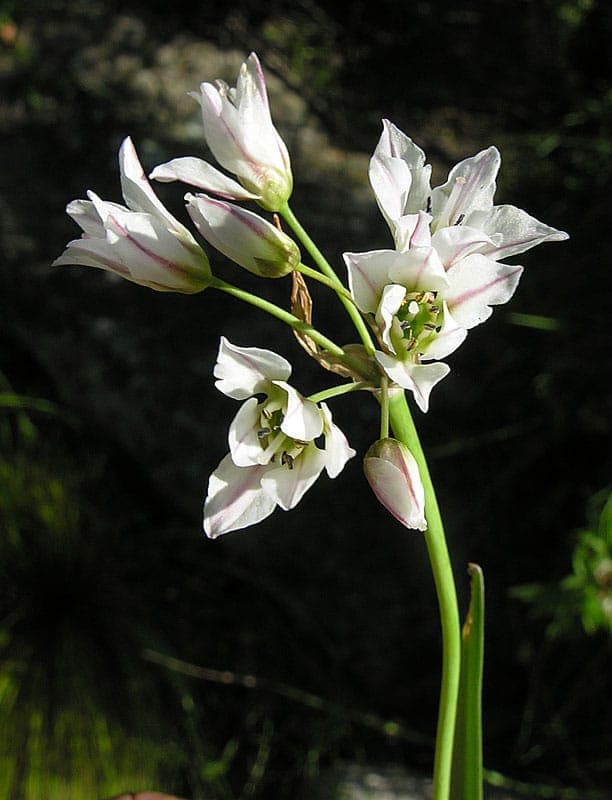
Dick Culbert from Gibsons, B.C., Canada / CC BY 2.0, via Wikimedia Commons
False garlic: complete guide
Nothoscordum gracile
Want to see False garlic: complete guide in your garden?
Full design in HD: €7.99
Look after your False garlic with the GardenWorld app
Identify plants with your camera and get a care calendar with reminders for this plant.


Overview
False garlic, scientifically known as Nothoscordum gracile, is a charming bulbous plant from the Amaryllidaceae family, originating in Central and South America. Although the name 'false garlic' suggests it might have garlic scent, this plant is primarily an ornamental bulb with delicate, white flowers appearing early in the season. This low-growing plant emerges from small bulbs and displays fine, linear foliage forming dense clusters. For gardeners seeking early, low-maintenance blooms, Nothoscordum gracile is a perfect choice.
The plant is highly maintenance-friendly and is often found naturalizing in meadows, grass verges, and cultivated gardens. It self-seeds readily, creating beautiful white displays in spring. At gardenworld.app, use this tool to integrate this charming bulb into your garden design.
Appearance & Bloom
Nothoscordum gracile forms compact tufts of very fine, linear foliage that typically grows 20 to 40 cm tall, though most specimens remain around 25 cm. The leaves have a soft, grass-like appearance and form dense clusters. In spring (April to May, depending on climate), slender flower stems emerge, culminating in delicate, white star-shaped flowers. These blooms are quite fragrant and remain open in sunlight. The flowering period lasts several weeks, after which seed capsules develop.
The flowers smell subtly sweet, which is significant as they attract pollinators. After blooming, foliage gradually disappears as summer advances, making this bulb ideal as underplanting for later-blooming plants.
Ideal Location
False garlic thrives best in full sun to partial shade. The plant can tolerate 3-4 hours of afternoon shade, especially in very hot climates. However, full sun is better for optimal blooming. Provide at least 4 to 5 hours of direct sunlight daily. In very shaded environments, flowers are reduced and foliage may become leggy.
This plant is reasonably flexible and can grow beneath deciduous trees provided it is not completely shaded. It works well in rock gardens, along borders, and in gravel plantings.
Soil & Underground Requirements
Nothoscordum gracile is relatively undemanding about soil types, provided drainage is good. Heavy clay must be absolutely avoided. The plant prefers dry to moderately moist conditions. Sandy loam soil with good drainage is ideal. Add sand to heavy soils and ensure good drainage.
The plant thrives equally well in lean to moderately fertile soils. No extra fertilization is typically needed. For container culture, use well-draining potting mix blended with sand.
Free preview
Want to see False garlic: complete guide in your garden? Make a free preview of your design.
Watering
Once established, False garlic is very drought-tolerant. Water only if the soil becomes extremely dry during the growing season (spring). Once foliage yellows in summer, watering can cease. Excessive water in summer can lead to bulb rot. In winter, when the plant sleeps, no water is needed.
Maintenance
This bulb plant requires minimal maintenance. Spent flowers can be removed if desired, but best practice is to leave them to set seed. Do not remove withered foliage until it is completely brown, as it returns nutrients to the bulb. Pruning is not necessary.
Maintenance Calendar
- January - March: No maintenance required. Plant dormant.
- April - May: Blooming period. Enjoy white flowers. Allow seed capsules to develop.
- June - July: Foliage yellows. Leave it to disappear naturally before completely browning. No watering.
- August - December: Rest. Plant prepares for next season. No water needed.
Winter Hardiness
False garlic is winter hardy to USDA zone 6, with temperatures down to approximately -20 degrees Celsius. In temperate regions, it can overwinter outdoors in most areas if well-drained. In very wet winters, bulbs may rot; raising the bed and adding sand helps.
Propagation & Spread
The plant self-seeds, slowly spreading throughout your garden, creating charming clusters. This is a desirable trait supporting naturalized gardens. You can also dig bulbs after blooming, separate them, and replant.
Companion Plants
False garlic combines beautifully with:
- Aubrieta: Purple flowers contrast with white false garlic.
- Phlox subulata: Low-growing with coinciding bloom time.
- Alyssum saxatile: Yellow with similar height.
- Sedum: Structural contrast.
- Astilbe: Delicate, airy effect.
Available at garden centres.
Conclusion
False garlic is a charming, low-maintenance spring player. Its self-seeding nature and delicate flowers create natural, loosely growing plantings. For small formal gardens requiring precision, this may not be the plant, but for semi-wild, naturalized gardens, it is invaluably precious.
Frequently asked questions about False garlic
Is False garlic winter hardy?
False garlic is winter hardy to USDA zone 6, with temperatures down to approximately -20 degrees Celsius. In temperate regions, it can overwinter outdoors in most areas if well-drained.
How much water does False garlic need?
Once established, False garlic is very drought-tolerant. Water only if the soil becomes extremely dry during the growing season (spring).
Where does False garlic grow best?
False garlic thrives best in full sun to partial shade. The plant can tolerate 3-4 hours of afternoon shade, especially in very hot climates.
What soil does False garlic need?
Nothoscordum gracile is relatively undemanding about soil types, provided drainage is good. Heavy clay must be absolutely avoided.

See it in your garden
See False garlic in your garden
One photo of your garden and a few questions. You see the result in about a minute.
Try it with a photoIdentify this plant in your own garden. Identify a plant
Similar plants
Agapanthus campanulatus: the hardy bell agapanthus
Agapanthus campanulatus
Agapanthus campanulatus is a deciduous African lily with blue bell-shaped flowers in summer. Learn about position, watering, winter care and good companions.
Agapanthus inapertus: the drooping African lily
Agapanthus inapertus
Agapanthus inapertus is a tall African lily with drooping, barely open tubular flowers in deep blue and violet. A guide to position, watering and winter care.
Tree onion: complete guide
Allium × proliferum
Everything about the tree onion (Allium × proliferum): planting, harvesting bulbils, dividing and overwintering. A perennial onion, toxic to dogs and cats.
