Wikimedia Commons / CC BY-SA 3.0, via Wikimedia Commons
Noccaea perfoliata: complete guide
Noccaea perfoliata
Want to see Noccaea perfoliata: complete guide in your garden?
Full design in HD: €7.99
Look after your Noccaea perfoliata with the GardenWorld app
Identify plants with your camera and get a care calendar with reminders for this plant.


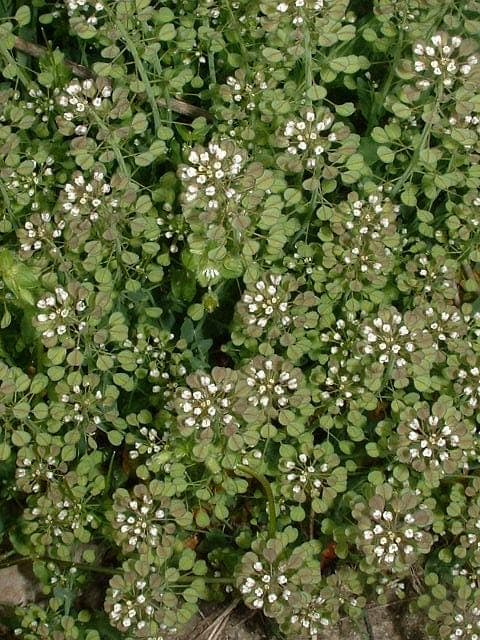
Noccaea perfoliata is an attractive annual plant in the Brassicaceae family, occurring throughout Europe from Great Britain to the Mediterranean. It is known for its distinctive clasping leaves that surround the stem. Perfoliate pennycress reaches heights of 30-60 cm forming an upright, branched stem. The most characteristic feature is the large, gray-green leaves that appear to clasp around the stem. The flowers are small, white to pale pink, arranged in dense racemes.
Perfoliate pennycress grows best in full sun to partial shade. It is very tolerant of local conditions and even grows on dry slopes. It grows in virtually all soils from sand to clay with drainage. Standard garden soil is completely suitable. Once established, the plant is very drought-tolerant and requires minimal water. Young seedlings must be kept regularly moist for at least four weeks to establish roots properly.
Perfoliate pennycress is a valuable plant for rural gardens and wildflower meadows. Its hardiness, rapid growth, edible leaves, and attractive flowers make it a favorite among gardeners who appreciate naturalness. With minimal care, this plant will return year after year through self-seeding, providing effortless beauty in every season.

See it in your garden
See Noccaea perfoliata in your garden
One photo of your garden and a few questions. You see the result in about a minute.
Try it with a photoIdentify this plant in your own garden. Identify a plant
Similar plants
Radish: complete guide to sowing, growing and harvesting
Raphanus sativus
Everything about radish (Raphanus sativus): when and how to sow, soil, watering, flea beetle and cabbage root fly, harvesting after four weeks and winter radish.
Brassica cretica: complete guide
Brassica cretica
Brassica cretica, the Cretan cabbage, grows wild on Aegean cliffs. Discover how to grow this drought-tolerant, yellow-flowered Mediterranean perennial.
Corsican cabbage: complete guide
Brassica insularis
Corsican cabbage is a rare Mediterranean rock cabbage with white flowers and blue-green leaves. Location, soil and winter protection.
