
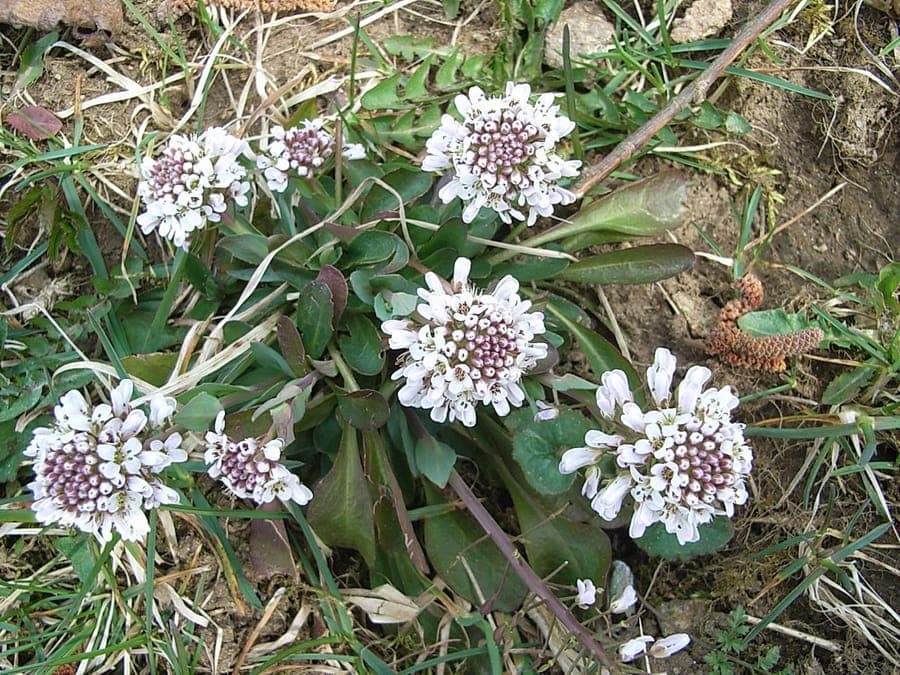
Konrad Lackerbeck / CC BY-SA 2.5, via Wikimedia Commons
Alpine pennycress: complete guide
Noccaea caerulescens
Want to see Alpine pennycress: complete guide in your garden?
1 minute, no credit card
Overview
Alpine pennycress (Noccaea caerulescens) is a small but exceptionally resilient perennial herb from the cabbage family (Brassicaceae). What makes this plant genuinely remarkable - and quite unlike the majority of garden plants - is its ability to accumulate heavy metals such as zinc and cadmium in its tissues at concentrations that would be toxic to virtually any other species. This process, known as hyperaccumulation, has made alpine pennycress one of the most studied plants in the field of phytoremediation - using plants to clean contaminated soils. In an ordinary garden where soils are not polluted, alpine pennycress behaves simply as a compact, low-maintenance perennial with attractive white flower clusters. It is native to central and western Europe, including the Netherlands, Belgium, Germany, France, and Switzerland, where it colonises calcareous rock outcrops, mountain slopes, and former mining sites.
The genus name Noccaea honours the Italian botanist Domenico Nocca (1758–1841). The species epithet caerulescens - meaning 'becoming bluish' - refers to the faint blue-grey bloom that can appear on the leaves, especially in mineral-rich soils. Older botanical texts list the plant as Thlaspi caerulescens, a synonym still frequently encountered in scientific literature. If you use gardenworld.app to plan a rock or alpine garden, alpine pennycress makes an intriguing botanical accent among other drought-tolerant species.
Appearance and bloom cycle
Alpine pennycress forms a neat, low-growing rosette of spatula-shaped to oval leaves, typically 10–15 cm across. The foliage is smooth, grey-green, and can take on a pronounced blue-green tint depending on soil mineral content. The leaf margins are entire to finely toothed, giving the plant a tidy, well-kept appearance even outside the flowering season.
From May to June, erect flowering stems rise to 20–40 cm. Each stem carries small white flowers arranged in dense, upright racemes. Each individual flower is tiny - just a few millimetres across - with four white petals arranged in the characteristic cross pattern of the Brassicaceae. Despite their modest size, the flowers attract bees, hoverflies, and small butterflies seeking nectar. After flowering, the plant produces the small, broadly winged seed pods (silicles) typical of the family, which ripen from July to August and disperse their seeds by wind. The plant can self-seed modestly but is not invasive.
Ideal location
Alpine pennycress thrives in a sunny to lightly shaded position. In the wild, it grows on open stony slopes and calcareous cliffs, sometimes in full sun with no shelter whatsoever. In the garden, it tolerates partial shade, though flowering will be somewhat reduced. Avoid persistently damp, windswept positions that promote fungal issues. A south-facing rock wall, a dry stone wall crevice, or a raised alpine bed are all ideal settings. USDA hardiness zones 5–6 cover the entire UK, the Benelux, and most of Germany, so winter hardiness is never a concern.
Alpine pennycress is rarely stocked at mainstream garden centres, but specialist alpine nurseries supply it readily. Mail-order alpine plant nurseries in the UK are the most reliable source for home gardeners.
Soil requirements
Soil is the single most critical factor for success with alpine pennycress. The plant prefers a pH between 5.5 and 6.5 - slightly acid to mildly acid - and absolutely does not tolerate heavy, waterlogged clay. A free-draining, sandy or gritty substrate with a moderate nutrient level (nutriment value approximately 5 on a scale of 1–10) is ideal. Alpine pennycress is one of the few plants that can actually thrive on zinc-enriched soils, such as those around old spoil heaps and mining waste, making it a true specialist.
When planting, incorporate coarse horticultural grit or fine gravel into the planting hole to ensure drainage. Avoid rich composts or fertilisers with high nitrogen content: lush, over-fed growth weakens the plant and reduces flowering. A sprinkling of limestone grit (two to three handfuls per square metre) helps stabilise pH and mimics the natural substrate the plant evolved on.
Free design
Want to see Alpine pennycress: complete guide in your garden? Make a free design now.
Watering
Once established, alpine pennycress is notably drought-tolerant and requires very little supplementary watering. In the weeks immediately after planting - ideally in April or May - water regularly to help the young plant establish its root system. After that, rainfall in a typical British or central European summer is more than sufficient.
During prolonged dry spells lasting more than three weeks, a thorough watering of 5–8 litres per plant in the evening will prevent stress. However, never allow water to stand around the roots: waterlogging, particularly in cold weather, causes rapid root rot and can kill the plant within days. Excellent drainage is therefore the single most important precaution. Raised beds and scree gardens are perfect precisely because they guarantee that water drains away freely.
Pruning
Alpine pennycress requires virtually no pruning. Once flowering is over in July or early August, the spent flower stems can be cut back to the rosette to keep the plant looking neat. If you want the plant to self-seed and naturalise in a rock garden, leave the seed pods in place until they ripen and split open before removing the stems. Self-seeded young plants can be transplanted to new positions in March or April before the taproot becomes too established.
In early spring - typically mid-February to mid-March - remove any dead leaves from the rosette with your fingers. This prevents moisture accumulating in the centre of the plant, which can lead to crown rot. Hard pruning is never needed and should be avoided, as the plant does not regenerate well from woody stem tissue.
Maintenance calendar
- January–February: Dormancy. No action needed. The plant survives frost without protection provided the drainage is good.
- March: New leaves emerge from the overwintered rosette. Remove dead foliage by hand.
- April: Ideal month for planting container-grown specimens. Transplant self-seeded seedlings if needed.
- May: Flowering begins. The first white racemes open and insect activity increases around the plant.
- June: Peak flowering. Best period for observation and photography.
- July: Flowering ends. Seed pods ripen. Optionally remove spent stems.
- August: Seeds disperse. The plant retreats to a compact summer rosette.
- September–October: Divide or transplant established clumps if necessary. Collect seed for propagation.
- November–December: Full dormancy. No care required.
Winter hardiness
Alpine pennycress is exceptionally winter-hardy. Its natural range extends into mountain regions where temperatures regularly drop below –20°C. In cultivation across the UK, the Benelux, and Germany, frost damage is virtually unknown. The essential requirement is that the roots remain dry: frozen standing water kills roots and will destroy even a healthy, established plant. A thin layer of fine gravel or grit around the base of the rosette improves drainage at the crown and provides a modest degree of insulation.
Do not cover with plastic sheeting or fleece: trapping moisture encourages grey mould (Botrytis cinerea) and other fungal diseases. Alpine pennycress is fully rated for USDA zone 5 and can be grown without concern throughout northern and central Europe.
Companion plants
Because alpine pennycress prefers poor, well-drained, slightly acid soils, it associates naturally with other rock garden and scree species. The following combinations work well:
- Sedum acre (biting stonecrop): identical soil preferences, bright yellow flowers that contrast beautifully with the white blooms of pennycress.
- Thymus serpyllum (wild thyme): a low-spreading mat-former with purple-pink flowers, tolerating the same dry, sunny conditions.
- Arabis caucasica (wall rock cress): white flowers in early spring, robust and reliable on dry, sunny slopes.
- Alyssum montanum (mountain alyssum): golden yellow flowers, the same pH preference, and minimal care requirements.
- Campanula cochleariifolia (fairy thimbles): charming blue-lilac bells on delicate stems, thriving in similar rocky, lean substrates.
Avoid pairing alpine pennycress with moisture-loving, nutrient-hungry plants such as hostas, ferns, or astilbes. Their needs are incompatible and the pennycress will inevitably struggle in a rich, damp border.
Closing thoughts
Alpine pennycress is one of Europe's most botanically fascinating small plants - unassuming in appearance yet extraordinary in its biochemistry. Whether you are building a rock garden, a dry stone wall garden, or an alpine trough display, it rewards you with delicate white flower clusters in late spring and demands almost nothing in return. You can see how it might fit into your own outdoor space on gardenworld.app, where its low, spreading habit pairs wonderfully with other species from lean mountain habitats. Give it sun, grit, and good drainage, and it will return faithfully every May and June for years to come.
Want to see Alpine pennycress: complete guide in your garden? Make a free design now.
Upload a photo, pick a style, and get a photorealistic design with plant list in under a minute.
10,000+ gardens designed already
No credit card required


Similar plants
Brassica cretica: complete guide
Brassica cretica
Brassica cretica, the Cretan cabbage, grows wild on Aegean cliffs. Discover how to grow this drought-tolerant, yellow-flowered Mediterranean perennial.
Corsican cabbage: complete guide
Brassica insularis
Corsican cabbage is a rare Mediterranean rock cabbage with white flowers and blue-green leaves. Location, soil and winter protection.
Prostrate cabbage: complete guide
Brassica procumbens
Prostrate cabbage is a creeping North African cliff plant with yellow flowers. Discover location, soil type and winter protection.