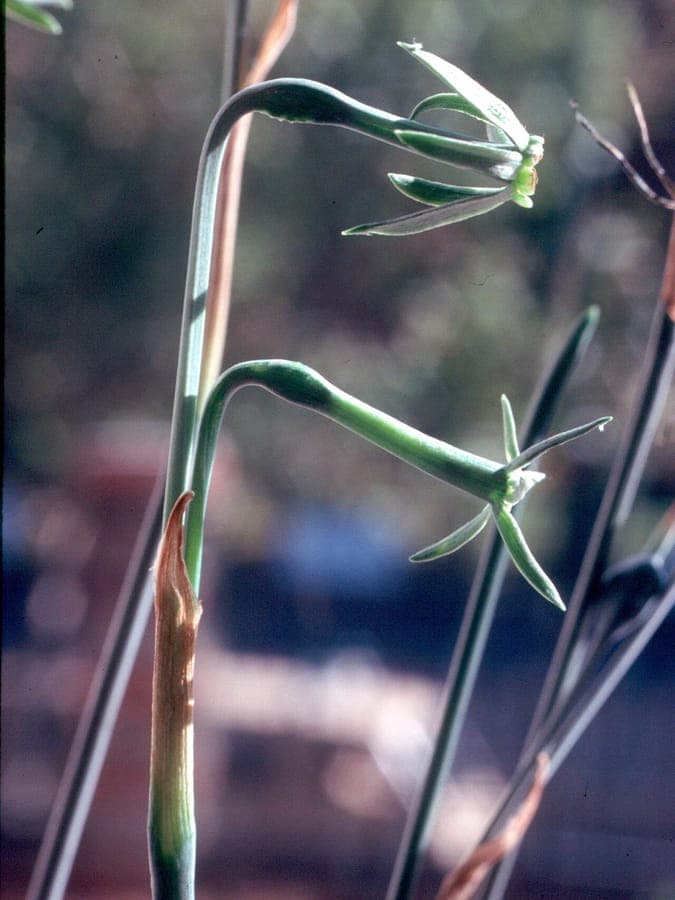
A. Barra / CC BY 3.0, via Wikimedia Commons
Narcissus viridiflorus: complete guide
Narcissus viridiflorus
Want to see Narcissus viridiflorus: complete guide in your garden?
Full design in HD: €7.99
Look after your Narcissus viridiflorus with the GardenWorld app
Identify plants with your camera and get a care calendar with reminders for this plant.


Overview
Narcissus viridiflorus, known as Green Narcissus or Green Jonquil, is perhaps the most unusual daffodil of all - the only daffodil with green flowers. This remarkable plant grows in the mountains of southern Spain and Morocco, where it blooms in October and November - much later than standard daffodils. It has a fragrant, understated appearance with green petals and a red-brown corona that is truly out of the ordinary.
This is not just a plant, it is a botanical marvel. Gardeners who grow it report passersby stopping stunned by this strange beauty.
Appearance and Bloom
The plant reaches 20-30 centimeters tall - larger than Gaditanus but smaller than standard daffodils. The flowers are the point - green petals range from dull to bright green, while the corona is yellow-green to red-brown. The contrast is hypnotic and totally unlike any other daffodil.
Blooming comes late in the season: October through November in southern climates, or December-January in temperate regions. The flowers are also highly fragrant - a sweet, honey-like scent that intensifies in the evening.
Ideal Location
Set this remarkable daffodil in full sunlight - full sun brings the best color. The plant thrives in partial shade too but blooms may be paler. Rock gardens, stone gardens, and alpine troughs are ideal. It can also be grown in pots in greenhouse glass for better flower production.
Free preview
Want to see Narcissus viridiflorus: complete guide in your garden? Make a free preview of your design.
Soil
Same as Gaditanus: poor, well-draining, stony. Sandy soil with gravel is ideal. Avoid wet soil.
Watering
Once established, drought-tolerant. Ensure the growing period (September through December) has regularly moist soil, but never waterlogged. In summer, give minimal water.
Pruning and Maintenance
Narcissus viridiflorus requires no pruning. Let foliage gradually die down after flowering - the bulb gathers energy for next season.
Maintenance Calendar
After blooming (January-February): Remove spent flowers, keep green foliage.
Spring-Summer: Bulb builds strength. Let foliage die down. Minimal water.
Summer: Full dormancy. Keep very dry.
September-October: Growth begins again. Add water if soil feels dry.
Winter Hardiness
This daffodil is less hardy than Gaditanus - better suited to -10°C. In cold regions, pot cultivation is recommended so you can protect them.
Companion Plants
Group with other autumn bloomers: Autumn Crocus, Colchicum, Sternbergia. The green flowers beautifully contrast autumn foliage. Perfect container plant in specialized collections.
Closing Thoughts
Narcissus viridiflorus is truly for plant lovers who want something totally different. This is a statement plant. Seek bulbs from specialized bulb suppliers. For more inspiration on special autumn bloomers, check gardenworld.app.
Grow this green-blooming oddity and make sure your neighbors are jealous.
Frequently asked questions about Narcissus viridiflorus
Is Narcissus viridiflorus winter hardy?
This daffodil is less hardy than Gaditanus - better suited to -10°C. In cold regions, pot cultivation is recommended so you can protect them.
When and how do you prune Narcissus viridiflorus?
Narcissus viridiflorus requires no pruning. Let foliage gradually die down after flowering - the bulb gathers energy for next season.
How much water does Narcissus viridiflorus need?
Once established, drought-tolerant. Ensure the growing period (September through December) has regularly moist soil, but never waterlogged.
Where does Narcissus viridiflorus grow best?
Set this remarkable daffodil in full sunlight - full sun brings the best color. The plant thrives in partial shade too but blooms may be paler.
What soil does Narcissus viridiflorus need?
Same as Gaditanus: poor, well-draining, stony. Sandy soil with gravel is ideal.

See it in your garden
See Narcissus viridiflorus in your garden
One photo of your garden and a few questions. You see the result in about a minute.
Try it with a photoIdentify this plant in your own garden. Identify a plant
Similar plants
Agapanthus campanulatus: the hardy bell agapanthus
Agapanthus campanulatus
Agapanthus campanulatus is a deciduous African lily with blue bell-shaped flowers in summer. Learn about position, watering, winter care and good companions.
Agapanthus inapertus: the drooping African lily
Agapanthus inapertus
Agapanthus inapertus is a tall African lily with drooping, barely open tubular flowers in deep blue and violet. A guide to position, watering and winter care.
Tree onion: complete guide
Allium × proliferum
Everything about the tree onion (Allium × proliferum): planting, harvesting bulbils, dividing and overwintering. A perennial onion, toxic to dogs and cats.
