
Oceancetaceen - Alice Chodura / Public domain, via Wikimedia Commons
Nananthea perpusilla: complete guide to this tiny Corsican daisy
Nananthea perpusilla
Want to see Nananthea perpusilla: complete guide to this tiny Corsican daisy in your garden?
1 minute, no credit card
Overview
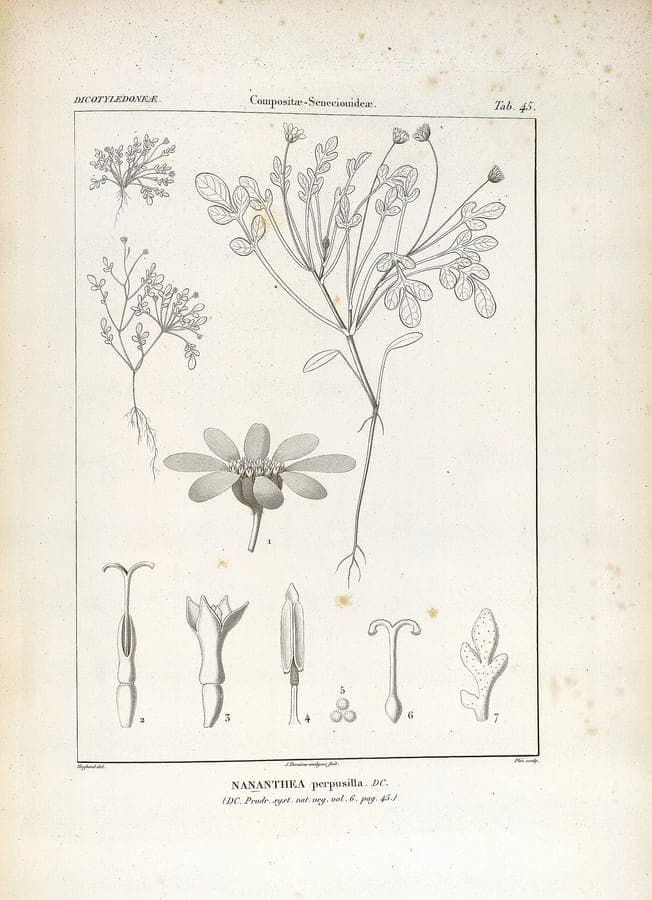
Nananthea perpusilla is one of the smallest members of the daisy family (Asteraceae) - a minute, mat-forming plant that grows naturally only on Corsica and Sardinia, making it endemic to these two Mediterranean islands. It is the sole species in its genus, described scientifically by De Candolle in 1838 and previously placed under the name Chrysanthemum perpusillum by Loiseleur. In the wild it occupies sparse, rocky ground at various altitudes, surviving on nutrient-poor substrates where larger plants cannot compete. For gardeners, it represents an unusual and rewarding challenge: a true Mediterranean miniature that works beautifully in rock gardens, alpine troughs, and containers on sunny terraces. On gardenworld.app you can explore garden design ideas that incorporate this and other compact Mediterranean species.
Despite its tiny stature, Nananthea perpusilla punches above its weight in terms of visual impact during its brief spring bloom. The cheerful white and yellow daisy-like flowers carpet the low mat of foliage in April and May, creating a display that is disproportionate to the plant's small size. It is a plant for enthusiasts - those who appreciate botanical rarity and the specific rewards of growing plants from restricted wild ranges.
Appearance and bloom cycle
The plant forms a low, tight rosette just a few centimetres tall, with narrow, slightly fleshy-looking leaves that are mid-green with a finely toothed margin. The flower heads are typical of the Asteraceae family: small white ray florets surrounding a yellow disc, resembling a miniature daisy. Flowering occurs from April through May, with peak bloom in April in mild conditions and May in cooler climates.
After flowering, the plant produces small seeds that disperse by wind. Under favourable conditions it self-seeds modestly. The foliage remains attractive outside the flowering period, forming a compact cushion of greenery. In its natural habitat on Corsica and Sardinia, it grows in colonies on bare rock faces and stony patches, often alongside mosses and other pioneer species. The overall growth habit is spreading and mat-forming, though very slowly in garden conditions.
Ideal location
Full sun is essential. Nananthea perpusilla evolved in the intense Mediterranean light of Corsica and Sardinia and performs best with as many direct sunlight hours as possible. A sunny south-facing rock garden, a dry stone wall, or a container on a sunny terrace are all excellent positions. Shade is genuinely harmful, leading to weak, drawn-out growth and a susceptibility to fungal disease.
In northern European gardens the cooler, wetter climate presents challenges. The plant can be grown successfully in containers that spend summer outdoors in full sun and are brought inside (or into a cool greenhouse) for winter. In mild coastal areas with almost frost-free winters, outdoor cultivation in a well-drained rock garden with a south aspect is possible. Treat it as an annual in colder regions, raising fresh plants from seed each spring or purchasing young plants from specialist nurseries.
Soil
The ideal growing medium is lean, gritty, and extremely free-draining. In the wild, Nananthea perpusilla grows on poor, rocky substrates - conditions that mimic what it needs in cultivation. Mix horticultural grit with a small amount of compost (roughly 2 parts grit to 1 part compost) for containers, or incorporate plenty of sharp sand and gravel into the planting hole in a rock garden.
Rich, moisture-retentive compost is unsuitable and will cause the plant to grow laxly before succumbing to root rot. Avoid peat-based mixes that hold water. A top-dressing of fine gravel around the plant keeps moisture away from the leaf bases and helps prevent rotting. The pH should be neutral to slightly alkaline, reflecting the calcium-rich rocky substrates of its native islands.
Free design
Want to see Nananthea perpusilla: complete guide to this tiny Corsican daisy in your garden? Make a free design now.
Watering
This is an inherently drought-tolerant species that dislikes overwatering more than underwatering. In containers, a thorough watering once a week in summer is typically sufficient; during periods of natural rainfall above 10 mm per week, supplemental irrigation is unnecessary. Always water at the base of the plant rather than overhead, as wet foliage in humid conditions encourages grey mould.
In winter, keep watering to an absolute minimum. Excess winter moisture combined with cold is the most common cause of death in cultivation. Plants overwintering under cover should receive no water at all for weeks at a time, only a very light moisture top-up if the growing medium becomes bone dry. Collected rainwater is preferable to hard tap water, which can deposit calcium salts in small containers over time.
Pruning
Very little pruning is required. After the bloom finishes in May, the spent flower stalks can be carefully snipped away to keep the plant tidy. If you want to collect seed for propagation, leave a few heads to mature before removing them. In early spring, gently remove any dead or frost-damaged leaves from the rosettes.
There is no benefit in cutting back the foliage hard - the rosette is already so small that any significant trimming risks damaging the growing point. The main maintenance task is keeping the area around the plant free of encroaching weeds, fallen leaves, and other debris that could smother the tiny rosettes.
Maintenance calendar
January-February: Dormancy. Keep container plants dry in a frost-free space. March: Growth resumes. Remove dead material. Refresh the top-dressing of grit. April: Flowering begins. Minimal irrigation needed. Enjoy the early white blooms. May: Peak flowering. Remove spent stems or leave for seed collection. June-August: Dry season management. Water sparingly in containers. Protect from heavy rainfall in wetter climates. September-October: Growth slows. Check pot drainage. Reduce watering. November-December: Bring container plants inside in frost-prone areas. Ensure outdoor plants have excellent drainage.
Winter hardiness
Nananthea perpusilla is not reliably frost-hardy in most of northern Europe. It is native to Corsica and Sardinia, where winters are mild, placing it in roughly USDA Zone 8-9. Prolonged frost below -5 degrees Celsius is likely to be fatal, particularly if the soil or growing medium is wet. In mild maritime climates with virtually frost-free winters, outdoor cultivation is possible in a very well-drained position. Elsewhere, treat it as a tender annual or bring containers inside to a cool, frost-free space for winter. A light mulch of fine grit over the crown provides a small degree of insulation against light frost.
Companion plants
Because of its miniature size, Nananthea perpusilla needs equally small companions that will not smother it. Good partners in a rock garden or alpine trough include Arenaria montana, low-growing thymes such as Thymus serpyllum, and tiny sedums such as Sedum acre or Sedum album. All share the same preference for lean, fast-draining soil and full sun. Small early bulbs - Muscari, miniature Crocus, or Scilla - complement the white daisies with contrasting colours at a similar season.
For a container composition, combine Nananthea perpusilla with Armeria maritima (sea thrift) and a few small ornamental grasses such as Festuca glauca for texture. On gardenworld.app you can visualise how such Mediterranean and alpine miniatures work together in a cohesive design. Avoid vigorous groundcover plants or anything with large leaves that will overwhelm this delicate species.
Closing thoughts
Nananthea perpusilla is a plant for the dedicated enthusiast - someone who finds pleasure in growing rare, botanically significant species and meeting their specific needs. Its tiny white spring flowers, cushion-forming habit, and tolerance of dry, rocky conditions make it a charming addition to a specialist rock garden or alpine collection. Look for it at specialist alpine nurseries or via plant society seed exchanges in the UK, rather than at mainstream garden centres.
Want to see Nananthea perpusilla: complete guide to this tiny Corsican daisy in your garden? Make a free design now.
Upload a photo, pick a style, and get a photorealistic design with plant list in under a minute.
10,000+ gardens designed already
No credit card required


Similar plants
Calendula stellata: complete guide
Calendula stellata
Complete guide to Calendula stellata, the star-flowered marigold from Sicily: location, soil, watering and companion planting tips.
Korean chrysanthemum: complete guide
Chrysanthemum x rubellum
Chrysanthemum x rubellum is a hardy autumn perennial with single pink to copper flowers from August to November. Care and combinations.
Helianthus divaricatus: complete guide
Helianthus divaricatus
Helianthus divaricatus is a North American woodland sunflower with yellow summer blooms, ideal for naturalistic borders and shady edges.