
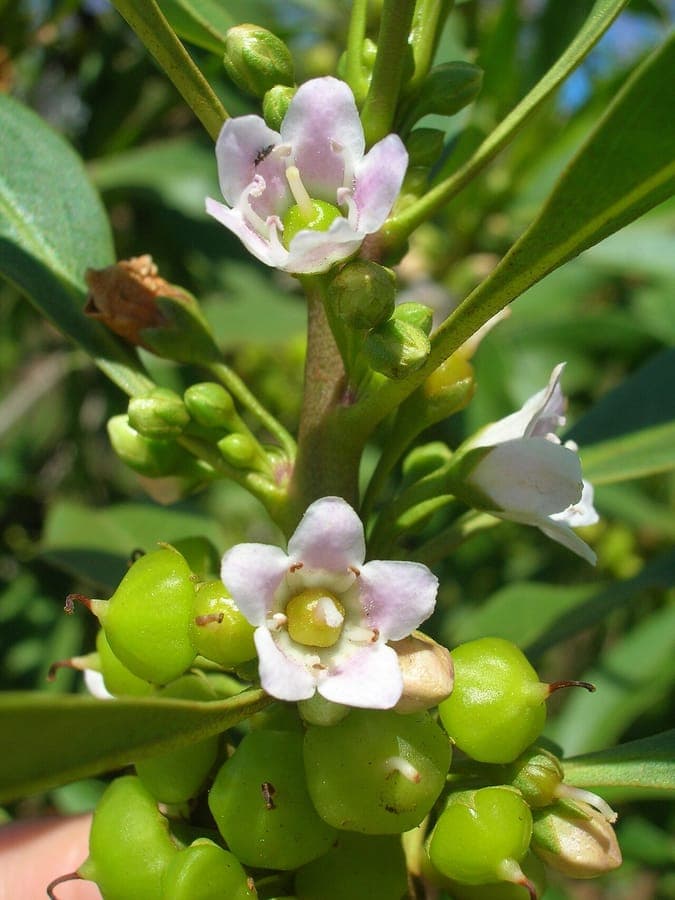
Forest & Kim Starr / CC BY 3.0, via Wikimedia Commons
Naio: complete guide
Myoporum sandwicense
Want to see Naio: complete guide in your garden?
1 minute, no credit card
Overview
Naio (Myoporum sandwicense), commonly called bastard sandalwood or false sandalwood, is a native Hawaiian tree or large shrub with a history as layered as the archipelago itself. It belongs to the family Scrophulariaceae - the same family that includes foxgloves and snapdragons - and is one of the most widely distributed native woody plants across the Hawaiian island chain. In its natural range, naio grows from sea level on coral rubble and coastal lava fields all the way up to approximately 2,400 metres elevation, adapting its form to suit the conditions: a low, wind-sculpted shrub on exposed coastal headlands and a taller, more upright tree on sheltered valley slopes and moist forest edges.
The common name bastard sandalwood has a revealing history. During the eighteenth and nineteenth centuries, when European and American traders were harvesting the genuine Hawaiian sandalwood (Santalum freycinetianum and related species) in vast quantities for the Chinese market, naio wood was sometimes knowingly or accidentally substituted and exported under the sandalwood name. Its timber is faintly aromatic and similar in appearance to true sandalwood, but the scent is considerably weaker. This substitution practice contributed to economic and ecological damage, as both species were heavily harvested during the sandalwood trade era.
For gardeners in temperate climates, naio is a specialist choice suited to mild, maritime, and Mediterranean gardens - the Atlantic coast of southern Portugal, the Canary Islands, the Azores, sheltered coastal Cornwall, and similar zones. In the UK and northern Europe generally, outdoor cultivation is feasible only in the mildest frost-free locations. Container growing allows naio to be enjoyed in colder regions, moved under cover before frost arrives. On gardenworld.app you can create a personalised garden design that weighs up which exotic species suit your particular climate and microclimate.
Appearance and bloom cycle
Naio has distinctively narrow, lance-shaped to narrow-elliptic leaves, 5 to 15 cm long and 1 to 3 cm wide. The upper surface is glossy dark green; the underside is slightly paler. The leaf texture is fleshy and somewhat succulent, an adaptation to the dry, saline coastal conditions where the plant often grows in the wild. Leaf margins are smooth or finely toothed. The plant is evergreen year-round, which makes it particularly useful as a structural element and windbreak with constant presence.
Flowering typically occurs in spring and early summer, though the exact timing depends on elevation and local conditions. The flowers are small - 6 to 10 mm across - and white with distinctive purple spots arranged in a ring inside the corolla tube. Five petals surround the tube in a star-like arrangement, with prominent stamens extending beyond the corolla. Flowers are borne in small axillary clusters of 3 to 8 blooms. While individual flowers are modest in size, a flowering naio tree has considerable charm, with countless small white stars scattered across the dark foliage.
After flowering, small fleshy berries develop, 4 to 8 mm in diameter, ripening from white or cream through to pale purple or lavender-blue. These berries are edible, though not particularly palatable to humans, and are consumed by native Hawaiian birds that play a key role in dispersing the species across the islands.
Ideal location
Naio is quintessentially a coastal plant that excels in conditions that defeat most ornamental shrubs: salt-laden wind off the sea, thin and stony or sandy soil, prolonged drought, and intense sun with little shade. On Hawaii, it is the dominant woody species on many coastal exposures where almost nothing else survives. This toughness makes it exceptionally valuable as a windbreak and shelter belt in mild maritime gardens.
For garden cultivation in mild climates, choose the sunniest available position, sheltered from cold continental winds but open to warmth and light. A south-facing courtyard, a sheltered terrace, or a garden behind a sheltering wall or fence provides ideal conditions. On the Atlantic and Mediterranean coasts of Europe, naio can serve as a freestanding windbreak or shelter hedge, withstanding salt spray that would damage or kill most conventional garden shrubs. Its tolerance of maritime exposure is its most distinctive and useful attribute.
In containers, naio makes an intriguing terrace plant for sheltered south-facing patios in milder regions, or a conservatory subject in cooler areas. Most garden centres in the UK and northern Europe do not stock naio, but specialist tropical and exotic nurseries offer it, usually as a named seed-grown plant.
Soil requirements
Naio grows naturally on an exceptionally wide range of substrates: black lava cinders, volcanic ash, coral sand, rocky slopes, and forested loam soils. The unifying requirement is good drainage. The plant cannot tolerate waterlogged conditions and will decline rapidly if the roots sit in moisture for extended periods. In garden situations, a free-draining, moderately lean soil gives the best results - rich, fertile soils promote fast growth but can make the plant soft and more vulnerable to wind damage.
For container culture, use a free-draining mix of general-purpose compost, coarse horticultural sand, and perlite in a ratio of two parts compost to one part sand to one part perlite. Ensure generous drainage holes in the base of the pot and a 3 to 5 cm layer of coarse gravel or crock shards above them. A soil pH of 5.5 to 7.0 suits the plant well. Avoid over-fertilising: naio is adapted to nutrient-poor conditions and responds to generous feeding by producing lush, soft growth that is less resilient than the wiry, drought-hardened growth of plants grown more leanly.
Free design
Want to see Naio: complete guide in your garden? Make a free design now.
Watering
Naio is strongly drought-tolerant once established in the ground. In its native Hawaiian coastal habitat, the plant endures extended dry seasons by drawing on a deep, wide-spreading root system and by utilising the slight water-storage capacity of its fleshy leaves. Newly planted specimens need regular watering during their first growing season to establish: water deeply every 10 to 14 days, applying 10 to 15 litres per plant each time.
Established plants in open ground in mild climates can typically go through the summer without supplementary irrigation as long as the drainage is excellent and the position is sheltered. A plant stressed by waterlogging is far more problematic than one stressed by mild drought. In containers, watering is required more frequently in summer - check soil moisture every 5 to 7 days and water when the top 3 cm feels dry. In winter, reduce watering to a minimum. The most common cause of naio failing in cultivation outside its natural range is overwatering, particularly during cool and wet winter conditions.
Pruning
Naio responds well to pruning and reshoot promptly and vigorously from old wood. In the wild, the plant is regularly browsed by feral ungulates on Hawaii, and has developed a strong capacity to regrow from the base and lower branches after cutting. This makes it a good candidate for regular shaping and management in the garden without risk of killing the plant through hard cutting.
For cultivated trees and large specimens, prune in early spring after the final frost risk has passed. Remove crossing, dead, or congested branches first, then assess whether the overall shape needs adjustment. To maintain a compact shrub, cut the longest stems back by 20 to 30% annually. To develop a small tree form, gradually remove the lowest side branches over several years until a clear trunk of the desired height is established. Naio does not produce ugly stubs after pruning - new growth quickly covers cut surfaces. On gardenworld.app you can explore design ideas for incorporating structural exotic plants like naio into a contemporary planting scheme.
Maintenance calendar
January-February: Rest and protection period. In zones with light frost risk, check foliage for cold damage. Apply extra mulch at the base if further cold spells are forecast.
March-April: Main pruning session once frost risk has passed. Remove any cold-damaged stems and reshape as needed. Apply a slow-release balanced fertiliser to the root zone.
May-June: Flowering season. Enjoy the small white and purple blooms. Water during dry spells - this is the period of highest water demand during active growth and flowering.
July-August: Hot, dry season. Established plants in open ground need little or no supplementary water. Container plants should be checked every 5 to 7 days.
September-October: Berries ripen and are taken by birds. Carry out any optional secondary pruning to remove unwanted extension growth.
November-December: Winter preparation. Apply a mulch layer of 8 to 10 cm around the root zone. Move container plants into a frost-free, well-lit position before temperatures drop below -2 degrees Celsius.
Winter hardiness
Myoporum sandwicense is not winter-hardy in the open garden in northern Europe. The plant tolerates light frost to approximately -3 to -5 degrees Celsius for short periods, but sustained sub-zero temperatures cause severe foliage damage or death of the above-ground parts. USDA hardiness zones 10 to 11 represent reliable outdoor cultivation territory: coastal southern California, Florida, the Canary Islands, Madeira, the Azores, and comparable zones.
Within the British Isles and Ireland, a handful of extremely sheltered coastal locations - the Isles of Scilly, the Lizard Peninsula in Cornwall, Tresco Abbey Gardens, and parts of West Cork and Kerry in Ireland - can sustain naio outdoors through mild winters with some protection. These are exceptions rather than the rule. For the majority of gardeners in the UK and northern continental Europe, container cultivation with winter housing in a frost-free greenhouse or conservatory is the only reliable approach.
In warmer garden climates - southern Portugal, the Canary Islands, the Azores, coastal Morocco - naio can be grown as a fully reliable landscape plant, used for shelter belts, coastal windbreaks, and low-maintenance structural planting. In these climates it is genuinely low-maintenance once established, tolerating drought, salt, and poor soils with minimal intervention.
Companion plants
Naio suits combinations with other robust, drought-tolerant, maritime-tough species. Pittosporum tobira, with its sweetly scented white flowers and dense, glossy habit, is a natural companion in warm coastal gardens and shares naio's tolerance for salt and wind. Callistemon citrinus (crimson bottlebrush) offers a vivid red-flower contrast with similar climate requirements. Oleander (Nerium oleander) is a classic pairing in the same Mediterranean and subtropical climate zone.
For a Hawaiian-themed garden, combine naio with Metrosideros excelsa (pohutukawa or New Zealand Christmas tree, closely related to Hawaiian ohia lehua), Cordyline australis, and Phormium tenax as structural accent plants, with Agapanthus africanus for summer-blue flowers. On a gravel garden terrace in a warm dry climate, naio pairs well with Agave americana and Yucca filamentosa - all three species tolerate heat, drought, and wind with equal composure. Visit gardenworld.app to build a garden design around these Mediterranean and subtropical performers.
Closing
Naio is a tree with deep cultural and ecological significance in Hawaii - woven into the history of the sandalwood trade, valued by native Hawaiians for its durable timber and firestarting properties, and important as food and habitat for native birds. As a garden plant, it is a specialist choice for gardeners in mild maritime and Mediterranean climates: evergreen, wind-tolerant, salt-resistant, drought-hardy once established, and carrying charming white-and-purple flowers in late spring.
In colder temperate climates such as the UK and northern Europe, naio is most successfully grown as a container plant, overwintered under cover and moved outside for the summer months. For gardeners in warm coastal zones - southern Portugal, the Canary Islands, the Azores, coastal California - naio is a genuinely low-maintenance and architecturally distinctive addition to the landscape. Pair it with other tough Mediterranean and subtropical companions and it will reward you with a resilient, evergreen, wind-filtering screen that asks remarkably little in return.
Want to see Naio: complete guide in your garden? Make a free design now.
Upload a photo, pick a style, and get a photorealistic design with plant list in under a minute.
10,000+ gardens designed already
No credit card required


Similar plants
Pittosporum tobira: complete guide
Pittosporum tobira
Pittosporum tobira (Japanese cheesewood) is a lush evergreen shrub with glossy leaves and fragrant white flowers. Perfect for warmer climates and Mediterranean gardens.
Pohutukawa: complete guide
Metrosideros excelsa
Metrosideros excelsa (pohutukawa) is a spectacular tree from New Zealand with characteristic red flowers. Learn how to grow this exotic tree in your garden.