
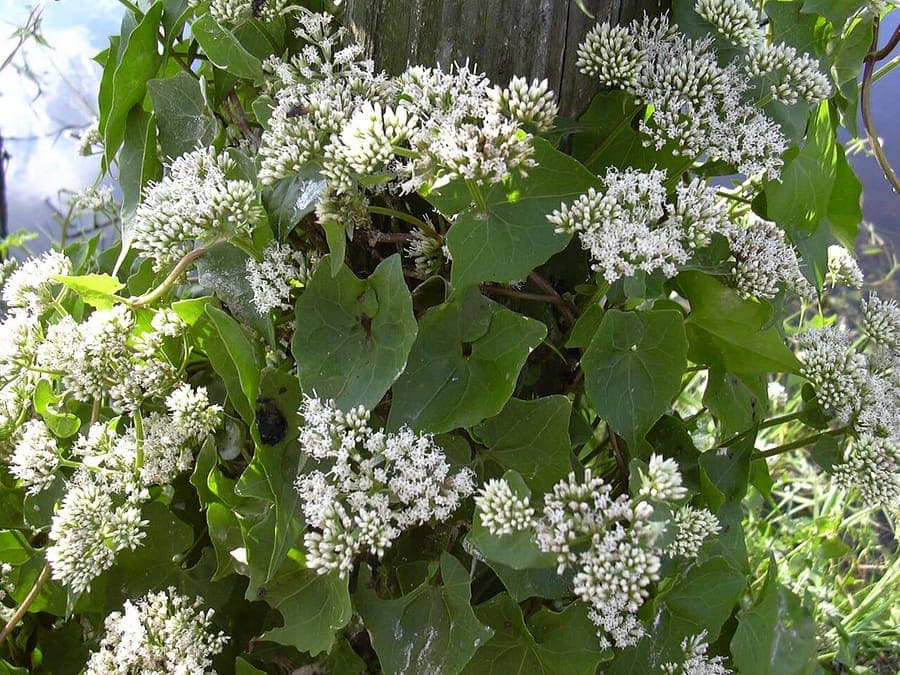
Forest & Kim Starr / CC BY 3.0, via Wikimedia Commons
Climbing hempvine: complete guide
Mikania scandens
Want to see Climbing hempvine: complete guide in your garden?
1 minute, no credit card
Overview
Mikania scandens (L.) Willd., commonly known as climbing hempvine or climbing hempweed, is a vigorous twining herbaceous vine in the family Asteraceae. Native to the eastern and central United States, from Maine to Florida and west to Texas, as well as Mexico and the Bahamas, this fast-growing plant colonises stream banks, marsh edges, woodland clearings, and moist thickets in its natural range. In cultivation it is valued for its dense green foliage, delicate clusters of white to pale pink flowers, and its ability to cover large structures rapidly.
The species was formally described by Carl Ludwig Willdenow in 1803, based on Linnaean material, under the epithet scandens, Latin for 'climbing'. Its common name references the superficial leaf resemblance to hemp (Cannabis), though the plants are botanically unrelated. Folk names include climbing boneset, duck blind, and mile-a-minute weed, the last of which speaks clearly to its growth rate.
For gardeners seeking rapid coverage of unsightly fences, trellises, or pergolas, climbing hempvine offers a fast, lush solution. In optimal conditions it can extend 3 to 6 metres in a single growing season. In temperate European gardens the growth is somewhat moderated by shorter summers, but the plant remains impressively vigorous for a herbaceous climber.
On gardenworld.app you can explore how climbing plants like Mikania scandens can be used to create layered, textured garden designs that support pollinators and provide rapid green coverage.
Appearance & bloom cycle
Mikania scandens grows as a twining vine, coiling its slender stems clockwise around any available support: wire, wooden lattice, fence posts, shrub branches, or other plants. Stems are light green to reddish-green, slightly hairy when young, and can reach 3-6 metres long in a single season. The leaves are opposite, heart-shaped to ovate, 5-10 cm long and 3-7 cm wide, with finely toothed margins and a pronounced veination. The long petioles (leaf stalks) give the foliage a relaxed, flowing appearance.
Flowers appear from July through October, peaking in August and September. Individual florets are tiny, but they are borne in dense corymbs (flat-topped clusters) at stem tips and in the axils of upper leaves. The colour is creamy white to light pink, and the fragrance is faintly sweet, drawing butterflies, bees, and other pollinators in great numbers. After pollination, the plant produces small achene fruits with feathery pappus bristles that disperse on the wind.
The overall habit is lush and informal, making climbing hempvine well suited to naturalistic or wildlife-friendly garden styles. It has few cultivated varieties; the species itself, along with the pubescent form Mikania scandens f. pubescens, is most commonly encountered in cultivation.
Ideal location
Climbing hempvine thrives in full sun to partial shade. In its native habitat it typically receives 4-6 hours of direct sunlight per day alongside dappled shade from taller trees and shrubs. In garden conditions, a position with morning sun and afternoon shade suits it particularly well, especially in continental climates with hot summers.
A sturdy support is essential. Wooden trellises, metal wire frames, and robust fences all work well. When planting near trees or shrubs, be aware that the vine can overwhelm smaller plants if not managed. Allow at least 60-80 cm between the planting hole and the support structure to give roots room to develop without restriction.
In cool-temperate regions (USDA zones 6-7), climbing hempvine may be treated as a tender perennial or annual. In USDA zone 8 and above it overwinters reliably if the root zone is mulched. Container culture is an excellent option in cooler climates: grow in a 30-40 cm pot, bring indoors before the first frost, and store in a cool, bright location at 5-10 °C over winter.
Soil requirements
The ideal soil for Mikania scandens is moist, fertile, and free-draining. In its native range it grows in alluvial, humus-rich soils alongside waterways, tolerating a wide pH range from 5.7 to 8.7. In garden practice, pH 6.0-7.5 is optimal for strong growth and reliable flowering.
Before planting, work the soil thoroughly to a depth of 30-40 cm. Incorporate mature compost or worm castings at a ratio of 1:3 with existing soil to improve moisture retention and fertility. On sandy soils, generous organic matter additions are essential; on heavy clay, add coarse sand (2-4 mm grade) and coir fibre to improve drainage. A 5-7 cm layer of bark mulch or compost applied annually around the base of the plant suppresses weeds, retains moisture, and gradually enriches the soil.
Fertilise during the growing season with a potassium-rich formula (such as tomato feed with an NPK ratio of approximately 3-5-8) every four to six weeks from April through September. This encourages dense foliage, strong stems, and prolific flowering.
Watering
Climbing hempvine has a relatively high water requirement, particularly during the first two years after planting. The soil should remain consistently moist but never waterlogged: extremes of drought and standing water are equally harmful. During dry summer spells, water deeply twice a week, ideally in the early morning so that the foliage can dry before nightfall.
Established plants (two or more years old) manage with once-weekly watering in normal summers, provided the soil is well mulched. Drip irrigation delivered at 10-15 cm depth near the root zone is significantly more efficient than overhead sprinklers and reduces the risk of fungal diseases caused by persistent wet foliage. Avoid evening watering, which promotes powdery mildew and other leaf-surface pathogens.
During extended wet periods, check drainage carefully. Standing water around the roots leads to root rot, one of the few serious problems affecting this otherwise robust plant. If drainage is poor, consider raising the planting site slightly or installing a 10 cm gravel layer at the base of the planting hole to improve water movement.
Free design
Want to see Climbing hempvine: complete guide in your garden? Make a free design now.
Pruning
Regular pruning is necessary to keep climbing hempvine within bounds. During the active growing season from May to September, new shoots can extend 20-30 cm per week in warm, well-watered conditions. Light trimming of over-long stems can be carried out at any time during the growing season without harming the plant.
The main pruning session takes place in late autumn after the first frost has killed the foliage, or in early spring before new growth begins. Cut all stems back to 20-30 cm above the root crown to rejuvenate the plant and prevent it from smothering neighbouring plants. Remove dead wood and damaged stems with clean, sharp secateurs. On a trellis, selectively tie back chosen stems with soft garden wire or jute twine to create a more structured coverage.
For container-grown plants, prune back hard in late winter before returning them outdoors, replacing or refreshing the top 10 cm of compost at the same time. Remove any dead roots found during repotting. This annual refresh keeps containerised specimens vigorous and prevents the root system from becoming pot-bound.
Maintenance calendar
January-February: Inspect overwintering pots for frost damage. Water sparingly, keeping compost barely moist. No feeding.
March: New growth begins. Gradually move pots outdoors when night temperatures stay above -2 °C. Cut back overwintered plants to 15-20 cm above the root crown. Topdress with fresh compost.
April-May: Growth accelerates rapidly. Attach new shoots to the support structure. Apply the first dose of potassium-rich fertiliser. Increase watering as temperatures rise.
June-July: Full growing season. Trim over-long shoots weekly. Fertilise fortnightly with liquid feed. Check for aphids and spider mites; treat with insecticidal soap if needed.
August-September: Peak flowering. Remove spent flower clusters to encourage a second flush of bloom. Maintain regular watering. Check that the support is bearing the weight of the plant safely.
October: Growth slows. Apply a final fertiliser dose. Take cuttings (softwood or semi-ripe) for overwintering under glass if desired. Remove spent flower stems.
November-December: Cut back to a winter framework. Apply a 10-15 cm mulch layer over the root zone. In cold gardens, cover the base with breathable horticultural fleece during hard frosts.
Winter hardiness
Mikania scandens is marginally hardy in temperate Western Europe. USDA zone 7 (minimum temperatures from -17.8 to -12.2 °C) represents the limit for in-ground overwintering; in zone 8 and above (including the milder coastal areas of Belgium, the Netherlands, and south-west England) the plant reliably overwinters outdoors with adequate root mulching.
In most garden centre catalogues across northern Europe, climbing hempvine is listed as tender, suitable for USDA zones 7-10. In practice, most of the Netherlands and Belgium falls in zone 8a-8b (average minimum -9 to -6 °C), meaning the plant has a reasonable chance of survival in average winters when the root crown is protected by a 10-15 cm mulch of bark or straw.
After an exceptionally hard winter when the roots have been lost, the species is easily replaced from fresh plants purchased in spring at garden centres or grown from seed sown indoors in March at 20-22 °C. Germination takes 10-14 days and seedlings are ready to transplant after about six weeks.
Companion plants
Climbing hempvine pairs naturally with other moisture-loving, informal-style plants:
- Lobelia cardinalis (cardinal flower): brilliant red spikes in August-September contrast dramatically with Mikania's white flower clusters; both prefer the same moist, rich conditions.
- Carex pendula (pendulous sedge): the arching, sword-like leaves and drooping spikes provide structural contrast below the vine, filling the base of the planting.
- Iris pseudacorus (yellow flag iris): statuesque yellow flowers in May-June bridge the gap before Mikania's bloom period; both thrive in damp, fertile soils.
- Humulus lupulus (common hop): another vigorous climbing plant that tolerates the same conditions; the two can be combined on a large pergola for a lush, informal effect.
- Caltha palustris (marsh marigold): early golden flowers from March to May act as a spring underplanting beneath the bare stems of the overwintering vine.
Avoid planting climbing hempvine next to delicate, slow-growing perennials or young shrubs that may be overwhelmed by its rapid expansion. Maintain at least 1 metre clearance from plants you wish to protect.
Conclusion
Climbing hempvine is a rewarding plant for gardeners who want fast, lush coverage and a long season of interest, from the dense summer foliage through to the delicate autumn flowers that attract the final pollinators of the season. With regular trimming it remains manageable; without it, the plant earns its 'mile-a-minute' nickname.
Explore planting combinations featuring climbing hempvine and other vigorous climbers at gardenworld.app, where you can visualise how different plants work together in a complete garden design before you commit to the spade.
Want to see Climbing hempvine: complete guide in your garden? Make a free design now.
Upload a photo, pick a style, and get a photorealistic design with plant list in under a minute.
10,000+ gardens designed already
No credit card required


Similar plants
Calendula stellata: complete guide
Calendula stellata
Complete guide to Calendula stellata, the star-flowered marigold from Sicily: location, soil, watering and companion planting tips.
Korean chrysanthemum: complete guide
Chrysanthemum x rubellum
Chrysanthemum x rubellum is a hardy autumn perennial with single pink to copper flowers from August to November. Care and combinations.
Helianthus divaricatus: complete guide
Helianthus divaricatus
Helianthus divaricatus is a North American woodland sunflower with yellow summer blooms, ideal for naturalistic borders and shady edges.