
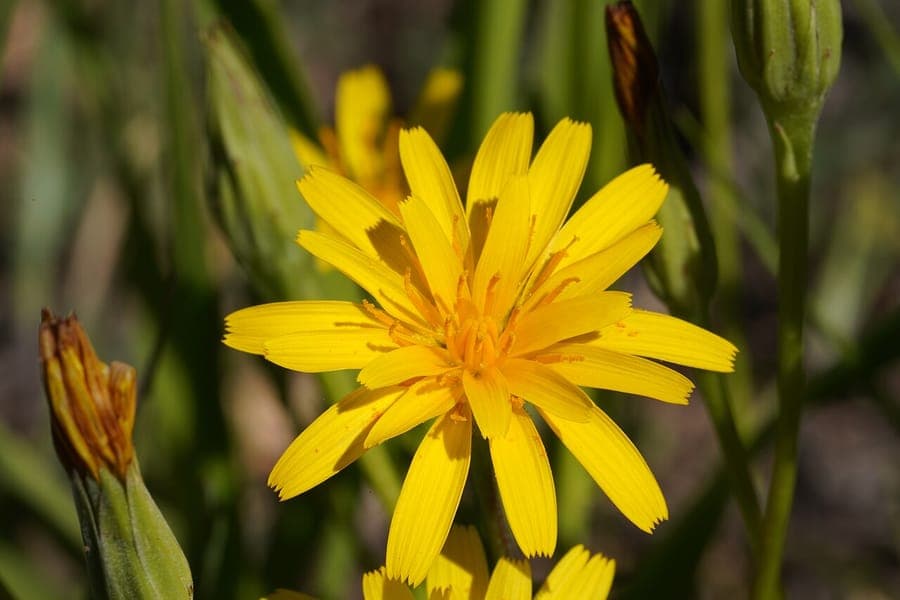
NPS photo / Public domain, via Wikimedia Commons
Nodding microseris: complete guide
Microseris nutans
Want to see Nodding microseris: complete guide in your garden?
1 minute, no credit card
Overview
Microseris nutans - known by the common names Nodding microseris, Nodding silverpuffs, and Nodding scorzonella - is a graceful, clump-forming perennial in the aster family (Asteraceae). Native to the western regions of North America, its range spans from Alberta and British Columbia in Canada south through Washington, Oregon, Idaho, Montana, Wyoming, California, Nevada, Utah, Colorado, and South Dakota in the United States.
The species name 'nutans' means nodding in Latin, a direct reference to the flower heads and seed heads that characteristically droop or tilt at the top of the slender stems. This nodding habit, combined with the dandelion-like yellow flowers and the decorative spherical seed heads (the 'silverpuffs' that give the plant one of its common names), makes it one of the more distinctive members of the genus Microseris, which belongs to the chicory tribe (Cichorieae) of the Asteraceae.
In terms of taxonomy, Microseris nutans has a complex synonymy reflecting decades of reclassification by botanists. Previously placed in the genera Scorzonella, Ptilocalais, Calais, Ptilophora, Crepis, and Stephanomeria at various times, it was finally settled in Microseris, where it remains accepted today. The species itself is variable, with two former varieties (var. major and var. macrolepis) described, though these are no longer recognized at the species level.
In its natural habitat, Microseris nutans grows on moist to dry open grasslands, prairie slopes, forest openings, and streamside meadows across a wide elevation range from near sea level to over 2,500 metres. It thrives at soil pH 6.0 to 7.2. For gardeners, it offers a light, airy floral display in spring and early summer - complemented by the charming spherical seed heads - with minimal maintenance requirements. Discover how Microseris nutans can be integrated into naturalistic garden designs at gardenworld.app.
Appearance & bloom cycle
Microseris nutans is a herbaceous perennial with a single crown growth habit, meaning it grows from a single central rootstock without producing rhizomes or stolons. It forms a basal rosette of linear to narrowly lance-shaped leaves, 5 to 25 cm long. Leaves are bright green to slightly glaucous, with entire or slightly toothed margins depending on the individual.
In spring - April to June at lower elevations, later at altitude - slender, upright flowering stems of 15 to 50 cm emerge from the rosette. Each stem is topped by a single flower head that characteristically nods or tilts, often at a 45 to 90 degree angle from vertical. The flower heads are composed entirely of ray florets (ligulate flowers), pale to medium yellow in colour, 2 to 3 cm in diameter - resembling a small, refined dandelion.
After pollination, the flower head transforms into a spherical seed head 2 to 4 cm across, composed of numerous feathery-plumed seeds (each with a pappus of fine barbed bristles) that disperse on the wind. These seed heads - the 'silverpuffs' of the common name - are delicately ornamental, particularly when backlit by low morning or evening sun.
The above-ground parts die back in midsummer (June-July at most elevations) as conditions become drier and warmer, and the plant enters a dry-season dormancy typical of prairie and montane species. In wetter garden conditions it may remain partially active longer. The plant overwinters as a compact rootstock and re-emerges the following spring. Planting distance of 25 to 30 cm is appropriate for group plantings.
Ideal location
Microseris nutans is naturally a full-sun to light partial-shade plant, adapted to open prairie, grassland, and woodland edge habitats where it receives direct sun for most of the day. In the garden, a position in full sun or receiving at least five to six hours of direct sunlight per day produces the best flowering and the most vigorous growth. Light shade in the afternoon is acceptable in hotter climates to prevent early dormancy.
The plant is well suited to dry to moderately moist borders, gravel gardens, prairie-style plantings, sloped beds with good drainage, and naturalistic wildflower gardens. It is particularly effective in mixed prairie borders where its nodding yellow flowers and decorative seed heads add lightness and movement. Avoid heavy, poorly drained soils where water pools in winter; these are not appropriate and will cause crown rot.
For smaller gardens, Microseris nutans can be grown in containers with excellent drainage, in a sunny position. Choose a container at least 30 cm in diameter and 25 cm deep, filled with a gritty, well-draining compost mix. Terracotta pots in sunny spots work particularly well as they provide additional warmth and allow evaporation from the pot walls.
Soil requirements
Microseris nutans grows best in slightly acidic to neutral soil with a pH between 6.0 and 7.2. It is naturally adapted to lean, nutrient-poor prairie and mountain meadow soils and does not require rich garden soil - in fact, overly fertile soils tend to produce lush but floppy growth at the expense of flowers.
The most important soil property is drainage: the root system of Microseris nutans is sensitive to prolonged moisture, particularly in cool or cold conditions. Sandy loam, loamy sand, or gravelly garden soil is preferred over heavy clay. On clay-heavy soils, thorough improvement with coarse horticultural grit (20 to 30 percent by volume) is necessary, or alternatively raise the bed to ensure drainage.
Organic matter content of 3 to 5 percent in the topsoil is sufficient and beneficial for moisture retention during dry spells, but excessive composting or manuring is counterproductive. In lean soils, a single application of a balanced slow-release fertiliser (5-5-5 or similar) at planting time is adequate. Annual fertilising is not necessary unless growth clearly declines over several seasons.
In a rock garden or gravel garden context, Microseris nutans thrives in a standard alpine mix of 50% coarse grit, 30% loam, and 20% leaf mould. This provides the sharp drainage, moderate fertility, and slight moisture retention that the plant needs.
Free design
Want to see Nodding microseris: complete guide in your garden? Make a free design now.
Watering
Microseris nutans is adapted to a seasonally variable moisture regime: active and moist in spring, progressively drier through summer, and dormant during the driest part of the season. Replicating this pattern in the garden is the most effective strategy for healthy, long-lived plants.
During the active spring growing season (March to June), water once per week during dry spells to support leaf and stem growth and flowering. The soil should not remain dry for extended periods during this phase, as lack of moisture during flowering reduces the number of flower heads and seed set. However, do not keep the soil permanently wet: allow the top 5 cm to dry slightly between waterings.
As the plant begins to flower and temperatures rise, gradually reduce watering. After blooming ends and seed heads form (June-July), the plant begins its natural die-back cycle; supplemental watering can be stopped entirely. The rootstock requires very little moisture during summer dormancy.
In autumn, when the plant may re-emerge with fresh basal leaves (in moister garden conditions), a resumption of modest watering is appropriate if rainfall is insufficient. The critical period for moisture management is winter: ensure drainage is adequate so the rootstock does not sit in cold, wet soil, which is the primary cause of winter losses.
Pruning
Pruning requirements for Microseris nutans are minimal. The main seasonal task is cutting back the above-ground stems after the plant has flowered and the seed heads have matured or been dispersed - typically in late June or July. Leave the seed stems standing until the silverpuff heads are fully formed and open: they are ornamental and valuable to seed-eating birds and insects. Once the seed heads start releasing their plumed seeds, cut the stems to the base if self-seeding is not desired.
If controlled self-seeding is acceptable, leave a proportion of seed heads to disperse naturally. Microseris nutans self-seeds readily on open, sandy or gravelly soil; on denser soils spontaneous germination is less frequent. Seedlings are easy to identify by their basal rosette habit and can be transplanted when small.
In spring (March-April), remove any remaining dead material from the previous season's growth once new leaves are clearly emerging. Take care around the fragile new shoots, which are easily damaged. Division of the clump is possible but not routinely necessary; the single-crown growth habit means the plant does not spread aggressively and old clumps rarely become unmanageable.
Maintenance calendar
January-February: Dormant period. Ensure drainage around the overwintering rootstock is adequate. No irrigation needed. A light grit mulch around the crown provides useful winter protection.
March-April: First leaves emerge. Remove any remaining dead material from the previous season. Check for frost damage. Apply a light dressing of slow-release fertiliser in lean soils.
April-May: Active leaf growth. Water once per week in dry conditions. Flowering stems begin rising from the rosette.
May-June: Flowering period. Enjoy the nodding yellow blooms and forming silverpuff seed heads. Decide whether to leave stems for self-seeding or remove for tidiness.
June-July: Seeds ripen and disperse. Remove spent stems if self-seeding is not desired. Plant begins dying back into dormancy.
July-August: Summer dormancy. No watering or maintenance needed.
September: Possible re-emergence of basal leaves. Light watering if very dry.
October-November: Prepare for winter. Ensure drainage is adequate. Apply a grit collar around the crown on heavier soils.
December: Full dormancy. No care required.
Winter hardiness
Microseris nutans is reliably cold-hardy, reflecting its native range extending from the Canadian prairies of Alberta and British Columbia, where winters are long and cold. The species tolerates temperatures of -20 degrees Celsius and below in well-drained soils, corresponding to USDA hardiness zones 4 to 7. In the UK, Netherlands, Belgium, Germany, and northern France - generally zones 7 to 8 - the plant is fully hardy without winter protection.
As with most prairie and mountain plants, the primary winter risk is not cold itself but the combination of cold and waterlogged soil. Persistent winter wet around the rootstock causes crown rot, which is the most common cause of winter plant loss. Excellent soil drainage is the most effective preventive measure. On heavier soils or in wet gardens, a raised bed or a grit collar around the crown substantially reduces winter losses.
Snow cover is beneficial, acting as a natural insulator for the root zone. In areas without reliable snow cover - such as much of lowland north-west Europe - a thin layer of coarse grit or pine bark around (not over) the crown provides useful thermal buffering without impeding drainage.
Late spring frosts after emergence are tolerated reasonably well; any frost-damaged foliage typically recovers quickly from the healthy rootstock below.
Companion plants
Microseris nutans associates naturally with other prairie and grassland species, and these groupings work beautifully in naturalistic garden settings. The nodding yellow flowers and decorative seed heads pair well with plants of complementary texture and colour:
- Geum triflorum (Prairie smoke): a low prairie perennial with feathery seed plumes very similar to those of Microseris, flowering at the same time or slightly earlier. The two together create a coherent, naturalistic scene in a prairie bed.
- Penstemon strictus (Rocky Mountain penstemon): tall spikes of blue-purple flowers provide vivid contrast to the delicate yellow Microseris blooms; both grow in the same dry, well-drained prairie conditions.
- Erigeron species (fleabane): small white or pink daisy-like flowers complement Microseris well in a mixed prairie border, extending the flowering season after Microseris finishes.
- Festuca glauca (blue fescue): the compact blue-grey clumps of this ornamental grass provide a contrasting backdrop that sets off the light Microseris flowers beautifully.
- Achillea millefolium (yarrow): the flat-topped white or cream flower clusters of yarrow bloom at the same time as Microseris and share the same lean, dry soil preference.
- Salvia nemorosa: spikes of blue-purple flowers add vertical interest and flower colour alongside the more delicate Microseris stems and heads.
In a wildflower border context, Microseris nutans works well alongside Geranium pratense, Leucanthemum vulgare, and other European grassland natives that share its preference for lean, well-drained soils.
Conclusion
Microseris nutans is a quiet gem of the prairie plant world - graceful, undemanding, and ornamental across two seasons with its nodding yellow flowers followed by charming silverpuff seed heads. It is a plant for gardeners who value lightness and naturalistic beauty over showy mass planting, and who are prepared to offer it the well-drained, lean soil conditions it needs to thrive long-term.
For inspiration on incorporating Microseris nutans into a prairie-style or naturalistic garden, visit gardenworld.app for personalised garden design services. More plant profiles, planting combinations, and practical tips are available at gardenworld.app.
Want to see Nodding microseris: complete guide in your garden? Make a free design now.
Upload a photo, pick a style, and get a photorealistic design with plant list in under a minute.
10,000+ gardens designed already
No credit card required


Similar plants
Calendula stellata: complete guide
Calendula stellata
Complete guide to Calendula stellata, the star-flowered marigold from Sicily: location, soil, watering and companion planting tips.
Korean chrysanthemum: complete guide
Chrysanthemum x rubellum
Chrysanthemum x rubellum is a hardy autumn perennial with single pink to copper flowers from August to November. Care and combinations.
Helianthus divaricatus: complete guide
Helianthus divaricatus
Helianthus divaricatus is a North American woodland sunflower with yellow summer blooms, ideal for naturalistic borders and shady edges.