
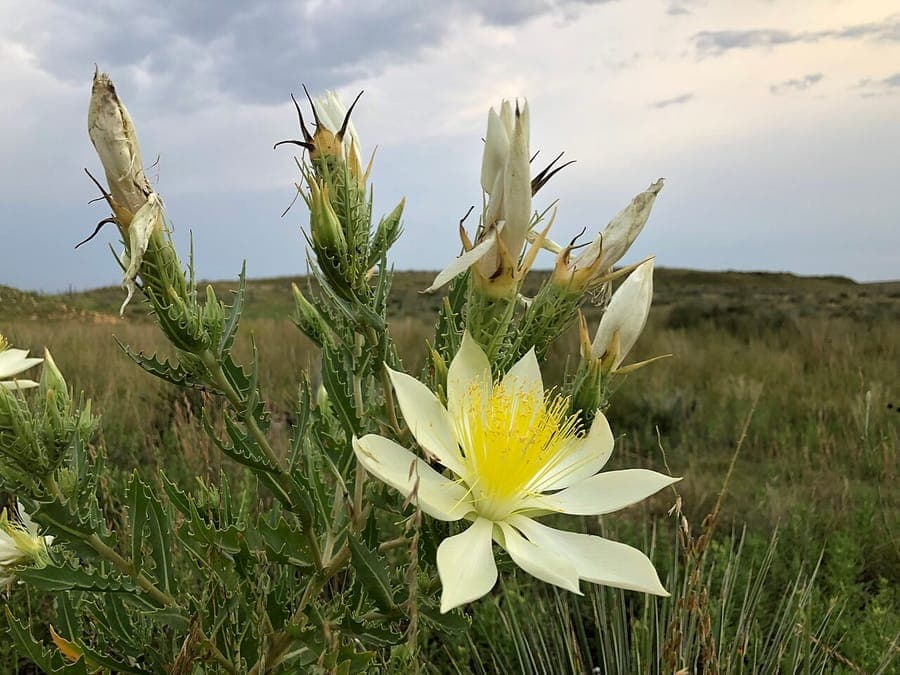
Kara White https://www.inaturalist.org/people/kara_white / CC BY 4.0, via Wikimedia Commons
Tenpetal blazingstar: complete guide
Mentzelia decapetala
Want to see Tenpetal blazingstar: complete guide in your garden?
1 minute, no credit card
Overview
Mentzelia decapetala, commonly called the tenpetal blazingstar, evening starflower, or gumbo-lily, is a striking perennial herb in the family Loasaceae native to the dry prairies, gravelly slopes, and open plains of western North America. Its native range extends from Alberta and Saskatchewan in Canada south through Montana, Wyoming, Colorado, Nebraska, Kansas, Oklahoma, Texas, New Mexico, and Utah. It was formally described in 1892 by Urban and Gilg and has accumulated several synonyms over the years: Bartonia decapetala, Mentzelia ornata, and Hesperaster decapetalus among them.
The species epithet decapetala directly references its defining trait: ten spreading cream-white petals that form large, saucer-shaped flowers up to 8 cm across. These blooms open in the evening and early nighttime hours, making the plant a specialist in attracting hawkmoths and other nocturnal pollinators. The result is a garden experience unlike almost any other - a plant that transforms into a glowing spectacle just as the sun goes down.
For gardeners in Europe dealing with dry, alkaline, or sandy soils, Mentzelia decapetala is an underutilised gem. It thrives in conditions that defeat many conventional border plants, requiring no irrigation once established and tolerating pH levels as high as 8.4. Plan your evening garden around it using the design tools at gardenworld.app, where you can visualise drought-tolerant prairie plant combinations tailored to your specific front garden.
Appearance & bloom cycle
Mentzelia decapetala forms a single-crowned, upright herb reaching 30 to 80 cm in height depending on soil quality and available moisture. The stems are whitish, tough and somewhat branched, bearing deeply lobed or pinnately divided leaves with a coarse, sandpaper-like texture. This roughness comes from stiff barbed trichomes - microscopic hook-tipped hairs covering the entire plant surface. These trichomes help seeds and plant fragments attach to passing animals, aiding dispersal. The leaves are grey-green, lanceolate at the base narrowing toward the tips, typically 6 to 15 cm long.
The flowers are genuinely remarkable. Each bloom carries ten broad, elliptical petals arranged in two whorls, creamy white to pale yellow, with a dense cluster of golden stamens at the centre. Individual flowers measure 5 to 8 cm in diameter. They open reliably in the late afternoon and evening, closing again by mid-morning the following day. The effect on summer evenings is theatrical: the pale blooms seem to glow in the low light, attracting sphinx moths and long-tongued bees that forage at dusk.
The bloom period runs from July through September, peaking in August in most garden settings. After pollination, cylindrical seed capsules 2 to 4 cm long develop along the stems. These capsules split open when ripe, releasing small winged seeds dispersed by wind. The dried capsules and stems remain ornamental into autumn and winter, providing structure in the dormant garden.
Ideal location
This species demands full sun - a minimum of six to eight hours of direct sunlight daily. On open prairies it receives unfiltered sun all day, and it performs best when you replicate those conditions. Choose a south- or southwest-facing position free from the shading cast by large trees, walls, or buildings.
It is well suited to rock gardens, gravel gardens, drought gardens, and naturalistic prairie-style plantings. Raised beds or slopes that drain freely work exceptionally well, as the combination of warm soil and excellent drainage mirrors its native habitat precisely. An aspect that faces into prevailing winds is acceptable - Mentzelia handles exposure well. Against a warm south-facing wall, the retained heat extends both the blooming season and seed-set.
In containers, it can succeed on sunny terraces and roof gardens if the pot is large enough (at least 30 cm diameter) and filled with a very free-draining mix of loam and horticultural grit in equal parts. Water sparingly after establishment.
Soil requirements
Mentzelia decapetala tolerates and even prefers poor soils. In its native habitat it grows on calcareous clay (gumbo), gravelly prairie soils, and dry rocky slopes - soils that few ornamental plants would accept. The key parameter is drainage: the plant absolutely cannot tolerate waterlogging or prolonged soil moisture around its root collar.
Soil pH of 6.0 to 8.4 covers its entire natural range. It performs well on neutral to distinctly alkaline soils, making it an excellent choice for gardens with chalk or limestone subsoil that frustrates acid-loving plants. Sandy loams and gritty soils need no amendment. On heavier clay, work 30 to 40 percent by volume of coarse horticultural grit into the planting area to at least 40 cm depth, or create a raised bed of at least 20 cm above the existing clay level.
Do not add organic matter or fertiliser generously. Rich, fertile soils encourage lush leafy growth at the expense of flowers, and the combination of fertility and moisture retention in heavy amended soils is harmful. A 5 to 8 cm mulch of fine gravel around the root collar keeps the crown dry, regulates soil temperature, and reduces weed competition without retaining excess moisture.
Watering
Once established - typically by the end of its first growing season - tenpetal blazingstar is highly drought tolerant and requires little supplemental watering in all but the most extreme dry spells. Its deep tap root system, which can penetrate 60 to 100 cm into the soil, allows it to access subsoil moisture that surface-rooting plants cannot reach.
During the establishment year, water weekly to encourage deep root development: soak the root zone thoroughly to a depth of 30 cm, then allow the surface to dry completely before watering again. From the second year onward, water only when there has been no significant rainfall for three to four weeks, and only if the plant shows visible stress (slight leaf curl in the morning hours). In an average British or central European summer, established plants will typically require no supplemental irrigation at all.
Avoid overhead irrigation in the morning when blooms may be closing - wet petals closing against each other invite fungal spotting. Drip irrigation at soil level is ideal. In winter, ensure the ground does not remain saturated; the root system handles cold well but not the combination of cold and wet.
Free design
Want to see Tenpetal blazingstar: complete guide in your garden? Make a free design now.
Pruning
Mentzelia decapetala requires minimal pruning. Its natural growth habit is tidy and self-contained, forming a single-crowned clump that does not spread aggressively. The main seasonal task is removing the previous year's dead stems in late winter or early spring, cutting them back to 5 to 10 cm above soil level once new basal growth becomes visible in March or April.
The seed capsules and dried stems can be left standing through autumn and winter. They provide structural interest in the dormant garden, and the capsules feed small seed-eating birds. If self-seeding is unwanted in a specific area, remove capsules before they open - typically in September and October. The adhesive trichomes on the seed coat mean seeds will stick to clothing and animal fur, so be mindful of carrying them to unwanted locations.
No summer clipping or deadheading is needed. The plant blooms on new stems produced throughout the season, and removing spent flowers does not significantly extend the blooming period. Let it set seed freely if you want the colony to expand or self-sow into adjacent gravel.
Maintenance calendar
February–March: Cut back old stems to 5–10 cm above ground. Top-dress with a 5 cm layer of horticultural grit if drainage needs improvement. Check that the root collar is not covered by accumulated debris.
April–May: Sow seed directly at the permanent site or transplant container-grown specimens. Space plants 40–60 cm apart. Water once at planting; do not water again until the top 5 cm of soil is dry.
June: First flower buds appear on established plants. Reduce watering to every two to three weeks if no rain. Watch for slugs on young growth in cool, wet springs.
July–September: Full bloom period. Enjoy evening displays. Water only if extreme drought causes leaf stress. Allow seed capsules to develop.
October: Harvest seed capsules if you want to sow elsewhere. Leave remaining capsules for winter interest and bird food.
November–January: No maintenance required. Leave stems standing for wildlife. Ensure drainage is not blocked.
Winter hardiness
Tenpetal blazingstar is considerably hardier than its exotic appearance suggests. It endures temperatures down to -20 °C or below, placing it firmly in USDA hardiness zones 4 to 9. This means it will overwinter without any protection in the UK, the Netherlands, Belgium, northern France, Germany, and most of the rest of Western and Central Europe.
The caveat is winter drainage: the cold alone is not the problem, but cold combined with waterlogged soil around the root collar can cause crown rot in poorly drained settings. On sandy or gravelly soils with natural free drainage, no winter protection is needed. On heavier soils, a collar of coarse gravel 10 to 15 cm across placed around the crown deflects moisture away from the vulnerable root collar. In the coldest regions of continental Europe (USDA zone 4), a light dry mulch of straw or pine bark over the crown in November provides insurance without retaining excess moisture.
The plant dies back fully above ground each winter and regrows from the root stock in spring, emerging noticeably later than most border perennials - do not be concerned if there is no sign of growth until late April or even May.
Companion plants
Mentzelia decapetala pairs beautifully with other sun-loving, drought-tolerant plants that share its preference for free-draining soils. The following combinations work particularly well in naturalistic prairie or gravel garden settings:
- Echinacea purpurea and E. pallida (coneflower): bloom simultaneously in late summer, providing pink and purple tones that complement the cream-white Mentzelia flowers dramatically.
- Gaillardia aristata (blanket flower): vivid yellow and red daisy flowers from June to September; shares the same full-sun, lean-soil requirements.
- Liatris spicata (prairie blazingstar): purple bottlebrush spikes in late summer that echo the prairie origin of Mentzelia and attract monarch butterflies.
- Penstemon digitalis and P. strictus: slender tubular flowers in white to purple; bloom slightly earlier than Mentzelia and extend the season.
- Salvia nemorosa 'Caradonna' or 'Ostfriesland': compact ornamental sage with deep violet spikes that create a striking contrast with white evening blooms.
- Festuca glauca (blue fescue): low grey-blue clumps provide year-round texture and echo the grey foliage of Mentzelia.
- Verbena bonariensis: tall, airy purple flower clusters that attract butterflies and moths; tolerates drought once established.
Avoid moisture-lovers such as Astilbe, Rodgersia, and Hosta, which require the opposite soil conditions and will struggle in the well-drained, lean soil that Mentzelia needs.
Conclusion
The tenpetal blazingstar is a plant that rewards those willing to look beyond the conventional herbaceous border. Its striking evening blooms, extreme drought tolerance, deep winter hardiness, and minimal care requirements make it an outstanding choice for contemporary low-maintenance garden design - particularly in rock gardens, gravel gardens, and prairie-inspired plantings.
For inspiration on how to incorporate Mentzelia decapetala into your own garden layout, create a personalised garden design on gardenworld.app and explore drought-tolerant planting schemes that work beautifully in your specific conditions.
Want to see Tenpetal blazingstar: complete guide in your garden? Make a free design now.
Upload a photo, pick a style, and get a photorealistic design with plant list in under a minute.
10,000+ gardens designed already
No credit card required


Similar plants
Acer pycnanthum: complete guide
Acer pycnanthum
Acer pycnanthum, the Japanese swamp maple, is a fast-growing tree with early red flowers and brilliant autumn color, ideal for damp garden settings.
Freeman maple: complete guide
Acer × freemanii
Everything about the Freeman maple (Acer x freemanii): a fast-growing shade tree with spectacular autumn colour for large gardens.
Silver vine: complete guide
Actinidia polygama
Discover silver vine (Actinidia polygama): a hardy climbing plant with silvery foliage, loved by gardeners and cats alike.