
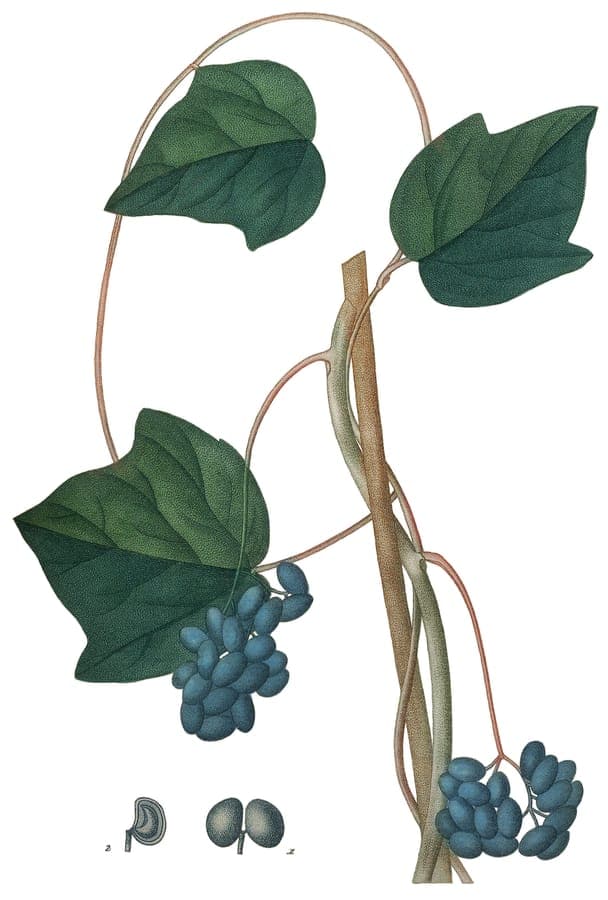
Jaume Saint-Hilaire, Jean Henri,1772-1845. / Public domain, via Wikimedia Commons
Yellow parilla: complete guide
Menispermum canadense
Want to see Yellow parilla: complete guide in your garden?
1 minute, no credit card
Overview
Yellow parilla (Menispermum canadense) is an elegant wild climbing plant from North America. This plant is known by various names including moonseed or Canadian moonseed. It is a unique plant primarily cultivated for its decorative fruits rather than edibility.
Appearance and growth
Yellow parilla is a vigorous climbing vine that winds itself around support structures with serpentine tendrils. The plant easily reaches lengths of 10-16 feet and can grow even larger. The stems are green and smooth initially, becoming slightly more woody later.
The leaves are large, round to kidney-shaped and green, often 4-8 inches in diameter. They provide a tropical effect in the garden despite the plant's hardiness. In autumn, they turn yellow before dropping.
The flowers are small, yellowish and inconspicuous, appearing in summer. After flowering, small dark blue to black round fruits form with a single moon-shaped pit - hence the name moonseed.
Ideal location
Yellow parilla grows well in partial shade to full shade. Unlike many climbing plants, this plant actually thrives in shadier conditions. This makes it excellent for difficult shaded spots.
The plant can tolerate full sun as well, but the foliage may become less dense. Choose a location where you can grow the plant against a wall, fence, or pergola.
Soil
Yellow parilla makes moderate soil demands. A nutrient-rich, humus-rich soil is best, but the plant grows even on less ideal soils. Ensure good drainage above all.
You can add some compost when planting for better establishment. After that, nutrient regulation is usually unnecessary as the plant is fairly self-sufficient.
The pH can range between 5.0 and 7.5.
Watering
During the first season after planting, you must water regularly. After that, the plant is quite drought-tolerant and independently takes up water via deep roots.
Ensure the soil doesn't dry out in hot summers, especially not in the first year. Once well-rooted (after 2-3 years), extra water is only needed during prolonged drought.
Avoid waterlogging around the roots.
Free design
Want to see Yellow parilla: complete guide in your garden? Make a free design now.
Support and training
Yellow parilla needs support to grow optimally. Provide a sturdy framework such as a wooden trellis, metal fence, or pergola.
The plant winds itself around support wires and posts. Check regularly that the plant is not wrapped too tightly around the structure, which can cause damage.
If you want a specific shape, you can gently bend branches in the right direction and hold them in place temporarily.
Pruning
Yellow parilla grows quickly and can be pruned annually. The best time to prune is in early spring, March-April, before new growth begins.
Cut the plant back to about half its size if it grows too wild. Remove all dead and damaged branches. The plant responds well to severe pruning.
Each year you can also remove older branches to make room for young, vital growth.
Maintenance calendar
March-April: Severe pruning cycle. Cut back to half size.
May-June: Water regularly. New growth appears.
July-August: Full growth. Flower formation.
September-October: Fruit setting. Beautiful blue berries.
November-February: Dormancy period. Minimal maintenance.
Winter hardiness
Yellow parilla is very winter hardy and grows wild from Canada into the US. The plant tolerates frost of -22 degrees Fahrenheit or even more severe.
Young plants may need some protection against extreme freezing in their first year. Applying mulch around the base helps.
Companion plants
Yellow parilla combines well with other shade-loving climbing plants such as Hedera (ivy) or wild grape. Together they can form impressive, airy walls.
Underneath, you can place shade-loving ground covers such as Vinca minor.
Closing
Yellow parilla is a surprisingly beautiful climbing plant for shaded corners of your front yard. With minimal maintenance, this plant grows for years and provides beautiful foliage and berries. For more plant ideas and a personalized front yard design, visit gardenworld.app. Get inspired and discover how gardenworld.app realizes your dream landscape.
Want to see Yellow parilla: complete guide in your garden? Make a free design now.
Upload a photo, pick a style, and get a photorealistic design with plant list in under a minute.
No credit card required


Similar plants
Acer pycnanthum: complete guide
Acer pycnanthum
Acer pycnanthum, the Japanese swamp maple, is a fast-growing tree with early red flowers and brilliant autumn color, ideal for damp garden settings.
Freeman maple: complete guide
Acer × freemanii
Everything about the Freeman maple (Acer x freemanii): a fast-growing shade tree with spectacular autumn colour for large gardens.
Silver vine: complete guide
Actinidia polygama
Discover silver vine (Actinidia polygama): a hardy climbing plant with silvery foliage, loved by gardeners and cats alike.