
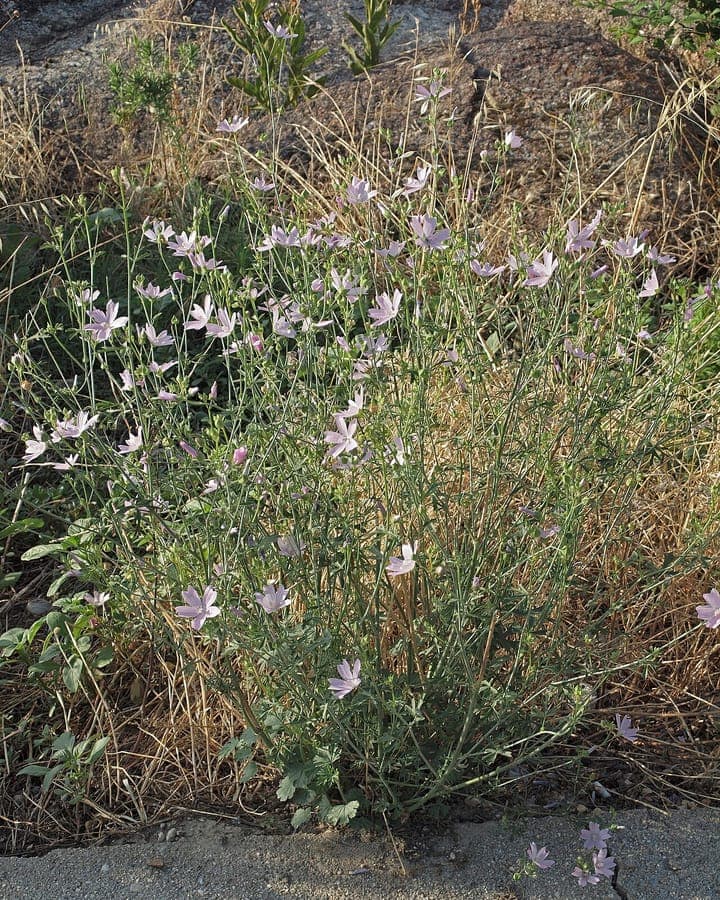
Luis Fernández García / CC BY-SA 3.0, via Wikimedia Commons
Tournefort's mallow: complete guide
Malva tournefortiana
Want to see Tournefort's mallow: complete guide in your garden?
1 minute, no credit card
Overview
Tournefort's mallow (Malva tournefortiana L.) is a little-known yet graceful perennial from the mallow family (Malvaceae). It was described by Linnaeus in 1755 and bears the name of French botanist Joseph Pitton de Tournefort, one of the founding figures of modern plant taxonomy. Its native range is restricted to south-western Europe - principally Spain, Portugal and France - and northern Morocco. In northern and central Europe this species remains rare in cultivation, but it deserves far wider attention from gardeners who value drought-tolerant, pollinator-friendly plants.
The species is related to the more familiar common mallow (Malva sylvestris) and musk mallow (Malva moschata), but distinguishes itself through more finely divided leaves and a slightly more compact habit. It draws bees, bumblebees and butterflies and contributes directly to the biodiversity of any garden. On gardenworld.app you will find Mediterranean garden design ideas that suit this plant beautifully.
Appearance and bloom cycle
Tournefort's mallow grows as an upright, multi-stemmed plant reaching 40 to 80 cm in height. The stems are lightly hairy and branched, giving the plant an open, airy structure. The leaves are dark green, palmately lobed with five to seven fingers bearing toothed margins. Compared with Malva sylvestris, the lobes are more deeply cut and narrower, lending the foliage a more elegant appearance.
Flowers appear from June through September. They are purple-pink, five-petalled and measure 2 to 3 cm across. Like all mallows, the petals carry faint darker veining that guides insects toward the pollen. After flowering, the plant produces flat, disc-shaped fruits - the characteristic "cheeses" that give the mallow family its English vernacular name. These rounded nutlets are perfectly symmetrical and resemble small wheels.
The plant blooms most freely in its second and third year. As a biennial or short-lived perennial it self-seeds readily, ensuring a constant supply of young plants in the garden year after year.
Ideal location
Tournefort's mallow thrives in a sunny to lightly shaded position. In its native habitats it favours open, warm situations: steep slopes, roadsides and rocky ground in the Mediterranean region. In the garden this translates to a preference for a hot, sunny border against a south-facing wall or fence, a gravel garden, or a dry Mediterranean-style planting.
At least four to five hours of direct sunlight per day are needed for good flowering. In too much shade the plant becomes lax and straggly with few flowers. A sheltered position - protected from cold easterly winds in spring - promotes earlier flowering and a more robust habit.
For a low-maintenance front garden, Tournefort's mallow pairs exceptionally well with lavender, rock roses and salvias. Visit gardenworld.app for garden design inspiration showing how to create cohesive Mediterranean plantings with this species.
Soil
This species is undemanding but has clear preferences. In nature it grows on calcareous to slightly acidic soils (pH 7.5 to 8.0) with moderately high nutrient levels. A moderately fertile, free-draining soil is ideal. Heavy, waterlogged clay is poorly tolerated: the roots rot quickly when water lingers at the root zone.
In terms of texture, the plant performs well on sandy loam, loamy sand or light clay, provided drainage is adequate. On heavier soils it is worth incorporating grit or coarse sand to improve permeability. On poor soils foliage may be less lush, but flowers are often more intensely coloured.
Adding compost at planting time encourages establishment and improves moisture retention during dry spells. Avoid nitrogen-heavy fertilisers: these promote leafy growth at the expense of flowering.
Watering
Once established, Tournefort's mallow is a drought-tolerant plant that needs little supplementary water. In the Mediterranean it survives hot, dry summers thanks to its deep taproot. In the cooler, wetter climate of north-western Europe, regular watering during the first summer after planting is advisable to help the plant develop its root system.
In dry summers - June through August - the plant benefits from weekly deep watering. Avoid frequent, shallow watering: this encourages shallow roots and increases vulnerability to drought. Water early in the morning, directing water at the base of the plant rather than over the foliage, to reduce the risk of fungal disease.
In wet years supplementary watering is rarely necessary. Check whether the top 5 cm of soil has dried out before watering. Waterlogging is more dangerous to this plant than drought.
Free design
Want to see Tournefort's mallow: complete guide in your garden? Make a free design now.
Pruning
Pruning requirements for Tournefort's mallow are minimal but meaningfully extend its lifespan and flowering performance. The most important intervention is the removal of spent flower stems. This prompts the plant to produce new flowering branches and extends the display from June through to September.
Cut spent stems back to a side shoot or node. Never remove more than a third of the plant at one time, as this risks weakening its vigour. After the first flush of flowers in July you can cut stems back by half - this typically triggers a second, somewhat less exuberant but still rewarding flush in August and September.
In autumn, once frost has blackened the foliage, cut the plant back to a few centimetres above ground. This prevents hollow stems from harbouring overwintering pests. As a short-lived perennial, however, it pays to leave some seed heads intact: this ensures natural self-seeding and a fresh supply of young plants the following year.
Maintenance calendar
January-February: The plant is dormant. Check whether self-seeded rosettes have survived the winter. Remove dead material if required.
March-April: Young rosettes resume growth. Thin excess self-sown plants to 40-50 cm apart. Apply a light dressing of compost around established plants.
May: Stems elongate rapidly. Stake taller specimens in exposed positions. Water well during warm, dry spells.
June-July: Peak flowering. Remove spent blooms regularly. Check for rust fungus or aphid colonies.
August-September: Second flush of flowers follows a midsummer cut-back. The plant may carry early seed capsules alongside new flowers.
October-November: Flowering ends. Allow some seed heads to mature for natural dispersal. Cut remaining stems back.
December: Frost period. Young rosettes tolerate light frost but are sensitive to prolonged wet cold.
Winter hardiness
Tournefort's mallow is moderately frost-tolerant, surviving temperatures down to around -5 to -8 degrees Celsius. It is sensitive to prolonged wet cold, which is the characteristic condition of north-western European winters. It falls in USDA hardiness zones 7 to 8.
In milder coastal regions of western Europe the plant survives most winters as a perennial. In areas with harder frosts it behaves more like a biennial or annual, dying back but self-seeding prolifically so that young plants always fill the gap.
For extra protection, mulch the root zone in autumn with a 10 cm layer of straw, wood chip or leaf compost. Remove this mulch gradually in March to avoid rotting the crown. A sheltered position against a south-facing wall provides useful additional warmth in cold winters.
Companion plants
Tournefort's mallow combines beautifully with other Mediterranean and drought-tolerant perennials. A classic combination is with lavender (Lavandula angustifolia), whose blue flowers contrast well with the mallow's purple-pink. Cistus and salvia (Salvia nemorosa and relatives) also make excellent summer companions.
For a more naturalistic, meadow-style planting, combine Tournefort's mallow with wild carrot (Daucus carota), greater knapweed (Centaurea scabiosa), oxeye daisy (Leucanthemum vulgare) and field scabious (Knautia arvensis). All these species share similar growing requirements and attract a wide variety of beneficial insects.
In a gravel or dry garden the plant works well alongside stipa grasses, ice plants (Delosperma sp.) and stachys. Avoid pairing it with moisture-loving plants such as hostas and astilbes, whose water requirements are incompatible.
Closing thoughts
Tournefort's mallow is an underappreciated gem that deserves a far higher profile in gardens across northern Europe. Its purple flowers, appearing from June to September, its drought tolerance and its value to pollinators make it an ideal plant for the modern, low-maintenance garden. It asks little in return for a long season of colour and a steady stream of visiting insects.
Whether you are planting a Mediterranean front garden, a wildflower border or a gravel garden, Tournefort's mallow fits perfectly into the picture. Look for it at specialist garden centres or grow it easily from seed collected in autumn. Use gardenworld.app to explore garden designs and planting combinations that show this handsome species at its best.
Want to see Tournefort's mallow: complete guide in your garden? Make a free design now.
Upload a photo, pick a style, and get a photorealistic design with plant list in under a minute.
10,000+ gardens designed already
No credit card required


Similar plants
Malva moschata: complete guide
Malva moschata
Musk mallow: European perennial with pink or white flowers May-September, reaching 45-75 cm tall. Self-seeding, pollinator magnet, tolerates part shade well.
Malva sylvestris: complete guide
Malva sylvestris
Malva sylvestris: Common mallow with magenta blooms and dark purple veins. Versatile, hardy, easy-growing. European classic.