
MichaelMaggs / CC BY-SA 2.5, via Wikimedia Commons
Japanese crab apple: complete guide
Malus × floribunda
Want to see Japanese crab apple: complete guide in your garden?
1 minute, no credit card
Overview
Malus × floribunda, commonly known as the Japanese crab apple or Japanese flowering crabapple, is one of the most spectacular ornamental trees available to gardeners in the temperate world. A member of the Rosaceae family, this hybrid was first described scientifically in 1865 by Siebold and Van Houtte and has since become a fixture of parks, large gardens, and avenues across Europe and North America. Its origin lies in Korea, where wild parent species of the Malus genus were first cultivated and subsequently brought to European and American collections during the nineteenth century.
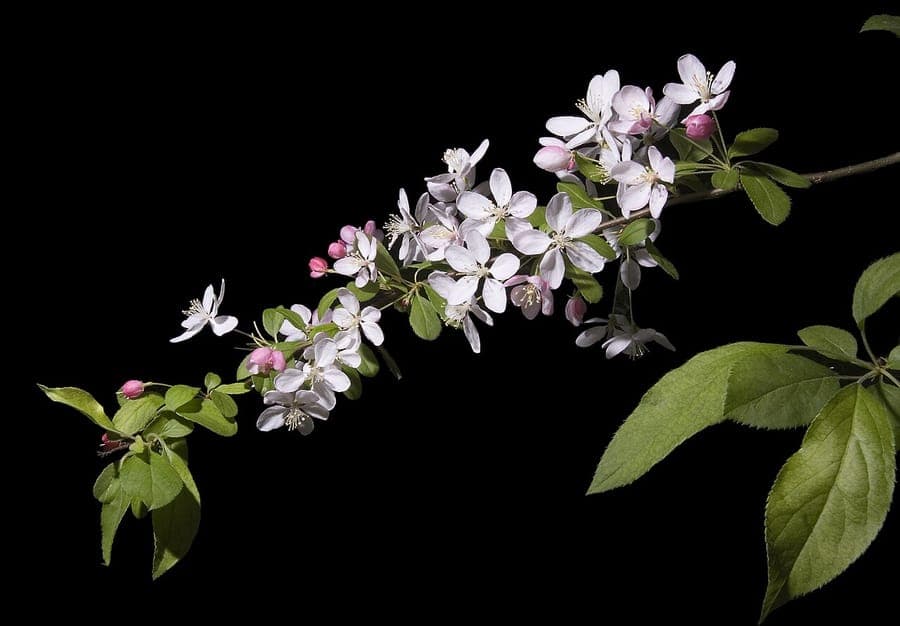
The tree's crowning achievement is its annual spring blossom display. In April and May, the branches become so densely covered with flowers that the structure beneath is almost invisible. The buds open deep crimson to carmine-red, then transition through rich pink to soft blush-white as they fully expand. Because buds, half-open flowers, and fully open blooms coexist on the tree simultaneously, the overall effect is a breathtaking blend of pink shades that shifts daily over the two to three week flowering period. The flowers are typically single, sometimes semi-double, and are carried in clusters along the length of every branch. For gardeners planning a planting scheme that showcases this tree to its full potential, gardenworld.app offers personalised garden design tools that visualise the tree alongside companion plantings.
Beyond the flowers, Malus × floribunda offers multi-season interest. The arching branch structure is ornamentally elegant in winter, the small rounded fruits - 6–8 mm across, yellow turning to orange and red - provide autumn colour and are eagerly eaten by birds, and the autumn foliage turns yellow to orange before leaf fall. The tree typically reaches 4–6 metres in height with a broad, arching crown of 4–8 metres in spread, making it a medium-sized tree well suited to gardens of moderate size.
Appearance and bloom cycle
The flowering period of Malus × floribunda runs from April into early May in most of northern Europe, though in mild springs flowering can begin in late March. The display lasts two to three weeks under cool conditions; warm spells can compress this to under a week. The colour transformation from deep crimson buds to pale pink-white open flowers is one of the most admired qualities of this tree and distinguishes it from many other crab apples.
The leaves are oval to elliptic, 4–8 cm long, dark green and smooth above, paler beneath. The autumn colouring is a pleasing yellow to orange, though not as dramatic as some ornamental cherries or maples. The bark on mature trees becomes gnarled and picturesque, adding winter interest. The overall branching habit is distinctly arching and spreading, giving the tree a graceful, slightly weeping character that is particularly noticeable when the branches are laden with blossom or fruit.
The fruits that follow flowering are small - just 6–8 mm in diameter - and ripen from green through yellow to orange-red by September and October. They are far too astringent for human consumption but are highly attractive to thrushes, starlings, waxwings, and other fruit-eating birds, often persisting on the tree well into December if not taken earlier. This makes Malus × floribunda a particularly valuable tree for wildlife-friendly gardens.
Ideal location
Malus × floribunda thrives in a sunny to lightly partially shaded position. Full sun produces the most abundant flowering and the most vivid autumn fruit colouring. Shade reduces flower bud formation and increases susceptibility to powdery mildew and apple scab. The tree tolerates moderate exposure to wind reasonably well, though excessively windswept sites are best avoided, as blossom is stripped rapidly in strong spring winds.
In garden design terms, this tree works well as a specimen on a lawn, as part of a mixed border of ornamental trees and shrubs, or planted in small groups of three where space allows. For smaller gardens, the slightly more compact growing cultivars such as 'Radiant' or 'Profusion' offer a more manageable size while retaining the ornamental qualities of the species. Allow a clear space of at least 5–6 metres in all directions around the planting position to accommodate the eventual spread. In group plantings, space trees 6–8 metres apart.
The species is rated for USDA hardiness zones 4–8, tolerating minimum winter temperatures of approximately -35 degrees Celsius. Frost damage in British, Dutch, or Belgian winters is virtually unknown, though late spring frosts after bud-break can occasionally damage emerging flower buds and reduce the blossom display in affected years.
Soil requirements
Malus × floribunda is adaptable in terms of soil type but achieves its best performance in slightly acidic to neutral, well-drained yet moisture-retentive soil. The acceptable pH range is 5.0–7.5. Heavy clay soils are workable provided they do not remain waterlogged in winter; prolonged saturation around the roots encourages root rots. Sandy soils are also acceptable but require organic matter additions to retain adequate moisture.
At planting time, excavate a hole at least 60 × 60 cm and 50 cm deep. Mix the backfill with garden compost in a ratio of one part compost to three parts soil. On heavy clay, add a thin layer of coarse grit at the base of the hole to improve drainage immediately around the rootball. Water the tree in thoroughly after planting and apply a mulch ring of 8–10 cm depth - bark chippings, wood chip, or leaf mould - extending to the drip line but leaving a 10 cm gap around the base of the stem to prevent collar rot.
An annual top-dressing of slow-release organic fertiliser in early spring - a balanced rose or fruit tree fertiliser applied according to the manufacturer's instructions - supports strong blossom development and overall tree health. Avoid high-nitrogen feeds, which encourage leafy growth at the expense of flower bud formation.
Free design
Want to see Japanese crab apple: complete guide in your garden? Make a free design now.
Watering
In the first year after planting, consistent watering is essential to encourage root establishment. Apply 15–20 litres per week during dry spells in the first growing season, increasing to twice weekly during hot, dry conditions. Young trees do not yet have the deep root system needed to access subsoil moisture independently. From the second or third year onward, an established tree is largely self-sufficient on most garden soils, though supplementary watering during prolonged summer droughts improves blossom quality the following spring.
Mature specimens tolerate moderate drought reasonably well for short periods, but extended dry spells in summer can cause premature leaf drop and noticeably reduced flowering the following year. In such conditions, apply 20–30 litres directly to the root zone once a fortnight, ideally in the evening or early morning. Shallow, frequent watering that wets only the upper soil layer is less effective than infrequent deep irrigation that penetrates to 30–40 cm depth.
The mulch ring plays a significant role in moisture retention: it slows evaporation from the soil surface, keeps the root zone cooler in summer, and suppresses competing weeds. Refresh the mulch layer each spring by lightly forking the old material and topping up with fresh bark to maintain a depth of 8 cm.
Pruning and shaping
Cutting Malus × floribunda correctly is important for maintaining a healthy, well-shaped tree that produces abundant blossom year after year. The tree flowers on one-year-old wood and on short flowering spurs on older branches. This means that hard cutting-back disrupts the flowering cycle and should be avoided. The goal of pruning is not to reduce the tree in size but to maintain an open, well-aired crown free of dead, diseased, crossing, and poorly placed wood.
The best time to prune is immediately after flowering in May or in early June. This gives the tree the remainder of the growing season to produce the new wood that will carry next year's flower buds. Begin by removing all dead wood, cutting back to healthy tissue. Next, remove any branches that grow into the centre of the crown or cross other branches. Aim for an open, airy canopy that allows good air circulation - this is the single most effective cultural measure for reducing the incidence of fungal diseases including apple scab and powdery mildew.
On young trees in the first three to five years, light formative pruning can be used to establish the desired crown shape. Mature trees generally need only light maintenance pruning to remove problem wood. Hard cutting-back, lopping of large branches, or severe crown reduction is inadvisable: it produces unnatural, vigorous regrowth that is more susceptible to disease and disrupts flowering for several seasons.
Maintenance calendar
January–February: Inspect for dead and storm-damaged wood. Remove any large dead branches promptly for safety. Note any signs of canker (Neonectria) and plan to address these after the main growing season.
March–April: Apply annual fertiliser before blossom opens. The gardenworld.app design planner is a useful tool for deciding which spring bulbs and early perennials to plant beneath the tree to complement the blossom display.
April–May: The main blossom season. Enjoy the display. Note any disease symptoms - spots on leaves, powdery coating - for treatment after flowering.
May–June: Prune after flowering. Remove dead, diseased, and crossing wood. Refresh the mulch ring.
July–August: Monitor for apple scab (Venturia inaequalis) and powdery mildew (Podosphaera leucotricha). Treat with a permitted fungicide if necessary.
September–October: Fruits ripen. Birds will remove most of them naturally. Rake up fallen fruits from the ground to reduce overwintering fungal spores.
November–December: Dormancy. Hold major pruning until after next year's flowering. Inspect the crown for structural issues and plan accordingly.
Winter hardiness
Malus × floribunda is fully reliable in the winter climate of western and northern Europe. The species tolerates minimum temperatures of approximately -35 degrees Celsius without structural damage. Late spring frosts after bud-break represent a greater risk than winter cold: a sharp frost of -3 to -5 degrees Celsius when the flower buds are fully swollen or just opening can destroy the blossom in affected years, leaving the tree leafless but with no flowers. This is not harmful to the tree's long-term health and normal flowering resumes the following year.
Young trees in their first two winters benefit from a mulch ring of 15 cm depth to protect the root zone. No stem wrapping or burlap protection is necessary for established trees in typical garden conditions. In areas with heavy snowfall, the broad arching crown can collect substantial snow loads: gently brush off heavy accumulations with a padded pole to prevent branch breakage, but avoid bruising the flower buds.
Stems are susceptible to frost cracking (bark splitting caused by rapid temperature fluctuations in late winter and early spring) in exposed positions. This is largely a cosmetic issue and most trees seal the cracks naturally, though severely affected bark may provide an entry point for canker fungi. A sheltered position and proper soil management largely prevent this.
Companion plants
The Japanese crab apple serves as a magnificent floral backdrop for a wide range of underplanting and border companions. In spring, a carpet of blue Scilla siberica, grape hyacinths (Muscari armeniacum), or white Narcissus 'Thalia' planted beneath the tree creates a classic combination: pink blossom above, blue or white flowers below. This combination is one of the most admired set-pieces of the spring garden.
For summer and autumn interest beneath the crown, shade-tolerant perennials such as Geranium × cantabrigiense 'Biokovo', Alchemilla mollis, and Heuchera 'Palace Purple' provide ground cover and textural variety without competing aggressively with the tree's roots. Rosa cultivars that share the same soil pH preference - particularly the robust Kordes shrub roses such as 'Dolomiti' or 'The Fairy' - work beautifully as neighbouring shrubs that extend the flowering season from late spring into autumn.
In larger landscape compositions, pairing Malus × floribunda with Prunus 'Accolade', Amelanchier lamarckii, and Magnolia stellata creates an extraordinary spring flowering sequence that runs from March through to May, with the crab apple providing the centrepiece of the display in April.
Want to see Japanese crab apple: complete guide in your garden? Make a free design now.
Upload a photo, pick a style, and get a photorealistic design with plant list in under a minute.
10,000+ gardens designed already
No credit card required


Similar plants
Siberian crab apple: complete guide
Malus x robusta
Complete guide to the Siberian crab apple (Malus x robusta): location, soil, pruning, winter hardiness and the best companion plants for your garden.
Chinese flowering crabapple (Malus x spectabilis): complete guide
Malus x spectabilis
Meet the Chinese flowering crabapple (Malus x spectabilis): a classic spring bloomer with carmine buds and pink blossom.
Potentilla crassinervia: complete guide
Potentilla crassinervia
Potentilla crassinervia, the Corsican cinquefoil, grows wild on Corsica and Sardinia's peaks. Discover how to grow this hardy alpine rock garden gem.