
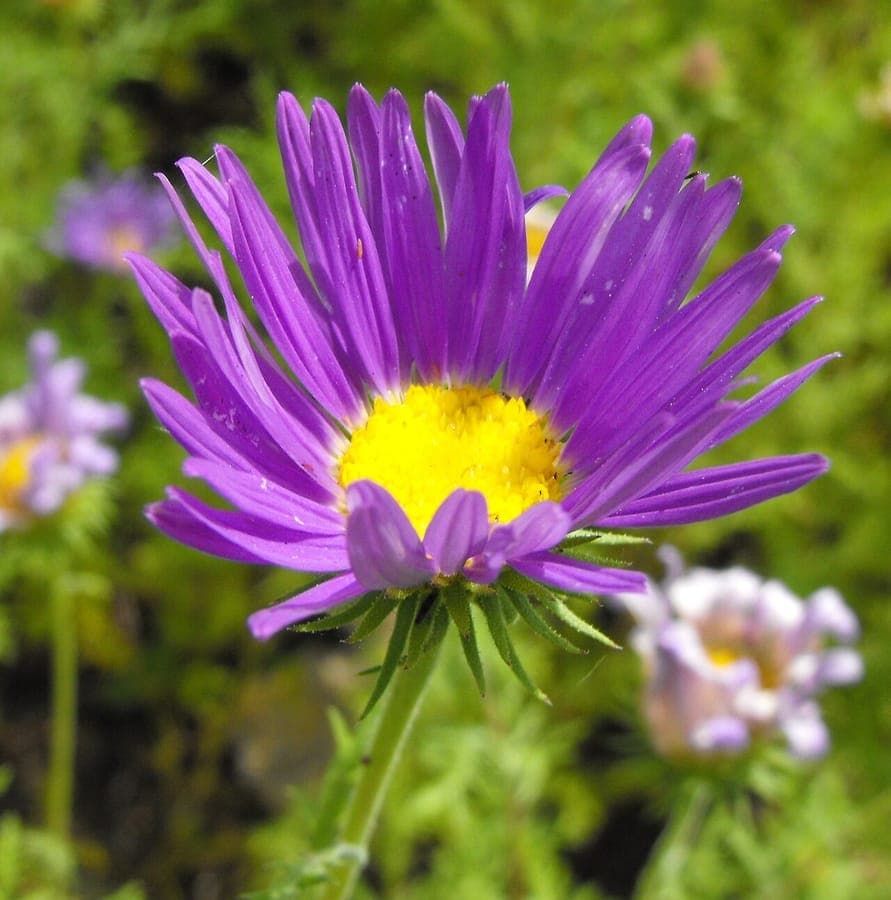
Stickpen / Public domain, via Wikimedia Commons
Tansy-aster: complete guide
Machaeranthera tanacetifolia
Want to see Tansy-aster: complete guide in your garden?
1 minute, no credit card
Overview
Tansy-aster (Machaeranthera tanacetifolia) is a fast-growing annual to biennial herb in the daisy family (Asteraceae), native to western North America from Alberta, Canada, south through the Great Plains and Rocky Mountain states to northern Mexico. Its range includes Colorado, Utah, Nevada, New Mexico, Texas, Wyoming, Montana, and South Dakota. In its natural habitat, it colonizes dry open plains, shortgrass prairies, disturbed roadsides, and rocky slopes, often at elevations from sea level to over 2,000 metres.
The species is also widely known as Tahoka daisy, a name derived from the town of Tahoka in west Texas, where the plant grows abundantly. The genus name Machaeranthera refers to the sword-shaped appendages on the anthers (from the Greek machaira, meaning sword or dagger). The species name tanacetifolia describes leaves resembling those of tansy (Tanacetum), both having deeply pinnately divided blades with spiny lobes.
In garden cultivation, tansy-aster is valued for its profuse display of purple-blue daisy flowers with bright yellow centres, produced over a long season from July through October. It is one of the best-performing annual wildflowers for hot, dry, sunny sites, thriving in conditions where many ornamental plants fail. Its rapid growth rate means it can flower in its first year from seed sown in late winter, making it a rewarding choice for quick summer colour in prairie-style plantings, gravel gardens, and wildlife borders.
The flowers attract a wide range of pollinators including native bees, bumblebees, small butterflies, and hoverflies. The plant also has value as a late-season nectar source when many early summer flowers have finished. Explore drought-tolerant planting combinations featuring tansy-aster at gardenworld.app.
Appearance & bloom cycle
Machaeranthera tanacetifolia grows 20-60 cm tall and 30-50 cm wide, with an erect, freely branching habit that gives the plant an airy, shrubby appearance. As an annual from early-sown seed, plants reach 30-50 cm. As a biennial, first-year rosettes are low and compact; second-year plants grow taller and bushier, often reaching 50-60 cm.
The leaves are the most distinctive vegetative feature: deeply pinnately lobed with spiny-tipped segments, closely resembling tansy (Tanacetum vulgare) leaves. They are dark green, lightly hairy, medium-textured, and aromatic when crushed. The branching stems are also softly hairy.
Flowering runs from July through October, peaking in August and September. The flower heads are 3-5 cm across and numerous - a well-grown plant may carry dozens simultaneously. Each head has a ring of purple to blue-violet ray florets (occasionally more pink or lilac) surrounding a tight disc of yellow tubular florets. This bold two-tone combination of purple-blue and yellow is the plant's signature ornamental feature.
After flowering, small achenes with feathery pappus develop and disperse on the wind. Under favorable conditions, the plant self-seeds freely, establishing recurring colonies in gravel or dry garden beds without annual replanting.
Ideal location
Tansy-aster demands a site in full sun - at least six to eight hours of direct sunlight per day. It is adapted to the unshaded, intense sun of western North American prairies and semi-deserts and performs poorly with less light: plants in partial shade grow tall and floppy with sparse flowering. An open, south- or west-facing aspect is ideal in temperate European climates.
Excellent garden placements include: hot dry borders, gravel gardens, prairie-style perennial beds, rock gardens, raised beds with gritty compost, and large containers. The species is particularly well suited to dry garden schemes where summer irrigation is minimal or absent. It also makes an excellent annual filler in established perennial borders, adding late-season colour from August onward.
In temperate northwest European climates - the Netherlands, Belgium, northern France, Germany - tansy-aster is most reliably grown as a hardy annual, sown each spring. In milder regions (southern France, southern Germany), it may overwinter as a biennial rosette. Spacing of 25-35 cm allows good air circulation and prevents the lodging that can occur if plants are crowded.
Soil requirements
Tansy-aster thrives in well-drained, dry to moderately moist soil. It is adapted to poor to moderately fertile substrates and strongly prefers neutral to mildly alkaline conditions, with an ideal pH of 6.5-8.5. This makes it one of the rare ornamental plants that genuinely performs well on thin, calcareous soils that challenge most garden plants.
Free drainage is the single most important soil requirement. The species cannot tolerate waterlogged or poorly drained soil; wet roots, especially combined with cool temperatures, quickly cause root rot and plant death. On heavy clay soils, improve drainage by incorporating generous amounts of coarse grit or fine gravel (30-40% by volume) before planting. Raised beds or berms with gritty compost are an excellent solution on naturally wet ground.
On sandy or gravelly soils, little or no soil amendment is needed. A top-dressing of fine gravel or grit (5-8 cm deep) helps keep the crown dry and reflects heat upward, which the plant appreciates. Avoid rich, moisture-retentive composts and heavy fertilizer applications - these promote lush vegetative growth at the expense of flowers, and make plants floppy.
Acid, boggy or peat-rich soils are entirely unsuitable. If your garden soil has a pH below 6.0, adjust by working in garden lime at the rate recommended on the packaging (typically 100-200 g per square metre) several weeks before planting.
Free design
Want to see Tansy-aster: complete guide in your garden? Make a free design now.
Watering
Once established, tansy-aster is exceptionally drought tolerant. Native to dry prairies and semi-arid regions, it survives extended dry periods with minimal water. In a typical northwest European summer with occasional rainfall, established plants rarely need supplementary irrigation after the first month or two.
During germination and the first four to six weeks after sowing, keep the seed bed or plug trays evenly moist to support establishment. Water every two to three days with a gentle rose watering can or fine spray. Once seedlings are 10-15 cm tall and actively growing, reduce watering frequency to once per week or less.
Counterintuitively, a degree of drought stress during the flowering period (July-October) actually improves performance: plants stay compact, develop more flower buds, and the display is longer-lasting. Overwatering at this stage causes excessive vegetative growth, fewer flowers, and increased risk of fungal stem and root problems. In unusually prolonged dry spells - more than three weeks without rain - a single thorough watering per week is sufficient.
Never allow standing water around the crown or in the root zone. Good drainage is non-negotiable. In containers, ensure drainage holes are clear and avoid saucers that collect water beneath pots.
Pruning
Tansy-aster requires minimal maintenance pruning. When young plants reach 15-20 cm, pinching out the growing tips encourages a more branched, bushy habit with more flowering stems. Nip out the top 5-8 cm of each main stem; this is especially worthwhile for plants intended for prominent display positions.
During the blooming season, deadheading spent flower heads prolongs the display by preventing energy going into seed production. If you want the plant to self-seed for future seasons, allow some heads to ripen fully before removing them. In windy or exposed positions, light staking with slim bamboo canes may prevent the branching stems from lodging.
At the end of the season, cut down or pull out annual specimens after hard frosts have ended flowering, typically in October or November. If biennial rosettes have survived the winter, leave them intact until spring; remove any frost-damaged outer leaves but do not cut the growing crown. New growth emerges from the centre of the rosette in early spring.
Maintenance calendar
February-March: Sow seed indoors on a windowsill or heated propagator at 15-20 degrees C. Press seed onto the surface of moist seed compost; germination takes 7-14 days. Sow in modular trays for easy transplanting.
April-May: Pot on seedlings when large enough to handle. Harden off outdoors from mid-April. Plant out after last frost at 25-35 cm spacing. Pinch tips at 15-20 cm for a compact bushy plant.
June: Active vegetative growth. Water only during dry spells. Minimal pest or disease issues at this stage.
July-October: Flowering season. Enjoy the purple-blue daisy display. Deadhead for longer blooming or allow seed to ripen for self-seeding.
October-November: Flowering ends after hard frosts. Remove and compost annual plants. Leave some seed heads standing for self-seeding or as food for birds.
December-February: No active care needed. Biennial rosettes may overwinter in mild conditions.
Winter hardiness
Machaeranthera tanacetifolia is an annual to biennial species, not a traditional hardy perennial. As an annual - which is the most reliable approach in temperate European climates - the plant completes its lifecycle in one season and is resown each year. Winter hardiness in the perennial sense does not apply.
As a biennial, first-year rosettes can survive mild winters in USDA zones 6-8 (minimum temperatures around -20 to -12 degrees C), particularly when grown in well-drained, dry conditions. In the Netherlands, Belgium, northern Germany, and northern France, overwinter survival of rosettes is possible in mild winters but not guaranteed during hard winters with extended periods below -10 degrees C.
In USDA zones 8-10 (southern France, Mediterranean regions), tansy-aster overwinters more reliably as a biennial. For cold-climate gardens, the simplest and most dependable approach is to treat it as an annual and start fresh from seed each spring - the fast growth rate means plants can flower within 10-12 weeks of sowing.
Container-grown plants can be overwintered in a cool, frost-free greenhouse or unheated conservatory. Keep plants barely moist and in good light through winter. Resume normal care when new growth begins in early spring.
Companion plants
Tansy-aster combines beautifully with other drought-tolerant, sun-loving plants in prairie-style and dry garden schemes:
- Echinacea purpurea (purple coneflower): bold pink-purple flowers on 60-90 cm stems, same bloom period. Space 40-50 cm apart.
- Gaillardia x grandiflora (blanket flower): fiery red-yellow blooms from June onward; warm-toned complement to tansy-aster's cool purple-blue. Space 30-40 cm.
- Ratibida columnifera (prairie coneflower): yellow or red-brown blooms above finely divided foliage. Space 30 cm.
- Salvia nemorosa (ornamental sage): purple-blue flower spikes in June-August, compact form. Space 30-40 cm.
- Agastache rupestris (licorice mint): orange-pink flowers on aromatic stems, excellent butterfly plant. Space 40 cm.
- Lavandula angustifolia (lavender): fragrant purple spikes, thrives on dry calcareous soil. Space 40-50 cm.
- Stipa tenuissima (feather grass): airy, fine-textured grass for textural contrast with daisy flowers. Space 30-40 cm.
Avoid pairing with moisture-loving plants such as Lysimachia, Caltha, or Iris pseudacorus - their growing requirements are entirely incompatible.
Conclusion
Tansy-aster is one of the most rewarding annual wildflowers for hot, sunny, dry garden situations. Its long season of vivid purple-blue daisies, rapid growth from seed, drought tolerance, and rich value for pollinators make it an outstanding choice for prairie-style borders, gravel gardens, and any low-maintenance sunny planting scheme. For gardeners looking to reduce irrigation while maintaining colour from midsummer through autumn, this species is highly recommended.
Discover drought-tolerant garden designs and prairie planting inspiration for sunny borders at gardenworld.app, with plant combinations suited to dry, sun-drenched conditions.
Want to see Tansy-aster: complete guide in your garden? Make a free design now.
Upload a photo, pick a style, and get a photorealistic design with plant list in under a minute.
10,000+ gardens designed already
No credit card required


Similar plants
Calendula stellata: complete guide
Calendula stellata
Complete guide to Calendula stellata, the star-flowered marigold from Sicily: location, soil, watering and companion planting tips.
Korean chrysanthemum: complete guide
Chrysanthemum x rubellum
Chrysanthemum x rubellum is a hardy autumn perennial with single pink to copper flowers from August to November. Care and combinations.
Helianthus divaricatus: complete guide
Helianthus divaricatus
Helianthus divaricatus is a North American woodland sunflower with yellow summer blooms, ideal for naturalistic borders and shady edges.