
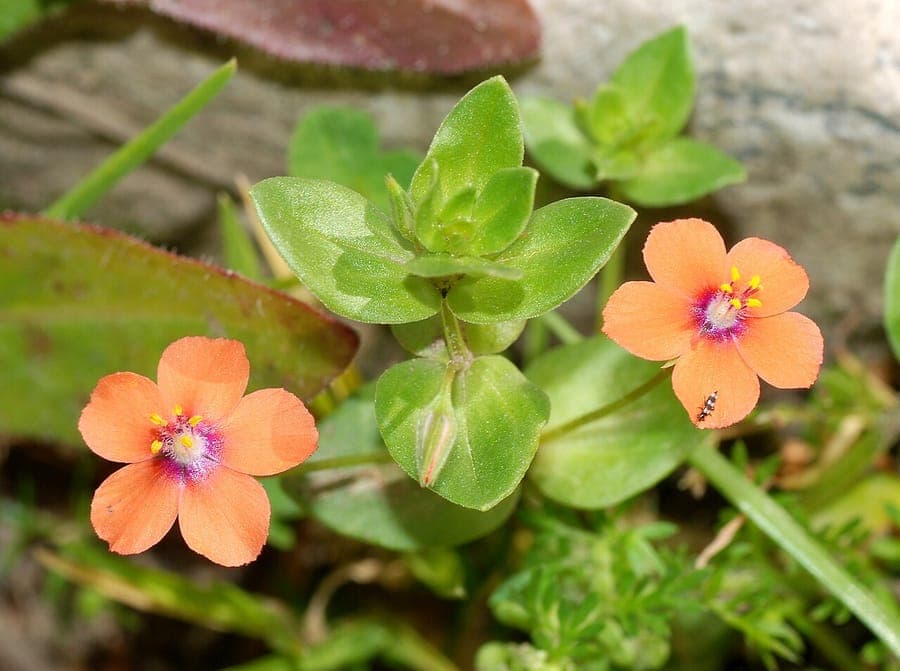
Alvesgaspar / CC BY-SA 3.0, via Wikimedia Commons
Scarlet pimpernel: complete guide
Lysimachia arvensis
Want to see Scarlet pimpernel: complete guide in your garden?
1 minute, no credit card
Overview
Scarlet pimpernel (Lysimachia arvensis, formerly Anagallis arvensis) is one of the most recognisable wildflowers of Europe, Western Asia and North Africa. Its tiny scarlet flowers are famous for opening only when the sun shines and closing at the approach of rain or cloud - a habit that earned the plant its folk names "poor man's weatherglass" and "shepherd's weatherglass" across many European languages.
Belonging to the family Primulaceae, scarlet pimpernel shares its botanical neighbourhood with primroses, cowslips and yellow loosestrife. The species is native across a vast range stretching from Ireland and the Canary Islands through the Middle East to Afghanistan, Pakistan and the western Himalayas. It has also naturalised on every inhabited continent as an agricultural weed and roadside plant.
For the modern gardener, scarlet pimpernel offers charm, ecological value and low-maintenance appeal. On gardenworld.app you can explore planting designs that incorporate scarlet pimpernel alongside complementary wildflowers.
Appearance and bloom cycle
Scarlet pimpernel is a low-growing annual or sometimes biennial herb, rarely exceeding 30 cm in height. Its stems are square in cross-section and tend to sprawl along the ground before curving upward. The leaves are oval to egg-shaped, 5-20 mm long, growing in opposite pairs or in whorls of three. A distinctive feature visible on leaf undersides are small dark dots - oil glands characteristic of many Primulaceae.
The flowers are small but jewel-bright: typically 5-7 mm across, they consist of five rounded petals fringed with minute hairs, ranging in colour from salmon-red and brick-red to vivid scarlet. Blue and pink-flowered forms occur naturally, especially around the Mediterranean. Each flower lasts only one day, but a healthy plant produces dozens of blooms in succession throughout its season.
The main flowering period runs from April through September, peaking in June and July. The flowers open when temperatures rise above about 10 degrees Celsius and the sky is clear, and close firmly at the approach of rain or when light intensity drops. This phototropic response is so reliable that country folk traditionally used it as a weather forecast.
After pollination, small round seed capsules form, each containing dozens of tiny seeds that persist in the soil for several years.
Ideal location
Scarlet pimpernel is a plant of open, sunny places. It requires at least six hours of direct sunlight per day to flower freely. In shade the plant becomes drawn and straggly and may fail to bloom at all.
In the wild it colonises arable fields, roadsides, waste ground, sandy shores, cliff tops and any open, disturbed habitat where competition from taller vegetation is limited. It is a true pioneer species, quick to establish on bare soil.
In the garden, ideal positions include:
- A sunny wildflower meadow or patch
- A gravel garden or stony border
- Gaps in paving or along sunny path edges
- A drought-tolerant flowering bed
- Containers filled with sandy, free-draining compost
The low, spreading habit also makes scarlet pimpernel a useful low-level filler between taller plants in a naturalistic border.
Soil
Scarlet pimpernel is highly adaptable as regards soil. It grows in sand, loam, gravel, stony ground and even thin chalky soils. Poor, nutrient-lean ground is actually preferred: in very rich soil the plant grows rank and leafy but flowers less generously.
The ideal pH range is approximately 6.0 to 7.5. Waterlogged conditions and heavy clay soils are unsuitable - good drainage is the single most important requirement. If your garden soil is compacted and moisture-retentive, improve it by digging in grit or coarse sand before sowing.
For a wildflower patch aimed at attracting scarlet pimpernel and its companions, stripping away the fertile topsoil and replacing it with subsoil or sandy fill will produce much better results than trying to grow these flowers on a well-composted bed.
Watering
Once established, scarlet pimpernel is a drought-tolerant plant that needs very little supplementary watering. In its native range it often grows where summer rainfall is sparse and irregular.
In the garden, natural rainfall is usually sufficient for a settled plant. In prolonged dry spells during summer, a weekly light watering is beneficial, but always allow the soil to dry out between sessions. Waterlogged roots rot quickly and the plant will collapse.
Freshly sown seed and young seedlings need slightly more consistent moisture to germinate and establish. Keep the soil barely damp - not wet - until the first true leaves appear. Once plants are 5-8 cm tall they can manage on their own.
Avoid wetting the foliage when watering; base watering at the root zone reduces the risk of fungal problems.
Free design
Want to see Scarlet pimpernel: complete guide in your garden? Make a free design now.
Pruning
As an annual plant, scarlet pimpernel does not require pruning in the conventional sense. The plant completes its life cycle - germination, growth, flowering, seeding, death - within a single growing season.
If you wish to prevent self-seeding, remove the round seed capsules as they begin to ripen but before they split. Left in place, the capsules open to scatter dozens of seeds that will germinate wherever soil is disturbed the following spring.
For many gardeners, self-seeding is precisely the desired effect: a colony of scarlet pimpernel that maintains itself year after year without replanting. In this case, allow the seeds to fall, ensure the soil around the plant is kept fairly open, and new seedlings will appear reliably the following April.
Cutting the stems back to ground level after flowering stops seed production but the root decomposes to feed soil organisms through the autumn and winter.
Maintenance calendar
January - February: Planning. Identify sunny, open spots where scarlet pimpernel could naturalise. Order seed from a wildflower seed supplier if needed.
March: Sow seed indoors at 15-20 degrees Celsius. Germination takes 2-3 weeks. Alternatively, wait and sow direct outdoors in April.
April: After last frost, transplant indoor-raised seedlings to their final position. Direct outdoor sowing is also effective this month.
May - June: First flowers appear. Very little maintenance required. Remove competing weeds that might shade the low plant.
July - August: Peak flowering. Enjoy the daily show of opening and closing blooms. Remove seed capsules if you want to prevent spread.
September: Flowering tapers off. Leave seed capsules to self-sow for next year's display if desired.
October - November: Plant dies back. Remove dead stems or leave them as minimal winter shelter for insects.
December: Rest period. Plan adjustments for the next season.
Winter hardiness
Scarlet pimpernel is an annual plant and does not overwinter as a living plant. The adult plant dies after its first growing season, but the seeds it leaves behind are remarkably persistent and frost-hardy, remaining viable in the soil for several years.
Germination occurs when soil temperatures rise in spring, typically around 12-15 degrees Celsius. The seeds require no stratification or special treatment - simply ensure they have access to open, lightly disturbed soil and they will germinate reliably.
In USDA terms, the seeds can be successfully overwintered in all zones. In mild climates (zones 8-13) the plant may sometimes survive as a biennial and flower in its second year, or new seedlings may appear in autumn and flower through a mild winter.
In continental northern European climates, scarlet pimpernel behaves reliably as a strict annual, self-seeding from spring onwards each year. Garden centres across the UK and northern Europe carry wildflower seed mixes containing scarlet pimpernel.
Companion plants
Scarlet pimpernel partners naturally with other low-growing, sun-loving wildflowers that share its preference for open, nutrient-poor ground.
Common poppy (Papaver rhoeas): The classic arable companion, sharing the same scarlet colour palette and thriving in the same conditions.
Cornflower (Centaurea cyanus): The blue of cornflower provides a striking contrast to scarlet pimpernel's red.
Chamomile (Matricaria chamomilla): Feathery, aromatic and low-growing; very compatible in a wildflower mix.
Heartsease (Viola tricolor): Cheerful tricoloured blooms that extend the season and attract bumblebees.
Borage (Borago officinalis): Taller but sharing the open, sandy habitat preference; the blue star flowers complement the red of pimpernel.
Chickweed (Stellaria media): A low companion that fills gaps between plants and keeps the soil slightly cooler and moister.
On gardenworld.app, you can design a custom wildflower garden that brings together scarlet pimpernel and its companion species in a thoughtfully planned layout suited to your front or back garden.
Closing
Scarlet pimpernel has accompanied human civilisation across the globe for millennia - following the plough, colonising roadsides and brightening waste ground with its gem-like blooms. Its role as a folk weather oracle, its ancient use in herbal medicine and its presence in European folklore make it a plant with a story far richer than its modest size suggests.
For the contemporary gardener, scarlet pimpernel represents a small but meaningful step towards gardens that support biodiversity, reduce the need for watering and maintenance, and reconnect outdoor spaces with the living heritage of the wild European landscape.
Whether you are creating a wildflower meadow, filling a sunny gravel garden or simply scattering a handful of seed on a bare patch of ground: scarlet pimpernel rewards the effort with weeks of cheerful colour and the daily pleasure of its sun-tracking flowers. Explore planting inspiration at gardenworld.app.
Want to see Scarlet pimpernel: complete guide in your garden? Make a free design now.
Upload a photo, pick a style, and get a photorealistic design with plant list in under a minute.
10,000+ gardens designed already
No credit card required


Similar plants
Creeping Jenny: complete guide
Lysimachia nummularia
Discover everything about creeping Jenny (Lysimachia nummularia): growth, location, moisture needs, care and winter hardiness guide.
Purple loosestrife: complete guide
Lythrum salicaria
Discover Lythrum salicaria, a vigorous waterside plant with dramatic purple-pink flowers. Essential for water gardens, marsh edges, and landscape design on gardenworld.app.