
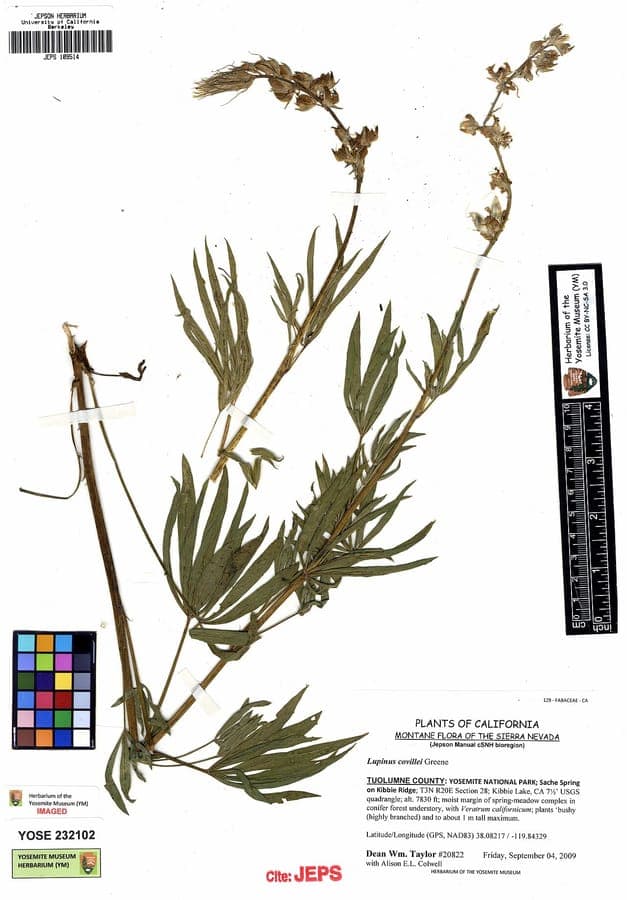
Dean Wm. Taylor / CC BY 2.0, via Wikimedia Commons
Shaggy lupine: complete guide
Lupinus covillei
Want to see Shaggy lupine: complete guide in your garden?
1 minute, no credit card
Overview
The shaggy lupine, Lupinus covillei, is an herbaceous perennial belonging to the legume family Fabaceae. First described in 1893 by the botanist Greene, the species was named in honour of Frederick Vernon Coville, an American botanist who conducted extensive research into the flora of the western United States. Native exclusively to California, this plant grows naturally on open, sun-drenched slopes and mountain trails where competition from surrounding vegetation is limited.
The common name 'shaggy lupine' refers to the dense, soft hairs that cover the stems and leaves, giving the plant its characteristic woolly, rough appearance. Like other lupines, Lupinus covillei forms root nodules in symbiosis with nitrogen-fixing bacteria, which means it actively improves soil fertility wherever it grows. If you are looking for garden design inspiration using wild native plants, gardenworld.app offers a wealth of ideas for naturalistic planting schemes.
Appearance and bloom cycle
Lupinus covillei grows as a multi-stemmed herb, producing several upright stems from a central crown. The stems and both surfaces of the leaves are densely clothed in fine, greyish-white hairs, which gives the entire plant a silvery sheen visible even from a distance. The leaves are palmately compound, typically composed of seven to nine lance-shaped leaflets radiating from a central point - a leaf form shared by most members of the genus Lupinus.
The flowers are a rich blue and are borne in dense, erect racemes. Each individual flower shows the typical pea-family structure: a broad banner petal at the top, two wing petals at the sides, and a keel formed by two fused lower petals. Flowering takes place from late May through July. After the flowers fade, hairy seed pods develop and turn brown when ripe. At maturity the pods split open and fling their seeds away from the parent plant, enabling natural self-seeding in suitable spots.
Ideal location
As a plant from the Mediterranean-climate hills of California, the shaggy lupine thrives in full sun. It requires at least six hours of direct sunlight per day to flower well and maintain a compact, upright habit. In partial shade the plant tends to become leggy and produces fewer flowers. In its native range it grows on open ridges and trailsides where shade is minimal.
In a garden setting, Lupinus covillei works beautifully as a specimen plant in a gravel bed, a dry border, or a California-inspired naturalistic planting. Its silvery foliage contrasts well with yellow or red-flowered companions, and the blue flower spikes create strong vertical interest in a mixed planting. This species is an excellent choice for gardens in regions with dry summers and mild winters.
Soil
Good drainage is the single most important soil requirement for Lupinus covillei. It prefers a pH between 6.5 and 7.0 and performs best in sandy to loamy soils that allow water to drain away quickly after rain. Heavy clay soils that stay wet for extended periods will cause the roots to rot and kill the plant.
If your garden soil is heavy, improve it by working in generous quantities of coarse sand or grit before planting. The soil does not need to be particularly fertile. As a legume, the shaggy lupine fixes its own nitrogen through root nodules, making high-nitrogen fertilisers unnecessary and potentially harmful. A lean, fast-draining substrate mimics the poor soils of its native California mountains and keeps the plant happy. Avoid planting in depressions where water pools after rainfall.
Free design
Want to see Shaggy lupine: complete guide in your garden? Make a free design now.
Watering
Once established, the shaggy lupine is notably drought-tolerant, reflecting the long dry summers of its California homeland. During the first growing season after planting, water moderately to help the root system become established. From the second year onward, rainfall in most of northern Europe is sufficient during the cooler months.
During the growing season in spring and early summer, water sparingly - no more than once a week during prolonged dry spells. Overwatering is a far more common cause of failure than drought stress. After flowering in July, reduce watering significantly or stop altogether. The plant enters a period of summer dormancy and does not need supplemental water. If you use irrigation, always allow the soil to dry out completely between waterings.
Pruning
The shaggy lupine requires very little pruning. After the flowers fade, you can remove the spent flower spikes to tidy the appearance and to prevent excessive self-seeding. If you want the plant to naturalise and spread through a bed, allow some pods to ripen and split before removing them.
In autumn, once the plant has finished growing and the foliage begins to die back, cut the stems down to just above ground level. This keeps the bed tidy and removes any fungal spores or debris that might harbour disease over winter. Alternatively, leave the dry stems standing through winter to provide shelter for overwintering insects and remove them in early spring before new growth begins.
Maintenance calendar
January-February: The plant is dormant. Ensure the site is not waterlogged. March: New shoots begin to emerge from the crown. Remove old stems if not done in autumn. April: Leaves unfurl rapidly. Water lightly if the weather is unusually dry. May: Flowering begins. Admire the blue racemes. June: Peak flowering season. Check gardenworld.app for companion planting ideas. July: Flowers fade. Allow pods to ripen for self-seeding or remove spent spikes. August: Summer rest. Drastically reduce or stop all watering. September-October: Foliage dies back. Cut stems down if desired. November-December: Full dormancy. No special care needed.
Winter hardiness
Lupinus covillei is rated for USDA hardiness zones 8 to 9, reflecting its origin in the mild-winter mountains and foothills of California. In the milder parts of north-west Europe, including coastal areas of the Netherlands, Belgium and the United Kingdom, the plant can survive most winters without protection as long as drainage is excellent.
In colder inland regions where temperatures regularly drop below -10 degrees Celsius, winter protection is advisable. A layer of dry mulch - straw, dry leaves or bark chips - applied over the root zone in November, to a depth of 10 to 15 cm, will help insulate the crown. Remove the mulch in early spring once the risk of hard frost has passed. In very cold climates, treat the plant as an annual or grow it in a container that can be moved to a frost-free space for winter.
Companion plants
The shaggy lupine pairs well with other drought-tolerant sun-lovers. Good companions include:
- Salvia officinalis (common sage): grey-green leaves and purple flowers echo the lupine's silvery tones
- Festuca glauca (blue fescue): rounded tufts provide textural contrast to the lupine's upright spikes
- Achillea millefolium (common yarrow): white or yellow flower heads complement the blue racemes
- Cistus spp. (rock rose): Mediterranean shrubs that share the same preference for dry, poor soils
- Erigeron karvinskianus (Mexican fleabane): small daisy-like flowers that take over after the lupine finishes blooming
Avoid planting alongside moisture-loving plants such as hostas or hydrangeas, which require frequent watering that would be fatal to the shaggy lupine.
Closing
Lupinus covillei is a rewarding plant for gardeners who appreciate wild, botanical species with strong character. Its silvery, hairy foliage and vivid blue flower spikes bring a touch of Californian wilderness into the European garden. Give it excellent drainage, full sun, and lean soil, and it will reward you with reliable flowering year after year. For more native plant inspiration and design ideas, explore the resources available at gardenworld.app.
Want to see Shaggy lupine: complete guide in your garden? Make a free design now.
Upload a photo, pick a style, and get a photorealistic design with plant list in under a minute.
10,000+ gardens designed already
No credit card required


Similar plants
Cusick's lupine: complete guide
Lupinus cusickii
A full guide to Lupinus cusickii, Cusick's lupine from eastern Oregon: site requirements, soil, water, pruning and garden uses.
Elmer's lupine: complete guide
Lupinus elmeri
Everything about Lupinus elmeri, Elmer's lupine from California: site conditions, soil, watering, pruning and garden planting ideas.