
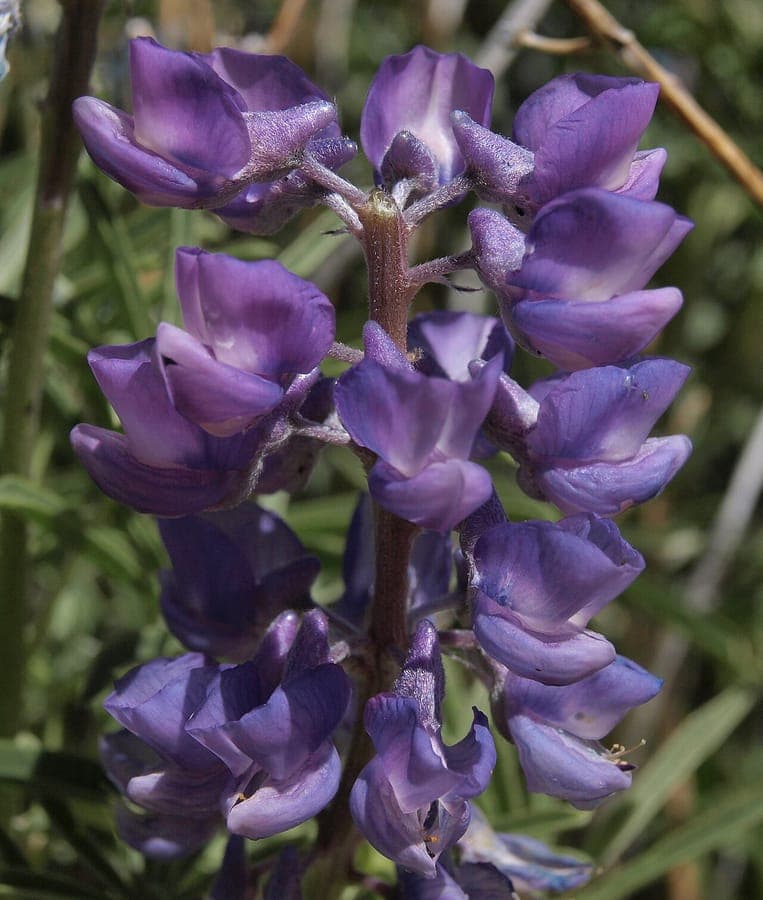
Jim Morefield from Nevada, USA / CC BY-SA 2.0, via Wikimedia Commons
Tailcup lupine: complete guide
Lupinus caudatus
Want to see Tailcup lupine: complete guide in your garden?
1 minute, no credit card
Overview
Lupinus caudatus, commonly known as the tailcup lupine, is a perennial herb in the legume family (Fabaceae). First described scientifically by botanist Kellogg in 1863, it takes its species name caudatus from the Latin word for 'tailed', a reference to the distinctive elongated form of its flower spike. It is native to a broad swath of the western and west-central United States, growing naturally in Arizona, California, Colorado, Idaho, Montana, Nevada, New Mexico, North Dakota, Oregon, Utah, and Wyoming.
As a member of the genus Lupinus, the tailcup lupine shares the remarkable nitrogen-fixing ability of all legumes. Through symbiotic bacteria living in nodules on its roots, the plant converts atmospheric nitrogen into a form available to surrounding plants. This makes lupines valuable participants in ecological planting schemes and natural land restoration projects. The tailcup lupine in particular thrives in dry, open habitats - grasslands, shrublands, and rocky slopes at various elevations across the western states.
For European gardeners looking for a striking blue-flowered perennial that handles drought and poor soil with ease, the tailcup lupine is a genuinely rewarding choice. At gardenworld.app you can explore how blue-flowering prairie plants like this one can anchor a dry, sunny front garden design with minimal ongoing care.
Appearance and bloom cycle
Lupinus caudatus grows as an upright, multi-stemmed herb, forming a bushy clump of stems that can reach 30 to 60 cm in height under garden conditions, depending on soil richness and moisture availability. The distinctive palmate leaves - with multiple narrow leaflets radiating from a central point like the fingers of a hand - are typical of the lupine genus and remain attractive throughout the growing season.
The flowers are blue and showy, carried in dense, upright terminal racemes - the characteristic lupine 'spike' that makes these plants so recognisable. Individual flowers follow the standard legume structure: a broad upper banner petal, two lateral wing petals, and a lower keel. The name 'tailcup' refers to the slightly elongated or tail-like appearance of the spike. Flowers appear from late spring through early summer, offering an attractive blue display that draws bumblebees and other pollinators.
After flowering, typical legume pods develop, turning brown at maturity. The seeds inside are toxic if consumed raw - this is important to know if children or pets have access to the garden. Allowing the pods to mature and split provides natural reseeding that can gradually spread the plant through a border.
The growth rate is rapid, meaning plants establish quickly and reach flowering size within the first or second season after planting or sowing.
Ideal location
Full sun is essential for Lupinus caudatus to perform at its best. In partial shade, the plant tends to become leggy and may flower sparsely. Position it where it receives at least six hours of direct sunlight daily. A south-facing or southwest-facing aspect in a European garden is ideal.
The tailcup lupine is adapted to open, exposed conditions including wind, temperature extremes, and seasonal drought. It grows from lowland plains to montane zones in its native range, demonstrating considerable adaptability. However, consistently wet or humid conditions are not to its liking.
In terms of hardiness, the tailcup lupine is rated for USDA zones 4 to 9, meaning it tolerates winter temperatures down to around -20 degrees Celsius. This makes it one of the hardier lupine species, suitable for virtually all European garden climates including Scandinavia and northern Germany. The key condition, as with many drought-adapted plants, is that soil drainage must be good year-round.
The plant suits dry borders, prairie-style plantings, wildflower gardens, and naturalistic front gardens well. Its blue flower spikes add vertical interest and a vibrant seasonal colour accent.
Soil
Lupinus caudatus prefers lean to moderately fertile soil with a pH between 7.0 and 8.0. This preference for neutral to slightly alkaline conditions distinguishes it somewhat from the more acid-tolerant cultivated garden lupines. In very acid soil, performance will be reduced.
Free drainage is non-negotiable. The plant cannot tolerate waterlogged roots and will decline quickly if planted in heavy, wet clay. In such soils, raise the planting area or incorporate large quantities of grit or coarse sand. Sandy loam, gravelly soil, or even thin rocky soil is perfectly acceptable.
Being a nitrogen-fixer, this plant does not need nitrogen fertiliser. Adding high-nitrogen feeds will promote excessive leafy growth at the expense of flowers and may produce plants that flop over without support. If the soil is very poor, a light spring application of a balanced, low-nitrogen fertiliser is all that is needed. In most cases, no supplemental feeding is required at all.
Free design
Want to see Tailcup lupine: complete guide in your garden? Make a free design now.
Watering
Once established in the garden, Lupinus caudatus requires very little supplemental water, reflecting its origins in the dry western United States. Its strong root system allows it to access moisture from deeper in the soil profile and to persist through extended summer dry spells.
In the first growing season, regular watering helps develop a strong root system. Water deeply once or twice a week when there is no significant rainfall, but allow the soil to dry partially between sessions. Avoid watering in the evening, as moist foliage through the night encourages fungal diseases.
In subsequent years, established plants in a typical North European garden with moderate summer rainfall will rarely need supplemental watering. During unusually hot, dry spells, a deep monthly watering helps sustain the plant. Watch for signs of drought stress - wilting or yellowing foliage - as triggers for irrigation rather than watering on a fixed schedule.
A layer of organic mulch around the base of the plant conserves soil moisture, moderates soil temperature, and suppresses competing weeds. This is particularly useful in the first year or two of establishment.
Pruning
Deadheading spent flower spikes after the first flush of bloom can encourage the plant to produce additional lateral flower spikes later in the season. Cutting the spike back to a side shoot or leaf node, rather than removing the entire stem, gives the best chance of secondary flowering.
If seed is wanted for propagation or to allow natural self-seeding, leave some spikes intact until the pods turn brown and begin to split. Collect seeds at this stage if storing them. Be aware that lupine seeds are toxic and should be stored away from children and pets.
In autumn, once the foliage has died back, cut the plant down to near ground level. This removes potential overwintering habitat for fungal pathogens and pests. In mild winters where some foliage persists, delay cutting back until late February or early March.
Always wear gloves when handling lupines, as the seeds and plant sap are toxic. Wash hands thoroughly after gardening with this plant.
Maintenance calendar
February to March: Remove remaining old stems if not cut back in autumn. Check soil drainage around the crown. Apply a thin mulch of compost if the soil is very poor.
April: Watch for emerging new shoots. Good time to plant young specimens or transplant self-seeded seedlings from elsewhere in the garden.
May to June: Main flowering period. Blue flower spikes at their best. Bumblebees and other pollinators visit frequently. Deadhead spent spikes to encourage secondary flowering.
July to August: Seed development and ripening. Collect or allow to self-seed according to preference. In very dry summers, one deep watering per month is beneficial.
September to October: Plant begins to die back. Good time to divide congested clumps. Cut back after the first frosts.
November to January: Dormancy period. Ensure drainage is maintained. No other action required.
Winter hardiness
Lupinus caudatus is one of the hardier lupine species, surviving temperatures down to around -20 degrees Celsius (USDA zone 4). In the UK, Netherlands, Belgium, France, and Germany, it will overwinter reliably without any special protection, provided the soil drains well.
As with most drought-adapted plants, the greater threat in Northwestern European winters is persistent wet cold rather than hard frost alone. A gravel mulch over the root zone applied in October provides meaningful protection by keeping the crown area drier during wet winter months.
Young plants installed in autumn benefit from a light protective cover of dry bracken or open straw through their first winter. Remove this cover promptly in late February as new growth begins to emerge. Established plants do not need this protection.
Lupines can be susceptible to lupin aphid, which attacks flower spikes in spring. Check regularly and treat with insecticidal soap spray if infestations appear. Powdery mildew can affect plants in hot, dry, poorly ventilated positions; ensure adequate spacing and air movement to reduce the risk. You can find more diagnosis and treatment guidance on gardenworld.app.
Companion plants
The blue flower spikes of Lupinus caudatus pair beautifully with yellow and orange perennials in a prairie-style border. Sunflower relatives (Helianthus, Rudbeckia), yellow yarrow (Achillea filipendulina), and orange daylilies (Hemerocallis) create vibrant combinations that recall the native grassland habitats where tailcup lupine grows.
For a cooler, more restrained palette, pair the lupine with white Echinacea, silver-leaved Stachys byzantina, and white Phlox paniculata. The palmate lupine foliage provides a strong textural contrast to the softer or broader leaves of these companions.
Being a nitrogen-fixer, the tailcup lupine is a genuine ecological asset in mixed borders. It enriches the soil for neighbouring plants, supports pollinators, and forms part of the complex plant community that makes naturalistic gardens ecologically functional. Other prairie and steppe species - sages, campanulas, ornamental grasses - are natural partners.
Closing
Lupinus caudatus is a robust, drought-tolerant perennial that brings genuine ecological value and striking blue colour to sunny, dry gardens. Its nitrogen-fixing roots benefit the surrounding plant community, its blue spikes are magnets for bumblebees and butterflies, and its low maintenance requirements make it well suited to the kind of naturalistic, sustainable planting that is increasingly popular in contemporary garden design.
While it is less commonly stocked than the hybrid garden lupines, specialist nurseries focusing on prairie and native plants carry it or can source seed. Once planted in well-drained, sunny conditions, it is a reliable, long-lived addition to the garden that returns year after year with minimal attention.
Want to see Tailcup lupine: complete guide in your garden? Make a free design now.
Upload a photo, pick a style, and get a photorealistic design with plant list in under a minute.
10,000+ gardens designed already
No credit card required


Similar plants
Crowded lupine: complete guide
Lupinus confertus
Lupinus confertus, the crowded lupine of California and Nevada. Complete care guide covering soil, blooming, winter hardiness, and planting.
Meadow vetchling (Lathyrus pratensis): complete guide
Lathyrus pratensis
Discover meadow vetchling, a vital host plant for butterflies. Growing tips, June-July bloom, and role in biodiversity gardens.
Sweet pea: complete guide
Lathyrus odoratus
Sweet pea (Lathyrus odoratus) offers fragrant, colorful flowers on climbing vines. Learn everything about planting, care, and cultivars for your garden.