
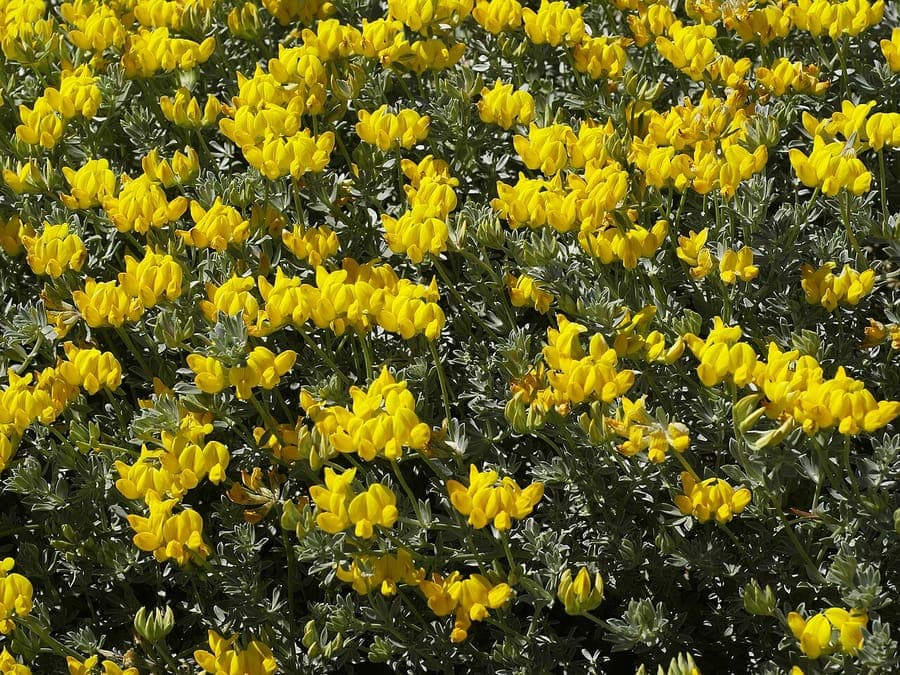
Hans Hillewaert / CC BY-SA 3.0, via Wikimedia Commons
Grey bird's-foot: complete guide
Lotus cytisoides
Want to see Grey bird's-foot: complete guide in your garden?
1 minute, no credit card
Overview
Lotus cytisoides, known in English as 'Grey Bird's-foot-trefoil' and in French as 'Lotier faux cytise', is a low-growing, semi-woody perennial herb in the pea family (Fabaceae). First described by Carl Linnaeus in his landmark 1753 'Species Plantarum', this Mediterranean native has a long record in botanical science. Its species epithet, cytisoides, refers to the resemblance of its grey-silky foliage to that of Cytisus shrubs (brooms).
The species is distributed across the full extent of the Mediterranean basin: Spain, the Balearic Islands, Corsica, Sardinia, Sicily, mainland Italy, the Balkans, Greece, Crete, Turkey, Lebanon, Palestine, Egypt and across North Africa from Morocco to Libya. In its native range, it grows on dry rocky coastal slopes, calcareous cliffs and sandy coastal dunes - all environments where its silvery hairy leaf covering provides effective protection against intense sun and desiccation.
Within the genus Lotus, this species stands out for its distinctly grey or silvery-green foliage, caused by a dense covering of fine silky hairs. This is an evolutionary adaptation to reduce water loss in hot, dry habitats. The bright yellow flowers contrast beautifully with the silver-grey leaves, making this a visually striking plant for Mediterranean-style gardens. At gardenworld.app, you can design a drought-tolerant Mediterranean planting scheme that includes Lotus cytisoides and other grey-leaved species, generating a photorealistic visualisation of the finished garden.
As a legume, Lotus cytisoides fixes atmospheric nitrogen through symbiotic Rhizobium bacteria in root nodules, meaning it enriches rather than depletes the soil - a genuine asset in poor, stony conditions where it thrives best.
Appearance and bloom
Lotus cytisoides is a perennial with a slightly woody base, reaching 20-40 cm in height and forming a spreading cushion or mat considerably wider than it is tall. Stems are ascending to spreading and densely clothed in fine silky hairs, giving the whole plant a soft, silvery-grey appearance even when not in flower.
Leaves are pinnately compound with five leaflets: three terminal leaflets and two basal leaflets resembling stipules, typical of the Lotus genus. Individual leaflets are small, obovate and covered in soft grey hairs. This texture is what gives the plant its distinctive silvery character and its common name. The foliage alone makes this a worthwhile addition to a planting where textural interest is valued beyond the flowering season.
Bloom time is April through June. The flowers are characteristically pea-like: an upright standard petal, two lateral wing petals and a keel enclosing the stamens. They are bright yellow and appear in small clusters of two to five at stem tips. The rich yellow blooms against the silver-grey leaves create a crisp, Mediterranean colour palette that works particularly well in rock and gravel gardens. After pollination - primarily by bumblebees and solitary bees - narrow, upright seed pods develop, turning brown-black at maturity before splitting to release seeds.
Ideal location
Lotus cytisoides demands full sun and heat. A minimum of six to eight hours of direct sunlight daily is required, and the plant performs best on south or south-west-facing slopes, in raised rock gardens, and in terrace beds with excellent drainage. In its native environment it colonises open, exposed rocky coastlines where shade is absent and drying winds are frequent.
In Northern European gardens, a south-facing position against a warm wall provides the ideal microclimate, as masonry absorbs solar heat during the day and radiates it overnight, extending the effective growing season and improving winter survival. When using gardenworld.app to lay out your garden, positioning grey-leaved Mediterranean plants like this near warm stone elements is a strategy the tool can help you visualise and refine.
Shaded, damp or cold positions are unsuitable. The plant needs open, well-ventilated locations that dry quickly after rain. Rock gardens, gravel gardens, stone terraces and raised beds are all excellent settings.
Soil
Soil requirements are simple: drainage is everything. Lotus cytisoides thrives in sandy, stony or calcareous substrates with a pH of 6.5-7.0. It is well adapted to nutrient-poor conditions and actually performs better in lean soils, where competition from other plants is reduced and flowering is stronger than in enriched ground.
Rich, humus-heavy garden soil leads to lush leafy growth at the expense of flowers and increases winter wet risk. A mixture of horticultural sand, coarse grit and a small proportion of compost is more than adequate. If planting into ordinary garden soil, incorporate at least one-third sand or grit to improve drainage.
As a nitrogen-fixing legume, this plant supplies its own nitrogen requirements through root bacteria and does not need nitrogen fertiliser. On acidic soils, a light application of ground limestone at planting time may be beneficial; otherwise no additional feeding is required.
Free design
Want to see Grey bird's-foot: complete guide in your garden? Make a free design now.
Watering
Lotus cytisoides is among the most drought-tolerant plants suitable for European gardens. Once established, it requires virtually no supplemental watering: rainfall alone sustains it comfortably through normal summers. Its silky, hairy foliage is a functional adaptation that reduces water loss in dry conditions.
In the first growing season after planting, water in well at planting time and repeat during any prolonged dry spells to help roots become established. Once the plant is settled, reduce watering sharply.
Excessive moisture is the main risk in Northern European conditions. Wet, cold soil in winter is far more damaging than cold alone. In containers, ensure adequate drainage holes and a gravel layer at the base; never stand pots in saucers of water. In open ground, raised or sloped positions reduce the winter wet hazard significantly.
Pruning
This plant requires minimal attention. After flowering, removing dried flower stems tidies the plant but is not essential. The slightly woody base maintains a compact form naturally in the right conditions.
If the plant becomes leggy or sparse after a few years, a light trim in early March, cutting back to just above the previous year's growth, encourages fresh bushy regrowth. Never cut back hard into the old woody base, as regeneration from very old wood is unreliable.
Remove frost-damaged or dead stems in early spring once it is clear which parts are still alive. In mild winters, little or no pruning is needed, as the plant maintains itself well.
Maintenance calendar
February-March: Check for frost damage; remove dead or damaged stems. Light formative trim if the plant is becoming too open.
April: Flowering begins. Enjoy the first yellow blooms. Water newly planted specimens during dry spells.
May: Full flowering period. Bees and butterflies visit frequently. No pruning needed.
June: Flowering winds down. Seed pods developing. Leave pods on plant if you want natural self-seeding.
July-August: Seeds ripen. Remove pods before splitting if you wish to limit spread. Plant copes well with heat.
September-October: Growth slows. Check drainage before the wet season. New plantings can still go in during September.
November-January: Dormancy. No special measures needed for well-sited plants. In wet climates, apply a layer of coarse gravel around the crown to reduce moisture contact.
Winter hardiness
As a Mediterranean species, Lotus cytisoides is only moderately cold-tolerant. It survives light frosts down to around -5°C to -10°C depending on soil drainage, but prolonged cold combined with wet soil is the main overwintering risk. In free-draining rocky substrates, survival rates are considerably higher than in heavy garden soil.
In USDA zone 8, it performs reliably as a perennial. In zone 7, overwintering is achievable with good drainage and a sheltered position. In zone 6 and colder, treat as an annual or grow in containers that can be brought under cover before hard frosts.
Soil moisture in winter is the critical factor: wet and cold together are far more damaging than cold alone. A mulch of coarse gravel or stone chippings around the crown of the plant reduces moisture contact and provides modest frost protection. Look for this species at specialist Mediterranean plant nurseries, or at larger garden centres with a Mediterranean range.
Companion plants
Lotus cytisoides suits a wide range of drought-adapted companions in Mediterranean rock or gravel gardens:
- Cistus x purpureus (rock rose): The purple-pink flowers of the rock rose create a warm contrast with the yellow Lotus blooms and silver-grey foliage. Both species share identical site requirements.
- Lavandula angustifolia (English lavender): The lilac-blue flowers and silvery leaves of lavender harmonise beautifully with the grey-green Lotus foliage in a classic Mediterranean pairing.
- Stipa tenuissima (Mexican feather grass): Fine, swaying stems provide textural contrast next to the compact, cushion-forming Lotus.
- Euphorbia rigida (rigid spurge): Blue-green succulent rosettes with yellow-green flowerheads complement the silvery Lotus foliage and share the same preference for dry, stony conditions.
- Salvia officinalis (culinary sage): Grey-green leaves and blue flowers pair perfectly with Lotus cytisoides in a dry herb bed.
These plants together create a garden that thrives on minimal care and dry conditions - ideal for a low-maintenance, south-facing planting. Visualise these Mediterranean combinations using gardenworld.app and see exactly how the finished planting will look before you buy a single plant.
Final thoughts
Lotus cytisoides deserves a place in every Mediterranean and drought-oriented garden. Its silky grey foliage is attractive throughout the year, its yellow spring flowers are a valuable early resource for bees and butterflies, and its exceptional drought tolerance makes it a genuinely low-maintenance choice for sunny, well-drained positions.
To see how the grey bird's-foot fits into your specific garden design, create a photorealistic plan at gardenworld.app and find out which Mediterranean plants will complement your garden style and conditions most effectively.
Want to see Grey bird's-foot: complete guide in your garden? Make a free design now.
Upload a photo, pick a style, and get a photorealistic design with plant list in under a minute.
10,000+ gardens designed already
No credit card required


Similar plants
Coimbra bird's-foot: complete guide
Lotus conimbricensis
Lotus conimbricensis is a Mediterranean white-flowered legume for dry, sunny gardens. Learn how to plant, care for and combine this uncommon rolklaver species.
Smallflower bird's-foot: complete guide
Lotus parviflorus
Lotus parviflorus is a Mediterranean annual with tiny yellow flowers for dry, sunny gardens. Complete guide to sowing, care and companion planting.
Lotus corniculatus: complete guide
Lotus corniculatus
Discover bird's-foot trefoil: a robust, evergreen groundcover with bright yellow flowers. Ideal for rocky situations and naturalistic gardens.