
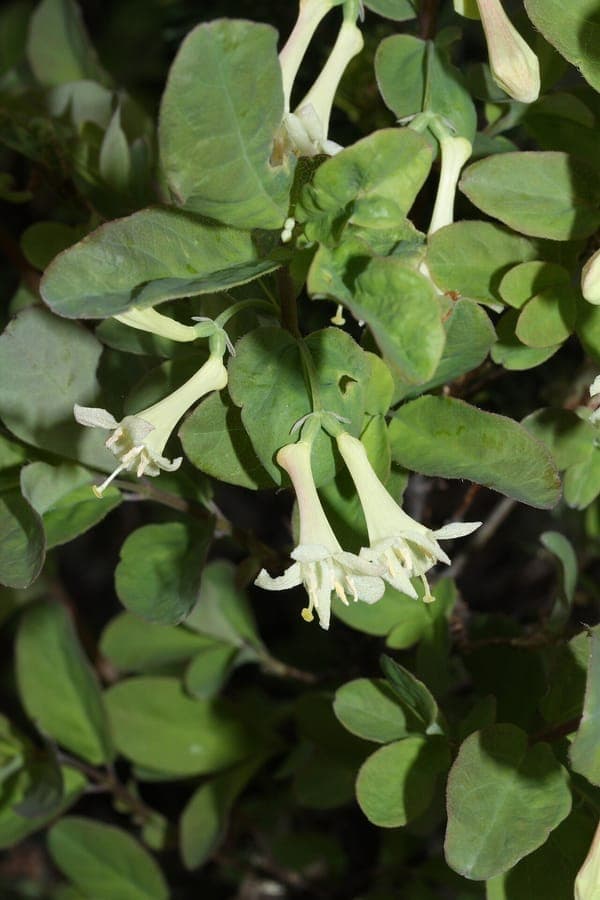
Walter Siegmund (talk) / CC BY-SA 3.0, via Wikimedia Commons
Lonicera utahensis: complete guide
Lonicera utahensis
Want to see Lonicera utahensis: complete guide in your garden?
1 minute, no credit card
Overview
Lonicera utahensis, the Utah Honeysuckle, is a compact shrubby honeysuckle native to the Rocky Mountain region. Unlike many honeysuckles that climb vigorously, this is an upright to spreading shrub reaching 1.5 to 2 meters tall. It is exceptionally drought-tolerant and thrives in alkaline, drier soils where many other plants struggle.
Appearance and Bloom
The Utah Honeysuckle forms a well-branched shrub with stiff, upright, brownish stems. Leaves are lance-shaped, green, and medium in texture. In May and June, pairs of yellow flowers emerge from leaf axils, each about 1.5 centimeters long. These flowers emit a subtle honey fragrance.
After flowering, red berries appear (July through September) that grow in pairs - hence the common name "red twinberry." These berries are valuable food for birds, especially in mountain regions where forage is scarce. Berries persist well into fall.
Ideal Location
Utah Honeysuckle prefers full sun, requiring at least 6 to 8 hours of direct sunlight daily. In partial shade, plants become leggy and flower sparsely. This shrub is ideal for dry, sunny sites and is among the best honeysuckles for windy locations. Wind actually strengthens stem growth and improves plant form.
Soil
This is where Utah Honeysuckle excels: it grows in poor, alkaline soils where many plants fail. It thrives in neutral to alkaline soils (pH 6.5 to 8.0). Well-draining soil is essential. In clay or wet soils, root rot can occur. Sandy, gravelly, and calcareous soils are ideal. Once established, the plant needs minimal feeding.
Watering
Once established (after 2 years), Utah Honeysuckle is highly drought-tolerant. During establishment, water regularly - about 2.5 centimeters per week. After that, water only during extreme drought or heat waves. Excessive water, especially in heavy soils, can be detrimental. Allow soil to dry between waterings.
Free design
Want to see Lonicera utahensis: complete guide in your garden? Make a free design now.
Pruning
Utah Honeysuckle requires little pruning. In early spring (March), remove dead or damaged stems. If the shrub becomes too dense, prune lightly after flowering (July). This is not a plant for hard pruning - it regrows slowly. Thin interior growth occasionally to improve air circulation and reduce disease risk. Sterilize pruning tools between cuts.
Maintenance Calendar
March: Remove dead stems. Light shaping. April-May: Blooming begins. May-June: Full bloom. Hummingbirds and bees visit. July-August: Berry formation. Prune after flowering. September: Berries ripen to red. October-November: Leaf color change. Reduce watering. December-February: Dormancy. Minimal care.
Winter Hardiness
Utah Honeysuckle is highly cold-hardy to USDA Zone 4b (-29 degrees Celsius minimum). In snowy regions, it provides natural food for birds as berries persist on branches well into winter. The plant is deciduous, dropping leaves in fall - this is completely normal.
Companion Plants
Utah Honeysuckle fits well in dry gardens with:
- Oregon Grape (Mahonia aquifolium)
- Red-osier Dogwood (Cornus sericea)
- Winter Jasmine (Jasminum nudiflorum)
- Ornamental grasses (Festuca, Stipa)
- Lavender (Lavandula)
- Sage species (Salvia)
Combine with other drought-tolerant plants for a low-maintenance landscape.
Closing Thoughts
Utah Honeysuckle is an unqualified asset for gardens in drier climates or on rocky slopes. With minimal water needs and tolerance for alkaline soils, it delivers years of flowers and bird food. This is a plant that adapts to difficult conditions and still thrives, rewarding gardeners with reliable performance.
Want to see Lonicera utahensis: complete guide in your garden? Make a free design now.
Upload a photo, pick a style, and get a photorealistic design with plant list in under a minute.
10,000+ gardens designed already
No credit card required

