
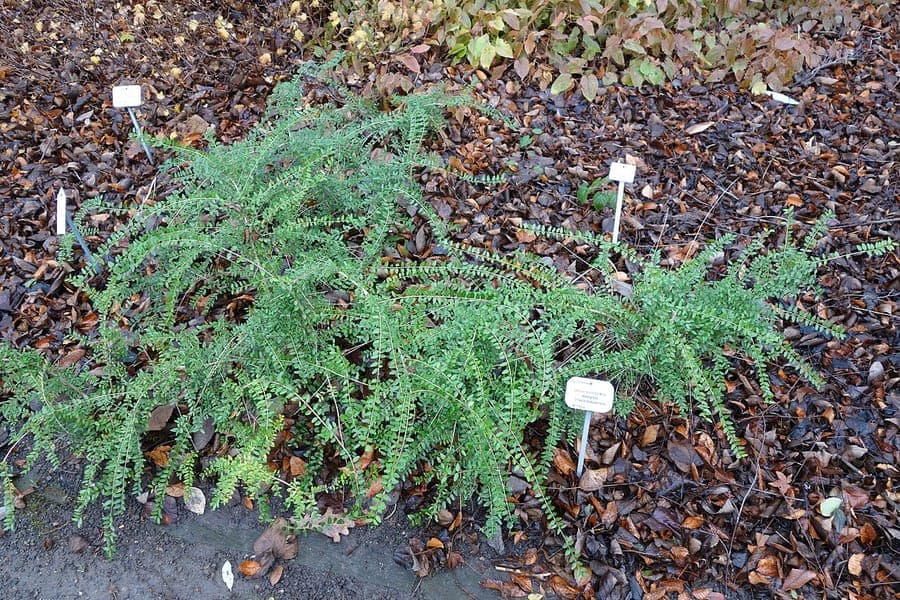
Daderot / CC0, via Wikimedia Commons
Privet-like honeysuckle: complete guide
Lonicera ligustrina
Want to see Privet-like honeysuckle: complete guide in your garden?
1 minute, no credit card
Overview
Privet-like honeysuckle (Lonicera ligustrina) is an elegant Asian shrub naturally occurring from Nepal to southern China. This plant grows in mountain forests where moderate moisture and slightly shaded conditions prevail.
This honeysuckle distinguishes itself through elegant growth and compact form. The plant has naturalized in diverse western gardens, especially in temperate zones of Europe. It grows well in protected gardens and is valuable for birds that enjoy its nutritious berries.
Appearance and Bloom
Privet-like honeysuckle grows as an elegant compact shrub with fine, lightly weeping branches. The leaves are small to moderate, dark green and glossy. The plant has an ornamental growth habit reminiscent of privet.
The flowers are small, white to creamy and appear in May in dense clusters. The bloom lasts several weeks and attracts many insects. Following bloom, dark red to black berries form that attract bird species.
Fall color is usually minimal, though the plant can achieve attractive tones in some years.
Ideal Location
Privet-like honeysuckle grows best in locations with full sun to half shade. In warm climates, afternoon shade helps the plant bloom.
The plant prefers wind-sheltered surroundings, though it is reasonably wind-tolerant. Place this plant against a warm wall or in the heart of the garden for maximum growth.
Soil
Privet-like honeysuckle grows well in moderately fertile, well-draining soil. The plant does not feel comfortable in very poor soils. Slightly acidic to neutral soil is preferred.
The plant can grow in normal garden soils and requires no extreme drainage. Mulch around the plant helps retain moisture during dry periods.
Free design
Want to see Privet-like honeysuckle: complete guide in your garden? Make a free design now.
Watering
Privet-like honeysuckle needs regular moisture, especially during the growing period. Regular watering in the first growing season helps the plant develop strong roots.
Once established, the plant needs less water, though regular moisture leads to better performance. Drought spells in summer can slow growth.
Pruning
Minimal pruning is needed for healthy growth. After bloom, damaged branches can be removed. The plant can be pruned to maintain shape, though this is not strictly necessary.
Formative pruning in spring can help give the plant an attractive shape. Heavy pruning should be avoided because it removes many flowers.
Maintenance Calendar
Spring: Check for winter damage. Water regularly after bloom starts. Summer: Add water during dry periods. Fall: Reduce water toward the end of the growing season. Winter: In its native range requires minimal protection.
Winter Hardiness
Privet-like honeysuckle is winter-hardy in temperate zones (zones 6-8). In zone 5 it can survive but may suffer some frost damage to tips.
In very warm zones, this plant grows well, though it cannot handle warm, dry summers without adequate water.
Companion Plants
Privet-like honeysuckle grows well with other fine shrubs and variety suppliers:
Native privet species form a fitting combination. Japanese privet varieties offer similar texture. Peninsula hydrangeas provide contrasting foliage. Small-leafed ilex species add evergreen structure.
Closing Thoughts
Privet-like honeysuckle is an underrated ornamental shrub that adds elegance to temperate gardens. With its fine texture, compact form, and bird food, this is a valuable addition. Find this Asian beauty at specialized tree nurseries or via gardenworld.app.
For design advice and plant combinations, visit gardenworld.app.
Want to see Privet-like honeysuckle: complete guide in your garden? Make a free design now.
Upload a photo, pick a style, and get a photorealistic design with plant list in under a minute.
No credit card required


Similar plants
Yellow honeysuckle (Lonicera tragophylla): complete guide
Lonicera tragophylla
Meet yellow honeysuckle (Lonicera tragophylla): a Chinese climber with large golden flowers that thrives in partial shade.
Lonicera korolkowii: complete guide
Lonicera korolkowii Stapf
Discover blueleaf honeysuckle, a vigorous shrub with beautiful flowers. Guide on growing, shaping and why this Asian climbing plant is perfect for gardens.
Lonicera oblongifolia: complete guide
Lonicera oblongifolia Hook.
Discover swamp fly honeysuckle, a North American woodland plant. Guide on growing, caring and why this native species is valuable for gardens.