
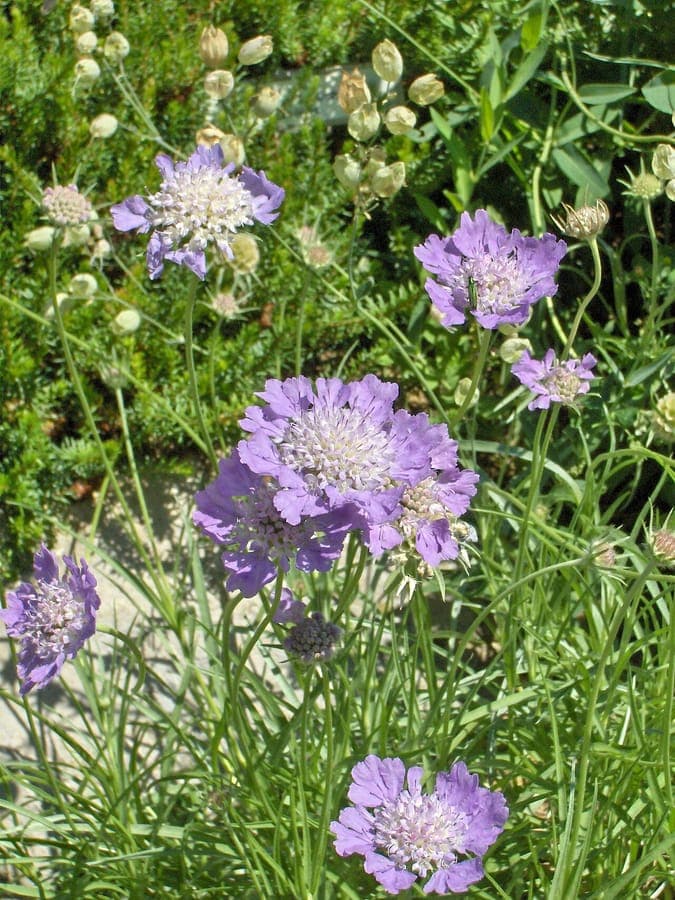
Qwertzy2 / CC BY-SA 3.0, via Wikimedia Commons
Lomelosia graminifolia: complete guide
Lomelosia graminifolia
Want to see Lomelosia graminifolia: complete guide in your garden?
1 minute, no credit card
Overview
Lomelosia graminifolia is an elegant, perennial herb belonging to the family Caprifoliaceae. Originally described by Linnaeus as Scabiosa graminifolia, the plant was later reclassified into the genus Lomelosia by Greuter and Burdet in 1985. Despite its species epithet 'graminifolia' - referring to leaves that resemble those of certain narrow-leaved plants - this is not a true grass or grass-like plant. It is a genuine flowering perennial from the Mediterranean region, closely related to the well-known scabious species (Scabiosa), but forming its own distinct botanical genus. It grows naturally across southern and central Europe, from Spain and Morocco east through France, Italy, Switzerland, Greece, and the former Yugoslav countries. In its native habitats, it thrives on dry, rocky or calcareous slopes and open grasslands, making it an outstanding choice for gardeners looking for a low-maintenance perennial in sunny, well-drained borders.
Appearance and bloom cycle
Lomelosia graminifolia forms compact rosettes of narrow, somewhat silvery-grey leaves. The leaves are elongated and relatively slender - hence the epithet 'graminifolia' - but should never be confused with a grass. From these rosettes, slender branched stems rise up, each topped by the characteristic round flowerheads in a striking blue-violet shade. The flowers are compound: each head consists of dozens of small tubular florets, with those at the margin being longer and more irregular than those at the centre - a typical feature of the scabious family. The flowering period runs from June through August, meaning the plant colours the garden throughout the whole summer. The blue-violet flowers are highly attractive to bees, butterflies, and hoverflies. Mature plants typically reach 30 to 50 cm in height with a similar spread. The silvery-grey leaf rosette remains visible through winter and gives the plant ornamental value outside the flowering season.
Ideal location
This plant demands a fully sunny position; partial shade leads to reduced flowering and weaker growth. In its natural habitat, Lomelosia graminifolia grows on dry, stony slopes and in open calcareous grassland, locations where sunshine is unobstructed. In the garden it is ideal for a rock garden, dry border, gravel garden, or a Mediterranean-style planting scheme. It tolerates heat and drought well, provided that drainage is excellent. Avoid positions where rainwater collects or where standing water persists in winter, as wet roots are its primary vulnerability. South- or southwest-facing slopes, raised beds, and terrace containers are excellent positions. At gardenworld.app you can find inspiration for dry, sunny garden designs where Mediterranean perennials take centre stage.
Soil
A free-draining substrate is absolutely essential. Lomelosia graminifolia performs best in poor to moderately fertile, dry to slightly moist conditions. Sandy or stony, slightly alkaline soils match the species' natural requirements most closely. On heavy clay or nutrient-rich soils, the plant tends to be overled and may sit wet in winter, leading to root problems. When planting into heavier soils, incorporate generous amounts of coarse grit or gravel to improve drainage. A light addition of lime is not required but certainly not harmful, given the species' preference for calcareous substrates in nature. Avoid peat-heavy or strongly acidic soils. An ideal pH range is between 6.5 and 8.
Free design
Want to see Lomelosia graminifolia: complete guide in your garden? Make a free design now.
Watering
Once established, Lomelosia graminifolia is remarkably drought-tolerant. In the first growing seasons after planting, regular watering helps the roots establish well. After that, supplemental watering is only needed during prolonged, extreme dry spells. Overwatering is the most common mistake made with this plant: wet roots quickly lead to rot, especially in winter. Containers and pots must always have a thorough drainage layer. A watering frequency of once every two weeks in summer is sufficient in most situations; in autumn and winter, water as little as possible.
Pruning
Maintenance requirements are minimal. After flowering, the spent flowerheads and stems can be cut back to just above the leaf rosette. This occasionally triggers a second, more modest flush of bloom later in the season. In spring - around March or April - the plant can be lightly trimmed to keep the rosette tidy and remove any winter-damaged leaves. Cutting back into woody growth at the base is not recommended, as the plant recovers poorly from hard pruning. Handle the slender stems with care: the plant renews itself more effectively through self-seeding or gentle division rather than severe cutting back.
Maintenance calendar
In March and April, the rosette can be tidied by removing dead leaves and giving a light trim. May is a good time to pot up any seedlings or plant additional specimens raised from cuttings. June, July, and August are the peak season: abundant bloom, regular pollinator visits, and very little care required. In September, spent flowerheads can be removed. October through February is the rest period: reduce watering, protect the plant from standing moisture, and watch for slugs that may attack the young rosettes during mild winters.
Winter hardiness
Lomelosia graminifolia is moderately winter-hardy. It survives temperatures down to approximately -10 to -15 degrees Celsius, corresponding to USDA hardiness zones 6 to 7. In practice, it comes through most British and northern European winters well, provided the soil is dry enough. Wet winters pose a greater risk than cold winters: root rot resulting from wet soil in freezing conditions is the main cause of winter losses. In regions with heavy, wet winters, it is wise to keep the plant in a container and move it to a cool but frost-free location in November, or to cover the rootzone with coarse grit or lava rock. Plants in a sheltered, south-facing position against a wall tend to survive best.
Companion plants
Lomelosia graminifolia fits beautifully in dry and Mediterranean-style borders. It pairs well with Salvia nemorosa and other sage species for a blue-violet harmony. Stachys byzantina (lamb's ears), with its silvery foliage, makes an elegant contrast. Sedum and Sempervivum species complement a rock garden setting. Achillea (yarrow) in yellow brings colour contrast. Nepeta (catmint) is an ideal neighbour in sunny, dry borders. For structure and height, Verbascum or Agastache fit perfectly. Visit gardenworld.app to visualise all these combinations in a personalised garden design.
Closing
Lomelosia graminifolia is an underappreciated gem for gardeners seeking a beautiful, low-maintenance perennial for sunny, dry borders. Its blue-violet flowers in the summer months attract pollinators and bring character to the garden. Specialist perennial nurseries and good garden centres are the best places to source it, as it is less widely available than some related scabious species. Those who discover its quiet grace and its resilience in dry conditions will rarely want to be without it.
Want to see Lomelosia graminifolia: complete guide in your garden? Make a free design now.
Upload a photo, pick a style, and get a photorealistic design with plant list in under a minute.
10,000+ gardens designed already
No credit card required

