
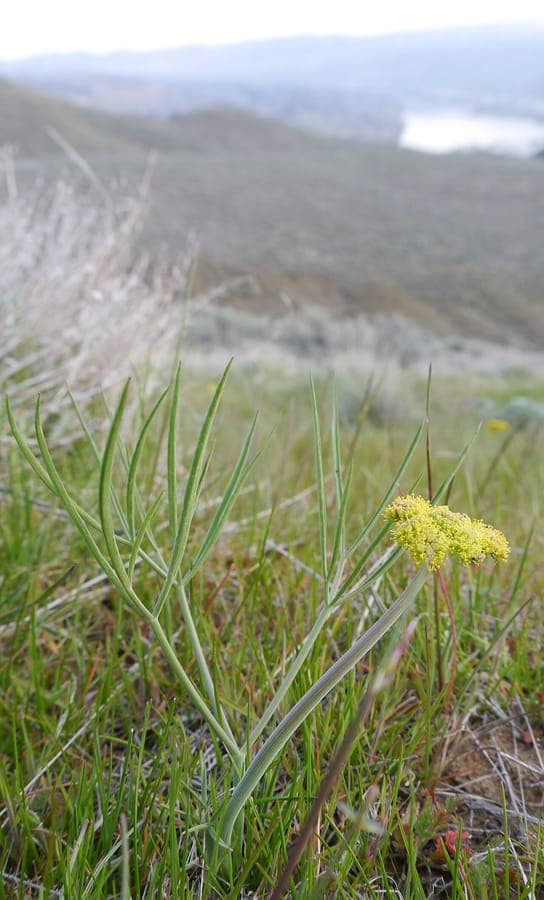
Thayne Tuason / CC BY-SA 4.0, via Wikimedia Commons
Nineleaf biscuitroot: complete guide
Lomatium triternatum
Want to see Nineleaf biscuitroot: complete guide in your garden?
1 minute, no credit card
Overview
Lomatium triternatum, commonly known as nineleaf biscuitroot, ternate desert-parsley, or ternate lomatium, is an elegant perennial herb in the Apiaceae (carrot family). Native to a wide range across western North America - from Alberta and British Columbia in Canada through California, Colorado, Idaho, Montana, Nevada, New Mexico, Oregon, Utah, Washington, and Wyoming - it is one of the most widely distributed Lomatium species. The botanical epithet 'triternatum' refers to the triternate leaf structure: each leaf is built from three groups of three leaflets, giving the plant its distinctive nine-leaflet appearance and its common name.
The species was formally described in 1900 by Coulter and Rose based on earlier material collected by botanist Frederick Pursh. The full scientific name is Lomatium triternatum (Pursh) J.M. Coult. & Rose. Older synonyms found in botanical literature include Cogswellia triternata and Seseli triternatum. The growth form is described as single crown and growth rate as moderate, making this species somewhat slower and less aggressive than Lomatium cous but steady and reliable in established plantings.
Lomatium triternatum is ecologically highly valuable: its early bloom period in April-May provides nectar and pollen to early-season pollinators at a time when few other plants are flowering. Indigenous peoples used the young leaves and stems as early spring vegetables. The yellow flowers attract honeybees, bumblebees, hoverflies, and smaller native bees in abundance.
On gardenworld.app you can find specialized garden designs built around drought-tolerant native perennials like Lomatium triternatum, helping you create a garden that is both beautiful and ecologically meaningful.
Appearance & bloom cycle
Lomatium triternatum has a compact to medium-sized rosette form, typically reaching 30-60 cm in height when in bloom, occasionally 70 cm on richer, well-moistened sites. The plant is immediately recognizable by its distinctive leaf architecture: the compound leaves are triternate, meaning each leaf has three primary groups each consisting of three leaflets. Each individual leaflet is narrow to linear, 2-6 cm long, with a very slender base. In total this creates the striking nine-leaflet pattern that gives the plant its common name and makes it easy to identify in the field.
Foliage is green, slightly lustrous, with a faint aromatic scent. Leaf texture is finer than Lomatium dissectum but coarser than Lomatium cous. In autumn, after summer dormancy, small fresh leaf shoots sometimes emerge, giving the plant a fresh green note at season's end.
The flower heads are compound umbels of yellow flowers 5-12 cm across. Flower stems stand erect and rise well above the foliage. Bloom begins early in the year, typically April through June depending on elevation: in lower elevations of Oregon and Washington sometimes from mid-April, at higher elevations in Wyoming or Colorado not until May-June. Individual flowers are yellow, ranging from pale to rich gold, and are conspicuously visited by pollinators.
After flowering, flat oval fruits with typical Lomatium wings ripen. Fruits are 1-2 cm long, turn brown when ripe, and disperse by wind. In summer the above-ground parts retreat and the plant enters dormancy. The thick roots survive underground.
Ideal location
Lomatium triternatum thrives in a fully sunny to lightly semi-shaded position. At least 5-6 hours of direct sunlight daily is ideal. The plant is adapted to the open grasslands, mountain meadows, rocky slopes, and woodland margins of western North America - environments characterized by intense summer sun, dry air, and well-draining soils.
In the European garden it is excellent in rock gardens, gravel gardens, dry steppe borders, and prairie-inspired planting schemes. A south- or west-facing front garden or terrace gives optimal results. The plant suits gently sloping or slightly raised terrain where drainage occurs naturally.
Avoid positions with waterlogging, deep shade, or heavy wet soils. In locations that remain wet for long periods in winter, root rot is a real risk. A reflective stone or gravel surroundings increase soil temperature and simulate the warm open-slope habitat of the plant.
The moderate growth rate makes Lomatium triternatum less aggressive than some relatives and better suited to plantings where spread control is desired. It does not crowd out neighboring plants.
Soil requirements
Lomatium triternatum is adaptable regarding soil type but has clear requirements for drainage and pH. The pH range runs from 6.5 to 8.8 - a notably wide tolerance that also encompasses moderately alkaline and even lightly calcareous soils. This makes the plant usable on calcareous sandy loams found in various parts of the Netherlands and Belgium.
The best soil is a light to medium, well-draining loam or sandy loam. On heavy clay soils, amendment is necessary: mix the top 30-40 cm with coarse sand and gravel (at least 30-40% by volume). Excessively high organic matter contents cause lush but weak foliage and reduce flowering.
A 5-8 cm gravel or decorative stone mulch around the rosette (not on it) maintains soil warmth in spring and keeps the root crown dry in winter. Spacing: 30-45 cm from other perennials. The taproot of established specimens reaches 50-80 cm deep; avoid digging in the immediate vicinity.
A light annual application of bone meal in spring (maximum 30-40 grams per plant) provides slowly-released phosphate that stimulates root development. Nitrogen-rich fertilisers are not recommended.
Watering
Lomatium triternatum is an excellent drought-tolerant plant once established. The first 1-2 growing seasons after planting require more attention; after that, supplemental watering in a temperate European climate is rarely needed.
In the first year: water every 7-10 days during dry, warm weather from April through August. Use the deep-and-infrequent method: give 8-12 litres per session so water penetrates deep into the soil. Allow the soil to dry completely to 10-12 cm depth between waterings. Shallow, more frequent watering makes the plant dependent and promotes shallow rooting.
From the second year: in a normally rainy UK, Dutch, or Belgian climate, supplemental watering is scarcely needed. During exceptional drought lasting more than 3-4 weeks, a thorough watering (10 litres per plant) is worthwhile. During summer dormancy when the foliage has retreated, never water - this almost certainly causes root rot.
In autumn and winter, give no water. Autumn rains are sufficient and the plant uses winter soil moisture for root growth.
Free design
Want to see Nineleaf biscuitroot: complete guide in your garden? Make a free design now.
Pruning
Lomatium triternatum requires barely any pruning. After flowering and fruiting between May and August, the dried flower stems can be removed. It is wise to let seed ripen fully first (brown, dry, easily detaching from the stem) before removing, allowing self-seeding and providing food for seed-eating birds.
Foliage retreats in summer; wait to remove it until it is completely yellow and dry. Then remove cleanly at the base without cutting into the root crown. In autumn, the remaining dry remnants can be tidied away.
Consider leaving some dry stems standing as overwintering shelter for beneficial insects (solitary bees, lacewings). In early spring, as new shoots become visible, carefully remove remnants without damaging emerging growth.
Fertilising is only advisable in the first year and then only in modest amounts. Lomatium triternatum is naturally a plant of poor to moderately fertile soils; excessive fertilising leads to weak, flopping foliage and reduced bloom.
Maintenance calendar
January-February: Winter dormancy. No action needed. Check that gravel mulch is intact around root crown. For prolonged severe frost below -15 degrees C, optional extra protection with dry straw.
March: First new leaf shoots appear at temperatures above 6-8 degrees C. Carefully remove dried remnants from the previous season. Optionally add a small amount of bone meal to the soil around the plant (30-40 grams).
April: Rapid vegetative growth. Flower buds and stems rise quickly. Check weekly for slugs attacking young leaf shoots. In dry Aprils, one watering if the soil is completely desiccated.
May: Peak bloom in most regions. Yellow umbels crowded with visitors: honeybees, bumblebees, hoverflies, small moths, and various butterflies. No fertilising, no overwatering.
June: Bloom fades. Fruit set. Fruits ripen. Foliage begins to yellow at warmer temperatures. Leave flower stems standing.
July-August: Summer dormancy. Foliage and stems have fully retreated. No water. Remove dried material if tidying the garden.
September: Possible regrowth of fresh leaves in cooler autumn weather. Seed can be collected for spreading to other garden locations.
October-November: Last plant parts dry out. Refresh gravel mulch around root crown (5-8 cm layer). Plant winter-ready.
December: Rest. Winters through easily in USDA zones 3-7.
Winter hardiness
Lomatium triternatum is an exceptionally hardy plant. In its native range it survives the harsh winters of Alberta, Montana, Wyoming, and Colorado, where temperatures of -25 degrees C or lower occur regularly. USDA zones 3-7 apply. In practice this means it overwinters effortlessly throughout the Netherlands, Belgium, the UK, Germany, and most of France.
The greatest danger is not cold but the combination of wet winter soil and freezing temperatures. Waterlogged, poorly draining soil around the root crown that freezes ruptures plant cell walls in the crown and kills the plant. Preventive measures: well-draining soil, gravel mulch around the root crown, and no watering during the autumn-winter period.
Snow cover is beneficial: it insulates the soil and keeps temperatures above the critical freezing point at root depth. In regions without reliable snow cover (low-lying Netherlands, Belgian coast), an extra mulch layer of dry material during the coldest period of December-February is a sensible precaution.
Young, recently planted specimens in their first winter are more vulnerable than established plants with deeper root systems. Extra protection using dry leaves or conifer branches during extreme frost is recommended for first-year plants.
Companion plants
Lomatium triternatum fits beautifully in prairie- and steppe-style plantings. Its moderate height and elegant leaf structure offer many combination possibilities:
- Penstemon strictus (Rocky Mountain beardtongue) - striking purple-blue flowers from June to August at 40-70 cm height. Similar soil requirements. Plant 30-40 cm from the Lomatium.
- Eriogonum umbellatum (sulphur buckwheat) - low-growing, yellow flowers, excellent as a front-of-border filler beside Lomatium triternatum.
- Allium acuminatum (tapertip onion) - graceful pink flowers in May-June. Bulb that retreats completely after bloom; accompanies the dormant Lomatium underground in summer.
- Balsamorhiza hookeri (Hooker's balsamroot) - low plant with broad leaves as textural contrast, yellow flowers in April-May in the same period as Lomatium.
- Festuca idahoensis (Idaho fescue) - fine blue-green ornamental grass, 30-50 cm tall. Gives the border an authentic prairie character. Plant at 25-35 cm spacing.
- Erigeron compositus (cut-leaved daisy) - low-growing white to pale purple composites, excellent as low fill around Lomatium rosettes.
- Phlox hoodii (Hood's phlox) - dense, mat-forming plant with small white or purple flowers in April. Identical drought tolerance.
In larger borders, combining with Salvia nemorosa 'Caradonna' (blue, 60 cm), Sanguisorba minor (salad burnet), or Veronicastrum virginicum also offers interesting seasonal contrasts.
Visit gardenworld.app for a professional garden design in which Lomatium triternatum and its companions are combined in a coherent dry border or prairie garden, tailored to your garden and climate.
Closing
Lomatium triternatum is a versatile, ecologically valuable perennial that deserves broader planting in European rock gardens, gravel gardens, and dry steppe borders. Its distinctive nine-leaflet foliage, its early yellow bloom that feeds pollinators from April onward, and its exceptional drought tolerance make it a reliable and attractive species.
The wide pH tolerance (6.5-8.8) makes it suitable for diverse soils including calcareous ground. Combined with good soil preparation (well-draining, neutral pH), a sunny position, restraint with fertilising, and minimal watering after establishment, Lomatium triternatum is a plant that functions effortlessly in the garden for decades. Consider it an investment in both garden aesthetics and ecological health - a plant that gives back far more than it demands.
Want to see Nineleaf biscuitroot: complete guide in your garden? Make a free design now.
Upload a photo, pick a style, and get a photorealistic design with plant list in under a minute.
10,000+ gardens designed already
No credit card required


Similar plants
Whorled carrot: complete guide
Daucus involucratus
Daucus involucratus is a Mediterranean umbellifer with white flower heads framed by lacy bracts. Growing this gravel garden gem.
Daucus muricatus: complete guide
Daucus muricatus
Daucus muricatus, the spiny wild carrot, grows wild on Mediterranean coasts. Discover sowing, June-July bloom, and wildflower meadow use.
Daucus pumilus: complete guide
Daucus pumilus
Daucus pumilus is a dwarf wild carrot relative with white lacy umbels, thriving on dunes and coastal rock in poor, fast-draining soil.