
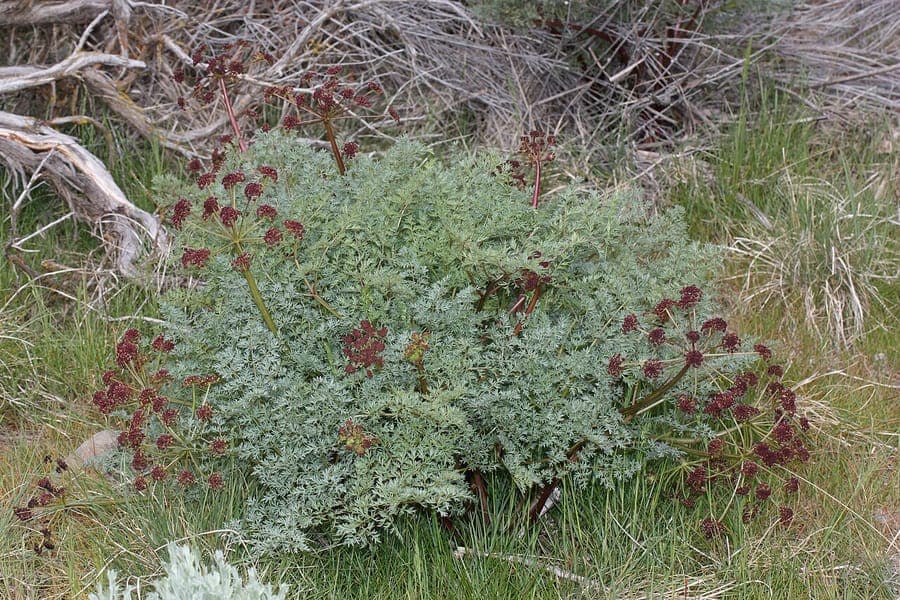
Walter Siegmund (talk) / CC BY-SA 3.0, via Wikimedia Commons
Fernleaf biscuitroot: complete guide
Lomatium dissectum
Want to see Fernleaf biscuitroot: complete guide in your garden?
1 minute, no credit card
Overview
Lomatium dissectum, commonly called fernleaf biscuitroot, fern-leaved desert-parsley, or chocolate-tips, is one of the most impressive members of the Lomatium genus. This perennial herb in the Apiaceae (carrot family) is native to southwestern Canada (southern Vancouver Island, British Columbia) through northern California, with occurrences in Colorado, Idaho, Oregon, and Washington. Among its genus relatives, Lomatium dissectum stands out as the large-statured species: it grows substantially taller, has more elaborate foliage, and produces larger flower heads.
Formally described in 1942 by botanists Mathias and Constance, building on earlier work by Nuttall, the species has accumulated many synonyms over time including Ferula dissecta, Leptotaenia dissecta, and Ligusticum apiodorum. The accepted name is Lomatium dissectum (Nutt.) Mathias & Constance. The vernacular name 'chocolate-tips' refers to the dark purplish-brown color of flower buds before opening. 'Coughroot' reflects the traditional medicinal use of the root by Indigenous peoples including the Nez Perce and Warm Springs tribes, who used root preparations for respiratory conditions.
For the garden designer, Lomatium dissectum offers exceptional value through its ornamental fern-like foliage, its striking height of 60-120 cm, and its early bloom period that supports a wide range of pollinators. The plant deserves wider cultivation in European gardens as part of dry or prairie-style plantings. On gardenworld.app you can explore how Lomatium dissectum and related species integrate into cohesive garden designs that are both visually striking and ecologically functional.
The soil pH preference of 6.5-7.5 indicates that this species favors neutral conditions. In the wild it occupies sandy loam to moderately clay soils on slopes and open woodlands.
Appearance & bloom cycle
Lomatium dissectum is the tallest-growing species of its genus commonly cultivated in European gardens. Plants reach 60-120 cm in height at flowering, with flower stems rising well above the leaf rosette. The leaves are strikingly large and finely fragmented, multiply pinnate, strongly resembling fern fronds or the finest foliage of wild carrot. Individual leaves can grow 20-40 cm long with segments successively subdivided into narrow lobes of 1-3 cm length. The foliage is deep green, soft to the touch, and has a faint aromatic scent when handled.
The flower heads are large compound umbels crowning sturdy, hollow stems. A distinctive feature is that the flower buds often have a purplish to dark chocolate-brown color before opening, explaining the common name 'chocolate-tips'. When fully open, the flowers are yellow or occasionally yellow-white. Umbels can reach 10-20 cm across, comprising dozens of small individual flowers. Bloom period runs from April through June depending on location.
After flowering, flat, broadly winged fruits develop, 1.5-2.5 cm in length. The seed wings are notably wide, enabling efficient wind dispersal. In summer the above-ground parts die back as drought intensifies. The thick taproot, which on mature specimens can reach 60-100 cm depth, survives underground and powers the following season's early growth. The growth form is described as single stem, meaning the plant grows from a central crown without extensive rhizome formation.
The finely textured foliage provides beautiful textural contrast in a border: placed beside broad-leaved plants such as Eryngium species or ornamental onions, the delicacy of Lomatium dissectum's foliage reads as particularly fine and elegant.
Ideal location
Lomatium dissectum needs a sunny to partially shaded position. In its native habitat it often grows in open woodlands, along forest margins, and on slopes with variable light. This makes it more flexible in light requirements than most other Lomatium species: it tolerates up to 50% shade but flowers best in full sun or light semi-shade with at least 5-6 hours of direct sunlight daily.
The plant's height - up to 120 cm in bloom - makes it suitable as a mid-border plant in larger plantings, behind shorter perennials but in front of shrubs. In a steppe border or prairie-style planting it functions as a focal point. It also works well as a specimen plant in a rock garden or gravel garden where its imposing silhouette can be appreciated.
Avoid locations with poor air circulation and poor drainage. In the UK, Netherlands, and Belgium, a sheltered but sunny south-facing position near a wall or building is ideal - the reflected warmth mimics the forest-edge habitat of Oregon and Washington where this species thrives.
Soil requirements
The soil requirements of Lomatium dissectum are slightly more specific than those of most other Lomatium species. The plant prefers a pH of 6.5-7.5, meaning neutral soils. Both strongly acidic and alkaline soils are poorly tolerated. In its native habitat it grows on well-draining loam soils, sometimes on clay-rich soils on slopes where the slope itself guarantees drainage.
In cultivation: the ideal soil is a light to medium loam that does not waterlog in winter. On heavier clay, amend the top 40 cm by incorporating coarse sand and gravel at a ratio of 2 parts clay to 1 part sharp sand and 1 part grit. Add a modest amount of compost - never more than 15-20% of total volume, as excessive organic enrichment stimulates lush leafy growth at the expense of flowering and increases root rot risk.
A 5-8 cm mulch of gravel or slate chips around the plant (but not directly over the rosette) keeps the soil at temperature and protects the root crown in winter. Space plants 45-60 cm from other large perennials to avoid root competition; the taproot needs room to develop.
Free design
Want to see Fernleaf biscuitroot: complete guide in your garden? Make a free design now.
Watering
Lomatium dissectum shares the drought tolerance of its relatives, but its larger leaf surface means it requires somewhat more water than the smaller species. Nevertheless, established plants from the second year onward remain reliably drought-tolerant in a temperate climate.
In the first growing season after planting: water approximately every 5-7 days during dry, warm weather from April through September. Allow soil to dry to 8-10 cm depth between waterings. During prolonged rainfall no supplemental watering is needed. It is critical to avoid keeping the root crown and stem base persistently wet; water at the base without wetting the foliage.
From the second year: in a normal UK, Dutch or Belgian climate with regular rainfall, supplemental watering is rarely needed. Only during dry spells exceeding 3 weeks without meaningful precipitation is a thorough watering worthwhile. When watering, give generously - 10-15 litres per plant - so water penetrates deep toward the taproot rather than wetting only the surface.
During summer dormancy, after foliage has died back, give no water at all. In autumn and winter the plant is completely self-sufficient from rainfall.
Pruning
Lomatium dissectum requires little active pruning. Flower stems can be removed after blooming and seed set. Wait until the seed has fully browned and dried - expect June through early August. The seed of Lomatium dissectum has variable germination rates with direct sowing but can establish in favorable garden spots; give it the chance.
The large fern-like foliage may begin to yellow and retreat in early summer. This is completely normal, not a sign of disease. Do not remove the foliage prematurely; allow it to die back fully so that nutrients return to the root. Only once fully dried can it be removed.
In autumn, dried plant remains can be removed for a tidy appearance. However, leaving some dead material standing protects the root crown and provides overwintering habitat for beneficial insects. Never use a mower or brushcutter near the root crown; the delicate crown structure is vulnerable to damage.
Maintenance calendar
January-February: Dormant. No action needed. Protect root crown with a thin gravel mulch during prolonged severe frost (below -12 degrees C).
March: First growth signs at mild temperatures above 5-8 degrees C. Remove old dried stems from the previous season. No fertiliser needed.
April: Rapid leaf and stem extension. Flower buds appear late April in favorable years. Watch for slugs attacking young leaves. Light watering if very dry.
May: Peak bloom period in most lowland climates. The impressive flower umbels attract hoverflies, honeybees, wasps, and various butterflies. No fertilising.
June: Bloom fades. Fruit set. Leave flower stems for seed dispersal. Foliage slowly begins retreating with heat.
July-August: Summer dormancy. Leaves and stems dry off. No watering. Remove dried material if desired.
September: Occasionally small fresh leaf growth with cooler weather. Possible to collect seed for spreading to other areas.
October-November: Last remains dry off. Refresh gravel mulch around root crown. Plant ready for winter.
December: Rest. Fully winter hardy in USDA zones 3-6.
Winter hardiness
Lomatium dissectum is winter hardy across most of the UK, Netherlands, Belgium, and the temperate parts of Germany. USDA zones 3-6 apply, corresponding to minimum temperatures of -40 degrees C and -23 degrees C respectively. In practice, it overwinters without additional protection through typical UK and Benelux winters.
As with other Lomatium species, the greatest risk is not cold itself but the combination of soil moisture and freezing. Well-draining soil and gravel mulch around the root crown are the best precautions. In coastal regions with persistent fog and prolonged winter wet (such as coastal Netherlands and western Belgium), paying extra attention to drainage is worthwhile.
For young plants in their first year, some protection using dry leaves or conifer branches during extreme frost is sensible. Established specimens with deep root systems are more robust and overwinter without supplemental protection.
Companion plants
Lomatium dissectum offers beautiful combination possibilities through its height and finely textured appearance:
- Balsamorhiza sagittata (arrowleaf balsamroot) - broad arrow-shaped leaves as a bold textural contrast to Lomatium's fine foliage. Similar soil requirements. Plant at 40-50 cm spacing.
- Penstemon palmeri (Palmer's beardtongue) - large fragrant pink flowers in June-July just as Lomatium bloom ends. Height 60-90 cm.
- Eriogonum heracleoides (whorled buckwheat) - low-growing yellow umbel clusters. Excellent as a front-border plant beneath the tall Lomatium.
- Artemisia tridentata (big sagebrush) - silver-grey aromatic foliage. An authentic prairie association with Lomatium dissectum in western North American plant communities.
- Elymus elymoides (squirreltail grass) - robust ornamental grass with distinctive awned spikes, height 30-60 cm. Plant 30 cm away.
- Lewisia cotyledon (bitterroot) - low rosette plant with showy pink flowers in May. Identical soil requirements and drainage needs.
In European garden culture, Lomatium dissectum also pairs well with the more familiar Ferula communis (giant fennel) or Foeniculum vulgare (common fennel) given their shared umbellate character, though soil requirements differ slightly.
Visit gardenworld.app for complete garden designs that make optimal use of the height, texture, and seasonal rhythm of Lomatium dissectum in combination with other native and cultivar plants.
Closing
Lomatium dissectum is a plant with genuine character: tall, impressive, and ecologically valuable. The finely divided, fern-like leaves give the plant a unique texture in any border. The early bloom period, the distinctive chocolate-tipped flower buds, and the generous height make it a standout specimen in any dry or prairie-inspired planting.
Combined with its strong drought tolerance, a pH preference of 6.5-7.5, and wide winter hardiness across USDA zones 3-6, Lomatium dissectum is a plant that brings pleasure for many years with minimal care. The recipe for success is straightforward: thorough soil preparation with excellent drainage, a sunny to lightly shaded position, and patience through the first year as the deep taproot establishes. After that, this remarkable member of the Apiaceae family grows into a lasting and valuable presence in the garden.
Want to see Fernleaf biscuitroot: complete guide in your garden? Make a free design now.
Upload a photo, pick a style, and get a photorealistic design with plant list in under a minute.
10,000+ gardens designed already
No credit card required


Similar plants
Whorled carrot: complete guide
Daucus involucratus
Daucus involucratus is a Mediterranean umbellifer with white flower heads framed by lacy bracts. Growing this gravel garden gem.
Daucus muricatus: complete guide
Daucus muricatus
Daucus muricatus, the spiny wild carrot, grows wild on Mediterranean coasts. Discover sowing, June-July bloom, and wildflower meadow use.
Daucus pumilus: complete guide
Daucus pumilus
Daucus pumilus is a dwarf wild carrot relative with white lacy umbels, thriving on dunes and coastal rock in poor, fast-draining soil.