
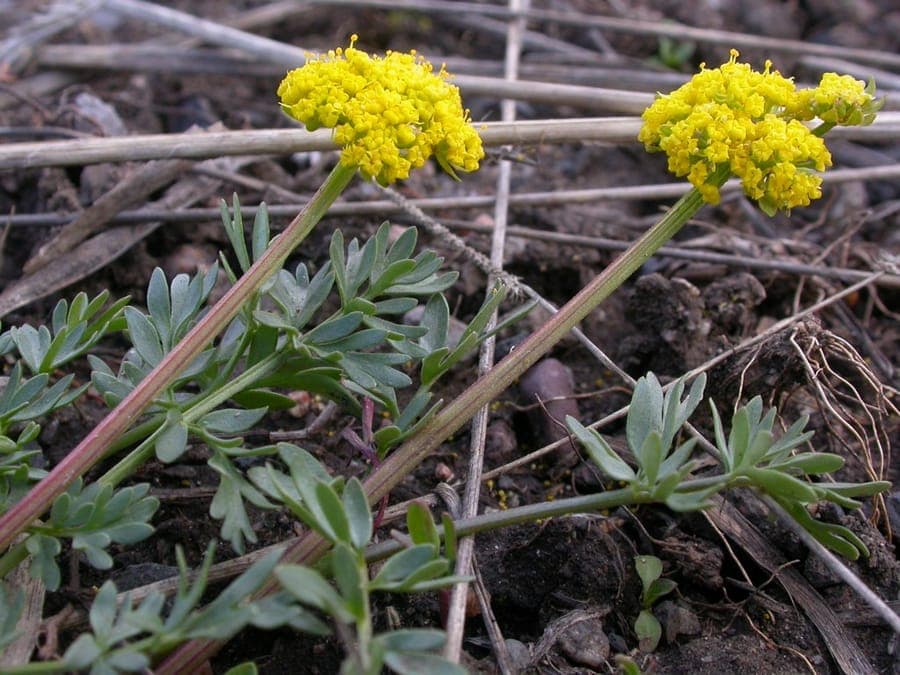
Matt Lavin from Bozeman, Montana, USA / CC BY-SA 2.0, via Wikimedia Commons
Cous biscuitroot: complete guide
Lomatium cous
Want to see Cous biscuitroot: complete guide in your garden?
1 minute, no credit card
Overview
Lomatium cous, commonly called cous biscuitroot or cous-root desert-parsley, is a perennial herb in the Apiaceae (carrot family). Native to the dry grasslands and steppe landscapes of western North America, its range extends from Alberta and Saskatchewan in Canada southward through Montana, Idaho, Oregon, Washington, Wyoming, Utah, Nevada, and the Dakotas. The name 'cous' refers to the edible starchy root that Indigenous peoples including the Nez Perce and other Plateau cultures harvested as a staple food, somewhat resembling a small turnip.
This plant belongs to the genus Lomatium, which encompasses over 70 species across western North America. All share umbel-shaped flower clusters and deep taproot systems that allow them to survive prolonged drought. Lomatium cous is distinguished by its rhizomatous growth, finely dissected foliage, and yellow flowers that emerge early in the season, sometimes in April when snow has barely retreated.
For gardeners interested in drought-tolerant, ecologically valuable planting, Lomatium cous is a fascinating choice that deserves broader cultivation in European gardens. It attracts early-season pollinators including honeybees, bumblebees, and hoverflies that are searching for nectar in spring. Older synonyms include Peucedanum cous, Cogswellia cous, and Lomatium montanum. The currently accepted name was formalized by J.M. Coulter and Rose in 1900.
On gardenworld.app you can find inspiration for garden designs that integrate this and similar native plants in an attractive way, combining ecological function with visual appeal.
Appearance & bloom cycle
Lomatium cous is a low, rosette-forming perennial typically reaching 20-40 cm in height, occasionally 50 cm under favorable conditions. The leaves are finely compound, multiply pinnate, giving the plant an airy appearance reminiscent of fennel or wild parsley. Foliage is green, fine in texture, sometimes with a subtle blue-green tinge. Individual leaflets measure 2-5 cm and are finely divided into thread-like segments.
The flower heads are characteristic compound umbels appearing at the tips of stems. Individual flowers are small and yellow, held together in compound umbels 5-15 cm across. Each umbel contains dozens of tiny blossoms. Bloom period runs from April through June depending on elevation and climate. At lower elevations, flowering can begin in late April; at higher altitudes, June is typical.
After flowering, the plant produces flat, oval fruits 1-2 cm long with pronounced lateral wings - a characteristic feature of the Lomatium genus. Fruits turn brown and ripen in July-August. Seeds disperse by wind thanks to the wings. Above-ground parts die back in summer drought, but the thick taproot or rhizome survives underground. New growth emerges in autumn or the following early spring.
The rhizomatous growth form means the plant can slowly spread via underground horizontal rhizomes, forming gradual colonies over time. Established specimens in suitable sites can live for decades, with root systems reaching 60-90 cm deep.
Ideal location
Lomatium cous thrives in a sunny to lightly semi-shaded position. Full sun for at least 6 hours daily is ideal. The plant tolerates partial shade but blooms less profusely and grows more slowly. In European gardens, where summers are generally less intense than the native range, a sunny position is especially important.
This plant is excellent for rock gardens, steppe borders, dry gravel beds, or as part of a native-inspired prairie-style planting scheme. Place it where soil drains freely after rain, since waterlogging around the root crown is the greatest threat in European climates. A slightly raised bed or gentle slope is ideal.
Avoid deep shade, dense ground covers planted too closely, or any location with persistent soil moisture. Keep away from pond margins or low-lying areas that collect water. A south- or west-facing front garden with reflective paving nearby suits this plant well, reproducing some of the warmth of its natural habitat.
Soil requirements
This plant is adapted to poor to moderately fertile, well-draining soils. The pH range spans 6.0 to 8.5, accommodating both mildly acidic and moderately alkaline soils. In its native environment it grows on sandy loam, loamy soils over rocky substrates, and occasionally on gravelly hillside crests.
In cultivation: avoid heavy clay without amendment. On clay soils, incorporate coarse sand and gravel (equal parts clay, sharp sand, and gravel in the top 30 cm). Porous soil with modest organic matter is fine; overly rich compost-amended soil produces excessive leafy growth at the expense of flowers and increases root rot risk.
A 5-10 cm mulch layer of gravel or grit on top of the soil offers two benefits: it keeps the root crown dry, and it reflects warmth that encourages the plant. Space plants 30-45 cm from neighbors. The taproot can reach 60-90 cm deep, so avoid digging or cultivating in the immediate vicinity once established.
Watering
Lomatium cous is an emphatically drought-tolerant plant once well rooted, which typically takes 1-2 growing seasons after planting. In its native habitat it survives summers of several months with negligible rainfall by drawing on deep groundwater through its taproot.
In the first year after planting: water moderately, approximately every 7-10 days during dry, warm weather. Allow the soil to dry completely to a depth of 10 cm between waterings. Avoid daily irrigation - this inhibits deep root development and encourages shallow rooting, making plants more vulnerable later.
From the second year onward, supplemental watering in a temperate European climate (UK, Netherlands, northern Germany) is rarely necessary. During hot, dry summers you can give a thorough deep watering every 2-3 weeks, but more frequent irrigation is unnecessary and detrimental. In summer, as the plant enters partial dormancy, it is particularly susceptible to root rot from excess moisture.
In autumn and winter, no watering is needed. Rainfall is sufficient.
Free design
Want to see Cous biscuitroot: complete guide in your garden? Make a free design now.
Pruning
Lomatium cous requires minimal pruning. After flowering and fruiting in June-August, spent flower stems can be removed if they look untidy. It is better to leave them standing until seed has fully ripened - this benefits insects and birds, and allows the plant to self-seed where conditions are suitable.
In late autumn, after the first frost, dried leaf and stem remnants can be removed. This is optional; the dead plant material provides modest frost protection for the root crown and adds winter texture to the garden.
Never prune aggressively and never remove the central rosette. The rhizome and taproot are vulnerable to damage. Always use clean, sharp secateurs for any maintenance work.
Maintenance calendar
January-February: No action needed. Plant is dormant. Consider a light mulch during prolonged severe frost (below -15 degrees C).
March: In mild spring temperatures the plant starts growing again. No fertiliser needed. Remove dead remnants from the previous season if not done already.
April: Flowering begins in favorable years. Check for slugs that may attack young leaf shoots. No watering needed unless extremely dry and warm.
May: Peak bloom period. Yellow umbels attract many pollinators. No fertilising, no generous watering.
June: Fruit set begins. Leave flower stems for seed formation. The plant begins to die back as temperatures rise.
July-August: Above-ground parts die back. Remove dry material if desired. Plant is in summer dormancy. Do not water.
September: Sometimes a second small flush of leaves in cooler autumn weather. Possible to sow ripe seed directly in place.
October-November: Last leaf remnants dry out. Optionally refresh a thin gravel mulch layer around the root crown.
December: Rest. Plant overwinters comfortably in USDA zones 3-7.
Winter hardiness
Lomatium cous is an exceptionally hardy plant. In its native range it survives the harsh winters of Montana, Wyoming, and Alberta, where temperatures regularly drop to -25 degrees C or below. USDA hardiness zones 3-7 apply, meaning the plant overwinters without difficulty throughout the UK, Netherlands, Belgium, and most of Germany and France.
The key to successful overwintering is not minimum temperature per se, but the combination of excess moisture and freezing. Stagnant moisture around the root crown combined with freeze-thaw cycles is the most common cause of death for cultivated specimens in European gardens. A 5-8 cm gravel mulch around (not over) the root crown substantially reduces this risk.
Snow cover is actually beneficial, providing soil insulation. In regions with little snow but regular frost periods (such as coastal Netherlands and Belgium), extra protection using dry straw or leaves during the coldest spells is a sensible precaution.
Companion plants
Lomatium cous combines beautifully with other drought-tolerant, open steppe-oriented plants. Good companion choices include:
- Penstemon species (beardtongue, including Penstemon davidsonii and P. strictus) - similar soil requirements, complementary blue or red flowers in the same season. Plant 30-40 cm apart.
- Eriogonum umbellatum (sulphur buckwheat) - low-growing, yellow flowers, excellent for dry rock gardens alongside Lomatium.
- Allium cernuum (nodding onion) - soft pink-lilac flowers in July-August when Lomatium is in dormancy, providing succession interest. Plant at 25-35 cm spacing.
- Artemisia frigida (fringed sagebrush) - silver-grey foliage as elegant contrast. Both tolerate extreme drought and alkaline soils.
- Festuca idahoensis (Idaho fescue) - fine-textured grass clumps between Lomatium rosettes create an authentic prairie appearance. Spacing of 20-30 cm.
- Gaillardia aristata (blanket flower) - fiery yellow and red flowers in summer when Lomatium retreats, extending the season beautifully.
In larger borders, combinations with Salvia nemorosa, Echinacea purpurea, or Rudbeckia fulgida are possible, though these require slightly more moisture. Plant them at 30-50 cm from Lomatium to avoid root competition.
Visit gardenworld.app for professionally composed garden designs that incorporate Lomatium cous and its companions in combinations optimised for your specific garden situation.
Closing
Lomatium cous is a remarkable perennial for the adventurous gardener who looks beyond conventional choices. Its yellow umbel flowers appear early in the season when few other plants are blooming, making it ecologically valuable for early-season pollinators including honeybees, bumblebees, hoverflies, and native mason bees. Its extreme drought tolerance and broad pH range (6.0-8.5) suit it to challenging positions where other plants struggle.
The plant rewards patience: in its first year it grows slowly as the taproot penetrates deep into the soil. But once established it is essentially maintenance-free for years. The recipe for success is simple - well-draining soil, ample sun, and restraint with the watering can.
Whether you grow it in a rock garden, a dry steppe border, or a native prairie scheme, Lomatium cous brings something genuinely unusual to the planting palette. Seek it out from specialist native plant nurseries or garden centres with a strong perennial selection.
Want to see Cous biscuitroot: complete guide in your garden? Make a free design now.
Upload a photo, pick a style, and get a photorealistic design with plant list in under a minute.
10,000+ gardens designed already
No credit card required


Similar plants
Whorled carrot: complete guide
Daucus involucratus
Daucus involucratus is a Mediterranean umbellifer with white flower heads framed by lacy bracts. Growing this gravel garden gem.
Daucus muricatus: complete guide
Daucus muricatus
Daucus muricatus, the spiny wild carrot, grows wild on Mediterranean coasts. Discover sowing, June-July bloom, and wildflower meadow use.
Daucus pumilus: complete guide
Daucus pumilus
Daucus pumilus is a dwarf wild carrot relative with white lacy umbels, thriving on dunes and coastal rock in poor, fast-draining soil.