
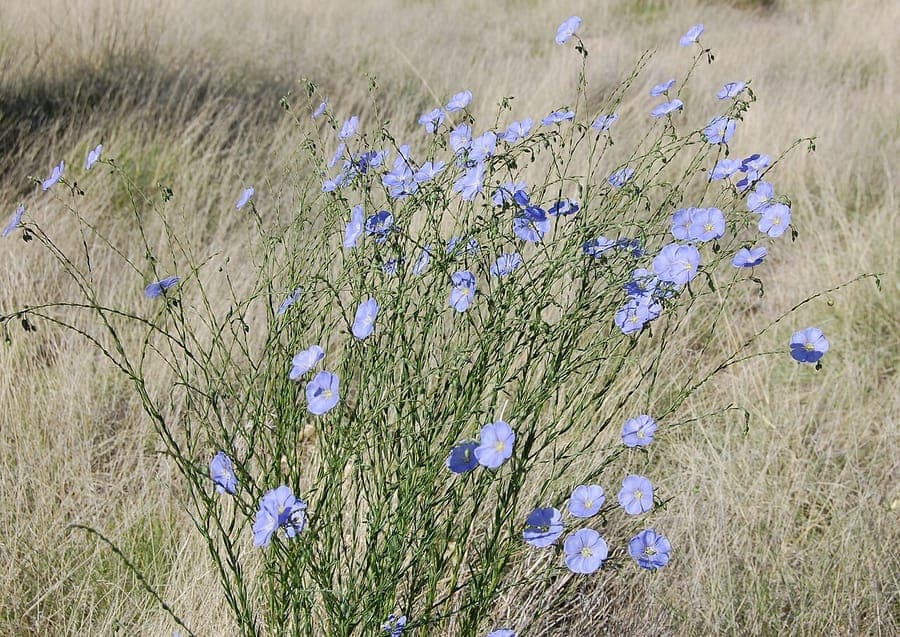
Skoch3 / CC BY-SA 3.0, via Wikimedia Commons
Lewis's flax: complete guide
Linum lewisii
Want to see Lewis's flax: complete guide in your garden?
1 minute, no credit card
Overview
Linum lewisii, commonly known as Lewis's flax or wild blue flax, is an elegant perennial herb in the family Linaceae. The species was formally described in 1813 by Frederick Pursh from specimens collected by Meriwether Lewis during the legendary Lewis and Clark Expedition across the American West. This botanical connection - the species named directly after an explorer - gives the plant a remarkable historical dimension unusual in horticulture.
The plant is native to an enormous geographic range, from Alaska and the Yukon in the north to northern Mexico in the south, and from the coastal ranges of British Columbia and California in the west to the great plains of Kansas, Nebraska, and the Dakotas in the east. This vast distribution reflects exceptional adaptability to diverse climates and soil types. In its home range, Lewis's flax grows on open, dry grasslands, in pine and spruce openings, along rocky slopes, and on calcareous soils.
In cultivation, the plant is prized for its beauty: slender, sky-blue to blue-violet flowers that appear to float on the delicate stem network, creating an airy, almost ethereal display. Each individual flower lasts only one day, but buds open in succession day after day throughout a long blooming season from June to August. This makes Linum lewisii excellent for naturalistic gardens, prairie-style plantings, and as a companion to other drought-tolerant species in a mixed border. Visit gardenworld.app to see how plants like Lewis's flax are used in contemporary garden designs for dry, sunny situations.
The plant has a bunching growth form with moderate growth rate. Height ranges from 30 to 60 cm, with stems that grow upright but sway gracefully in the wind. The spread of a mature clump is typically 20 to 40 cm. Botanical synonyms include Linum perenne var. lewisii, Adenolinum lewisii, and Linum sibiricum var. lewisii, reflecting the close relationship to the Eurasian species Linum perenne.
Appearance & bloom cycle
Linum lewisii has an open, somewhat airy habit consisting of multiple upright stems arising from a central root crown. The stems are slender but wiry and tough, clothed in small, narrow, lance-shaped leaves 1 to 3 cm long. The leaves are dark green to grey-green, alternate along the stems, and of medium texture - firm to the touch but not rough.
The flowers are the undisputed highlight of the plant. They are sky-blue to lavender-blue, sometimes with a lighter blue to whitish central zone, measuring 2 to 3 cm across. Each flower has five broad, thin petals that form an open, shallow bowl shape. The flowers open in the morning when sunlight strikes them and shed their petals by afternoon or on overcast days - this is entirely normal behaviour and not a sign of disease. The dropped petals are immediately replaced by new blooms opening from other buds on the same stems.
The blooming period runs from approximately June to August, depending on region and climate. In warm coastal regions, flowering may begin in May and continue into September. Cultivars such as 'Appar' and 'Flax Blue' offer somewhat greater floriferousness than wild-type plants, with slightly larger flowers on sturdier stems. A well-established group of Linum lewisii produces near-continuous bloom throughout these summer months.
After flowering, small round seed capsules develop and split open to release the shiny seeds. The plant self-seeds modestly in suitable conditions, which is an advantage in naturalistic gardens but should be managed in formal borders. The dried stems and seed capsules are attractive and can be left for winter interest or harvested for seed collection.
Ideal location
Linum lewisii thrives best in a fully sunny, open location. The plant evolved on open grasslands and mountain meadows with maximum solar exposure and needs at least 6 hours of direct sunlight daily for optimal blooming and sturdy, upright habit. In lower light levels, stems become thinner and weaker, causing the plant to lean and flop.
A south-facing or south-west-facing position in the garden is ideal. The plant tolerates moderate wind, making it suitable for open borders and slope plantings. It is less suited to sheltered, damp garden corners. When placing Lewis's flax in a border, choose a spot not shaded by taller neighbours, as insufficient light quickly reduces flowering and weakens stem structure.
A raised bed or gently sloping position improves drainage and prevents water accumulation around the root zone - particularly relevant during wet periods. The plant also grows well in large containers with adequate drainage holes positioned in a sunny, warm spot.
Soil requirements
The soil requirements of Linum lewisii are easily understood from its native habitat: open, dry grassland and rocky slopes with lean, sharply draining substrates. The ideal pH range is 5.6 to 8.4, an exceptionally wide range indicating adaptability to both slightly acidic and strongly alkaline calcareous soils. This versatility makes the plant particularly easy to accommodate in most garden situations.
The plant performs best in lean to moderately fertile, freely draining sandy or gravelly soil. Rich, heavy clay is less suitable: the plant becomes lush but weak and tends to flop, reducing the attractive airy display. Improve heavy soils by working in 5 to 10 cm of sharp sand and fine gravel before planting, or use a rock garden mix.
For container growing: use a lean, well-draining medium such as a mix of 50% general garden compost, 30% perlite or coarse sand, and 20% small gravel or grit. Avoid standard potting compost without amendment, as it retains too much moisture. Always ensure large drainage holes and never allow the pot to stand in water.
A mulch layer can be used to retain moisture in dry summers, but never apply it directly against the crown. Keep a mulch-free ring of 3 to 5 cm around the base of the plant to prevent crown rot.
Free design
Want to see Lewis's flax: complete guide in your garden? Make a free design now.
Watering
Once established, Linum lewisii is highly drought-tolerant. In its home range - the dry prairies and mountain grasslands of western North America - it survives on the sparse precipitation of dry summers and cold winters. In European gardens, where summers are generally wetter than in the plant's origin zone, supplemental watering is rarely necessary after the first year.
The first growing season after planting is the critical phase. Plant ideally in early autumn, allowing the winter months for root establishment before the first summer. Water regularly in autumn and through the first spring - once weekly during dry weather - to develop a strong root system. Once well established, watering can be reduced to only during extended dry spells.
In dry summers, during periods exceeding two weeks without rain, water in the early morning, directly to the ground around the roots, until the soil is moist to 10 to 15 cm depth. This may be needed every two weeks at most. Overwatering leads to root rot and premature decline.
Never allow soil to remain waterlogged for extended periods. Standing water in the root zone is more damaging than drought. After heavy rain events, check that drainage conditions are adequate.
Pruning
Linum lewisii needs relatively little pruning but benefits noticeably from well-timed trimming. After the first flush of bloom, when flowering begins to diminish (typically in August), cut the stems back to approximately half their length. This often stimulates a second, less prolific but still attractive late-summer or autumn flush of flowers.
In early spring, when the first new shoots become visible from the root crown (typically late March or early April), remove the old, dried stems from the previous season entirely. Cutting down to ground level is possible, but leaving a 3 to 5 cm stub protects the root crown. The plant regenerates vigorously from the roots.
Deadheading during the main flowering period is not practical given the quantity of flowers produced and the one-day flower lifespan. Instead, simply ensure old dead stems are removed before new growth in spring. In naturalistic plantings: allow seed capsules to ripen and open for natural self-seeding. In formal borders: collect or remove capsules before they open to control spread.
Maintenance calendar
January to February: Plant is dormant. Dry, standing stems can provide some insulation against frost and are best left until spring. Check drainage during thaw periods.
March to April: Remove winter stems as new growth becomes visible. Check for winter damage. Fertiliser is rarely needed; a small dose of low-nitrogen, potassium-rich fertiliser can enhance flowering.
May: First flower buds appear. Ensure adequate spacing around plants. Remove unwanted self-seeded plants if too crowded.
June to August: Main flowering period. Maintain adequate air circulation; remove stems flattened by wind or rain. Water only during extended drought.
August: After the first bloom flush: cut stems back by half to encourage a possible second flowering.
September to October: Seed capsules ripen. Harvest seeds or leave for birds. Plant new specimens.
November to December: Minimal maintenance. Plant enters winter dormancy.
Winter hardiness
Linum lewisii is an exceptionally winter-hardy perennial that in its native range withstands temperatures of -30 °C and below, provided the roots are in dry conditions. In European garden settings, the plant is suitable for USDA zones 3 to 8, covering all of the Netherlands, Belgium, and much of Germany. Under normal conditions it overwinters without difficulty.
Winter hardiness depends significantly on drainage. A well-draining soil is the key: roots entering winter in waterlogged soil are far more vulnerable than roots in dry, open-textured ground. On light sandy soils or in raised borders, the plant typically overwinters without any problems.
In areas with heavy clay or high groundwater tables, consider planting in raised beds at least 20 cm high, filled with draining substrate. This can be the deciding factor between a plant that returns reliably year after year and one that succumbs after the first wet winter.
In extreme cold (sustained periods below -15 °C, rare in the Netherlands and Belgium), light protection with pine branches or a straw layer over the root zone provides useful insurance. Remove the protection promptly when temperatures rise above freezing.
Companion plants
Linum lewisii fits beautifully into plant combinations that evoke the spirit of western prairies and dry mountain meadows:
-
Echinacea purpurea (purple coneflower): the pink-purple flowers bloom simultaneously with Lewis's flax, creating a classic prairie pairing. Growing height 60 to 90 cm, plant at 40 to 50 cm spacing.
-
Salvia nemorosa (meadow sage): compact blue-purple flower spikes that combine excellently with the sky-blue of Linum. Plant at 30 to 40 cm spacing.
-
Gaillardia aristata (blanket flower): warm orange and yellow blooms that create vivid colour contrast with the blue flax. Both plants are drought-tolerant and bloom from June to August.
-
Penstemon strictus (Rocky Mountain penstemon): blue to violet flower clusters on upright stems. Shares the same preference for dry, well-draining soil and full sun.
-
Agastache foeniculum (anise hyssop): blue-purple flower spikes with aromatic foliage, attractive to bees and butterflies, floriferous and drought-tolerant.
Space Linum lewisii at 30 to 40 cm apart. In a border, plant in groups of three to five for maximum visual impact. Avoid overcrowding, which reduces air circulation and increases the risk of fungal disease.
Conclusion
Lewis's flax is a plant of exceptional delicacy and beauty - the translucent blue of the flowers, the way the slender stems sway in the breeze, and the daily renewal of blooms from June to August create a living display that few other perennials can match for sustained, effortless elegance. Named after a great explorer, it brings a piece of the wild American West into the European garden, performing reliably year after year with minimal care.
For complete garden design with blue perennials, prairie-style planting schemes, or drought-tolerant combinations, visit gardenworld.app for design inspiration and planting guidance that will help you create a beautiful, low-maintenance garden tailored to your space.
Want to see Lewis's flax: complete guide in your garden? Make a free design now.
Upload a photo, pick a style, and get a photorealistic design with plant list in under a minute.
10,000+ gardens designed already
No credit card required


Similar plants
Tree Flax: complete guide
Linum arboreum
Discover Tree Flax (Linum arboreum), a Mediterranean shrub with golden-yellow flowers and fine needle-like foliage. Perfect for sun-soaked dry gardens and rocky terraces.
Sea flax: complete guide
Linum maritimum L.
Sea flax is a Mediterranean coastal shrub with delicate yellow flowers. Learn how to grow and care for this salt-tolerant plant in your garden.
Linum corymbulosum: complete guide
Linum corymbulosum
Meet clustered flax, a refined Mediterranean plant with delicate flowers. Perfect for dry, sunny spots in your front garden design.