
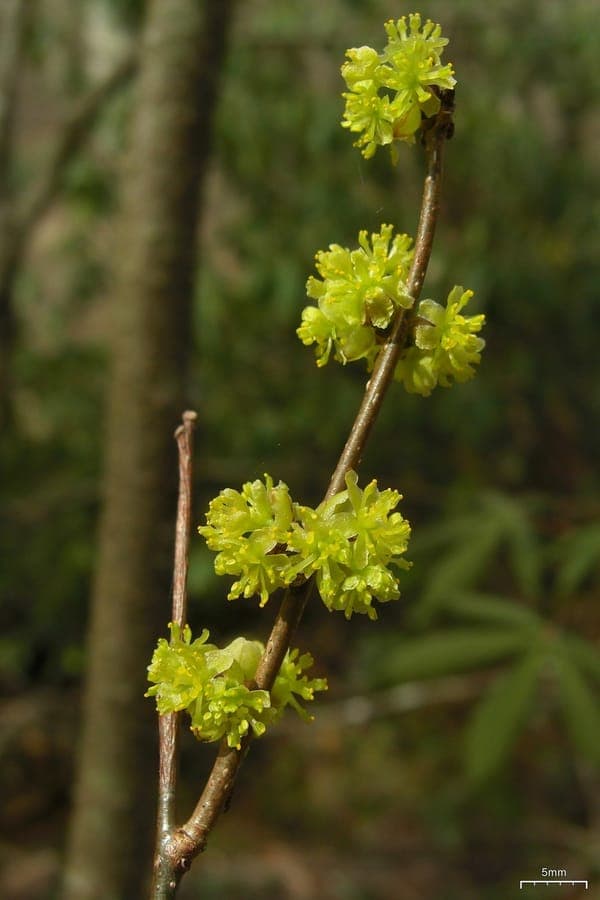
Jason Hollinger / CC BY 2.0, via Wikimedia Commons
Spicebush: complete guide
Lindera benzoin
Want to see Spicebush: complete guide in your garden?
1 minute, no credit card
Overview
Lindera benzoin, commonly known as spicebush, northern spicebush, or wild allspice, is a deciduous shrub in the laurel family (Lauraceae) native to the moist woodlands, stream margins, and bottomland forests of eastern and central North America. Its natural range extends from Ontario, Maine, and Vermont south to Florida, Texas, and Oklahoma, where it thrives as an understorey species beneath the canopy of mixed hardwood forests.
The genus name honours Johann Linder, an eighteenth-century Swedish physician and botanist, while the species epithet 'benzoin' refers to the distinctive spicy, resinous fragrance - reminiscent of cloves, allspice, and cinnamon - released when leaves, twigs, or berries are crushed. This aromatic quality led early European settlers to use the plant as a spice substitute during periods when imported spices were scarce, and indigenous peoples had long used it medicinally as a fever remedy and stimulant tonic.
In ecological terms, spicebush is an irreplaceable native plant: it is the exclusive larval host of the spicebush swallowtail butterfly (Papilio troilus) and the promethea silk moth (Callosamia promethea), and its fat-rich red berries are a critical pre-migration fuel source for dozens of neotropical songbirds including thrushes, vireos, and warblers. For European gardeners seeking plants with four-season appeal, shade tolerance, and genuine wildlife value, Lindera benzoin is an outstanding choice. Explore how it fits into a woodland-edge garden design at gardenworld.app.
Appearance & bloom cycle
Spicebush is a slow-growing, multi-stemmed shrub forming a rounded to broadly spreading mound. After ten to fifteen years it typically reaches 150–250 cm in height and spread; mature specimens in ideal conditions can achieve 300 cm or more, but this takes many decades. Annual growth under favourable conditions is 10–20 cm.
The stems are multiple from the base, giving a full, dense habit. Young twigs are greenish, aromatic when broken, and smooth; older branches become grey-brown. The bark is finely dotted with pale lenticels.
Leaves are alternate, elliptic to obovate, 6–14 cm long and 3–8 cm wide, bright medium green above and slightly paler beneath. The leaf surface is smooth and slightly glossy. When crushed, leaves release a distinctive spicy fragrance - the defining feature of the plant. Autumn colour is a consistent, clean bright yellow, turning in October and remaining colourful for two to three weeks - one of the most reliable yellow autumn displays of any shrub.
Flowers appear in March and April, well before the leaves unfurl - clusters of tiny bright yellow flowers crowded in tight axillary groups of 4–8 along the bare dark twigs. They are subtly but pleasantly fragrant. Spicebush is dioecious: male and female flowers are borne on separate plants, and both sexes must be present for fruit to develop. Fruits are smooth, glossy drupes about 1–1.5 cm across, ripening from green through vivid red to deep red or nearly black by September and October. They are intensely aromatic and eagerly consumed by birds.
Ideal location
One of spicebush's most valuable garden qualities is its genuine shade tolerance. In nature it grows as a woodland understorey shrub, typically receiving dappled light or even dense shade for much of the day. This makes it one of the very few flowering, fruiting shrubs that performs well in difficult shaded conditions where most ornamentals fail.
It thrives equally in partial shade (2–4 hours direct sun), dappled light beneath a light tree canopy, and even fairly dense shade. Full sun is possible but requires consistently moist soil; plants in dry, sunny positions suffer leaf scorch in summer and are more vulnerable to drought stress.
The ideal position combines partial shade with humus-rich, moisture-retentive soil - along the northern boundary of a garden, beneath a light canopy of deciduous trees, beside a pond, or in a moist low-lying area. For maximum berry production and the best show of both spring flowers and autumn colour, plant at least two shrubs (one male, one or two female) within 5 metres of each other.
Spicebush suits a wide range of garden styles: woodland gardens, naturalistic plantings, rain gardens, and shaded urban courtyards. In a smaller garden it works beautifully as a focal specimen in a shaded corner.
Soil requirements
Spicebush requires mildly to moderately acidic, humus-rich, consistently moist soil with reasonable drainage. The optimal pH range is 4.5–6.0, similar to rhododendrons and azaleas. On alkaline or calcareous soils, the plant develops iron chlorosis (yellowing of the leaves between the veins) and grows poorly - correct the pH before planting by incorporating acidic organic matter (ericaceous compost, leaf mould, pine bark) or apply a specialist acidifying fertiliser.
In its native woodland habitat, spicebush grows on deep, humus-rich, moist forest floor soils. In the garden, replicate this as closely as possible: work 10–15 cm of well-rotted leaf mould or ericaceous compost into the planting hole to a depth of 30–40 cm. Annual top-dressing with 5–8 cm of wood chip, leaf mould, or acidic bark mulch is highly beneficial and is the most effective single maintenance step you can take.
Heavy clay is tolerable if drainage is adequate and the soil is enriched with organic matter. Sandy soils need substantial organic amendment to retain moisture; without it, spicebush will struggle through dry summers. The plant has a naturally shallow root system, so maintaining consistent surface moisture - particularly through mulching - is critical.
Free design
Want to see Spicebush: complete guide in your garden? Make a free design now.
Watering
Spicebush is not drought tolerant and requires consistent soil moisture throughout the growing season. It is a naturally riparian and understorey species, accustomed to moisture-rich environments, and this characteristic must be respected in the garden.
In the first and second years after planting, water regularly throughout the growing season. During dry, warm spells, apply 15–20 litres per plant weekly, watering deeply at the root zone. The shallow root system means the plant feels drought stress quickly, and prolonged dry periods in the establishment phase can set back growth significantly.
From the third year onwards, established plants on moisture-retentive soil with good mulch coverage will generally cope through average northern European summers without supplemental irrigation. In prolonged dry spells (more than two to three weeks without significant rain), water thoroughly every seven to ten days. In full sun positions, irrigation needs are higher - every five to seven days during hot, dry weather.
The most effective way to maintain soil moisture is a thick, permanent mulch of 5–8 cm of leaf mould, wood chips, or bark around the shrub, replenished annually each autumn or spring. Drip irrigation works well in established plantings.
Pruning
Spicebush requires minimal pruning and naturally maintains a full, attractive shape. Its slow growth rate means it rarely outgrows its allotted space within the first ten to fifteen years.
The ideal pruning time is immediately after flowering in April or May, allowing the current season's new growth - which will bear next year's flowers - to develop fully before winter. At this time, remove only crossing or rubbing branches, dead wood, and any low-hanging stems that cause obstruction.
Avoid hard pruning: spicebush blooms on old wood, and severe cutting back removes flowering wood and can set the plant back several years. If rejuvenation is needed, take a gradual approach over two to three years, removing no more than one-quarter of the oldest, most congested stems to ground level each year. This encourages vigorous young growth while preserving flowering capacity.
In late spring, after the last frost risk has passed, remove any winter-damaged or dead wood that has become apparent. Young plants in their first three years benefit from removal of weak inward-facing shoots to keep the structure open and well-aired.
Maintenance calendar
March: Check for frost damage. Apply a fresh layer of mulch (5–8 cm) around the shrub, keeping mulch 10 cm clear of stems. Enjoy the early spring flowers on the bare twigs.
April–May: Leaves unfurl. Carry out any corrective pruning immediately after flowering. Check soil moisture in dry spring spells and water if necessary.
June–July: Active vegetative growth. In dry weather, water regularly. Green fruits are already visible on female plants.
August–September: Fruits ripen from green through vivid red. This is one of the most decorative periods. Birds begin foraging actively for the ripe berries.
October: Peak autumn colour in bright, clear yellow. Fruits deepen to dark red or near-black. Replenish mulch for winter.
November–December: Leaf fall. Check that the planting position is not becoming excessively wet over winter. No active irrigation needed.
January–February: No active care. Flower buds visible on the bare twigs, already swelling in preparation for the early spring display.
Winter hardiness
Spicebush is reliably hardy throughout northern and central Europe, rated USDA zones 4–9. It withstands temperatures as low as -25 °C without damage. In the Netherlands, Belgium, Germany, northern France, and the UK, it overwinters without any protection in all but the most extreme conditions.
In a temperate maritime climate such as the Benelux (typically USDA zone 7–8), winter hardiness is never a concern. Even in harsh continental winters with temperatures reaching -15 to -18 °C, the shrub remains fully intact. The flower buds set in autumn are slightly susceptible to very late spring frosts in March - a severe late frost can reduce or eliminate flowering in that particular year, but causes no lasting harm to the plant.
Young plants in their first winter may be slightly more vulnerable. A precautionary mulch of 10 cm around the root zone is worthwhile in the first winter, especially on light, free-draining soils.
Companion plants
Spicebush is superb in moist, shaded woodland gardens, naturalistic plantings, and stream-side schemes. Outstanding companions include:
- Hamamelis mollis or H. x intermedia (witch-hazel): also a very early spring flowering shrub with yellow to orange flowers on bare stems, complementary seasonal rhythm, excellent as a pairing for early spring interest in partial shade.
- Fothergilla gardenii or F. major: white bottlebrush flowers in spring, shared preference for moist, acidic soil, and magnificent autumn colours in red and orange that complement the yellow of Lindera perfectly.
- Viburnum cassinoides or V. lantanoides (witherod or hobblebush): white spring flower clusters, dark berries in autumn, good shade tolerance and moist soil preference.
- Leucothoe fontanesiana (drooping leucothoe): low arching groundcover with burgundy winter foliage, thriving under the same acidic, moist conditions.
- Hosta varieties: bold foliage groundcover for the root zone of spicebush, benefiting from the same moist, humus-rich soil.
- Carex morrowii or C. pendula (sedges): grass-like structure suited to the moist, shaded conditions around Lindera benzoin.
- Trillium grandiflorum (great white trillium): spectacular spring woodland perennial requiring the same moist, mildly acidic, humus-rich soil.
For garden centres in the UK and northern Europe, spicebush is available from specialist native and woodland plant nurseries. It is best planted in spring or early autumn.
Conclusion
Spicebush is a uniquely rewarding four-season shrub: early yellow flowers on bare stems in March and April, pleasantly aromatic foliage through summer, vivid red berries in September and October, and a clean bright yellow autumn colour display. Its genuine shade tolerance sets it apart from most ornamental fruiting shrubs, making it invaluable for the challenging shaded corners of gardens.
For a personalised planting plan incorporating spicebush alongside the best woodland companions, visit gardenworld.app and design your ideal garden border or shaded courtyard scheme.
Want to see Spicebush: complete guide in your garden? Make a free design now.
Upload a photo, pick a style, and get a photorealistic design with plant list in under a minute.
10,000+ gardens designed already
No credit card required


Similar plants
Ocotea floribunda: complete guide
Ocotea floribunda
All about Ocotea floribunda, a tropical laurel tree from Central and South America: growing in temperate climates, containers, pruning, and care in greenhouses.
Redbay: complete guide
Persea borbonia
A full guide to redbay (Persea borbonia), a fragrant evergreen tree native to the southeastern United States, related to avocado and laurel.
Swamp bay: complete guide
Persea palustris
A full guide to swamp bay (Persea palustris), an evergreen tree native to the wetlands and coastal swamps of the southeastern United States.