
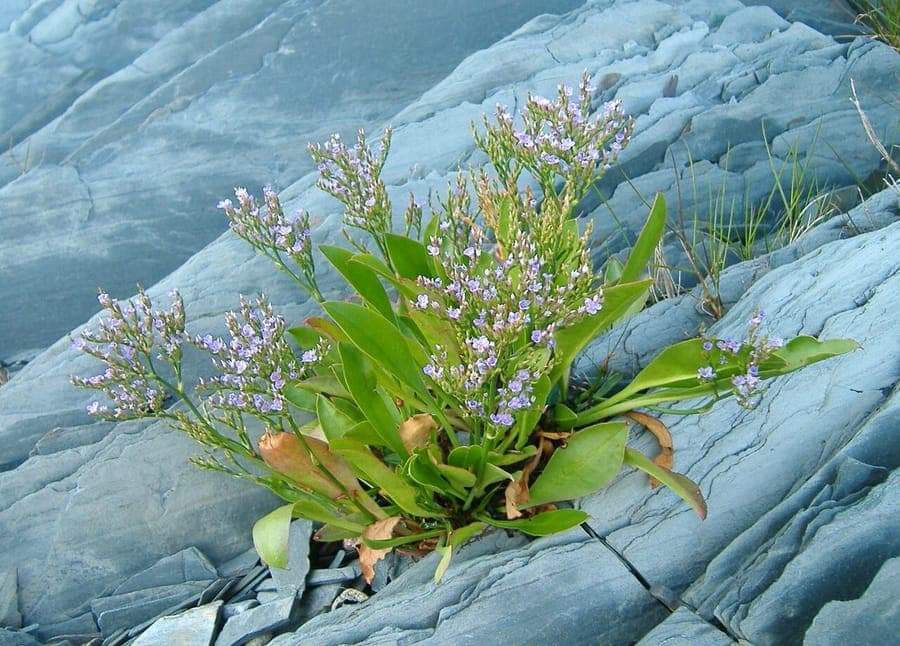
Limonium-nashii.JPG: Botsci derivative work: Bff (talk) / Public domain, via Wikimedia Commons
Carolina sea-lavender: complete guide
Limonium carolinianum
Want to see Carolina sea-lavender: complete guide in your garden?
1 minute, no credit card
Overview
Limonium carolinianum, commonly called Carolina sea-lavender, marsh rosemary, American thrift, or seaside thrift, is a native perennial forb in the family Plumbaginaceae - the same family as the familiar sea thrift (Armeria). It grows along the Atlantic and Gulf coasts of North America, from Newfoundland and Labrador south to Florida and the northeastern coast of Mexico, including Bermuda. In the wild, it colonises salt marshes, tidal flats, brackish shorelines, and sandy coastal strips that experience regular exposure to salt spray and periodic tidal inundation.
The genus name Limonium derives from the Greek leimon (wet meadow) - a nod to the moist coastal habitats the genus favours. The species was formally placed in this genus by Nathaniel Lord Britton in 1894, drawing on Thomas Walter's earlier epithet caroliniana from his 1788 flora of Carolina. Older literature lists it as Statice caroliniana (Walter) or Limonium nashii (Small). Several geographic varieties are recognised: var. nashii, var. compactum, var. angustatum, and var. trichogonum, which differ subtly in leaf shape and flower cluster density but are horticulturally identical.
As a garden plant, Carolina sea-lavender brings a two-season spectacle: a rosette of handsome, glossy dark-green leathery leaves year-round, followed by an airy cloud of tiny lavender-blue flowers on rigid, branched stems 30 to 60 cm tall from July through September. The papery, persistent calyces remain on the stems long after the petals fall, creating a natural dried-flower effect - making Limonium carolinianum as valuable in autumn as in summer. For design ideas that incorporate this coastal classic, visit gardenworld.app.
The plant's standout ecological feature is its exceptional salt tolerance. It withstands saltwater spray, occasional inundation with brackish water, and highly alkaline soils that would defeat most ornamental perennials. This makes it irreplaceable in seaside gardens, coastal promenades, and areas near roads that receive salt spray or saline run-off in winter.
Appearance & bloom cycle
Carolina sea-lavender forms a compact basal rosette of leathery, spatula-shaped to broadly oval leaves, 8 to 20 cm long, smooth and glossy dark green above, paler grey-green beneath, with a slightly wavy margin. The leaves are semi-evergreen to evergreen in mild winters. Their texture - thick and almost succulent-like - helps the plant cope with both drought and salt exposure.
From July onwards, rigid, leafless flowering stems emerge from the centre of the rosette. These branch repeatedly in their upper half, creating a wide, flat-topped or broadly domed canopy of tiny flower clusters. Each individual flower is 3 to 5 mm across, with 5 lavender-blue petals and a persistent white papery calyx. The combined effect of hundreds of these small flowers - covering the upper portions of the branched stems - is a hazy, misty cloud of soft purple-blue that is visible from a considerable distance.
Peak flowering runs from July through September, with the most intense display in August. After the petals fall, the papery white calyces remain on the stems, continuing to provide ornamental interest through October and into winter. Cut stems at peak bloom dry naturally and are widely used in dried flower arrangements; Limonium features prominently in commercial dried flower production for exactly this reason.
The growth habit is single-crown: one central growing point produces the leaf rosette and flower stems, with no rhizomatous spreading. Plants are therefore slow to colonise an area but completely manageable and non-invasive.
Ideal location
Full sun is essential. In its wild coastal habitat, Carolina sea-lavender receives unobstructed sunlight all day. In garden conditions, a minimum of six hours of direct sun is the baseline; full sun all day produces the best flower display and the most robust leaf rosette. A south-facing or south-west-facing position in a mixed border, a coastal garden, or a sunny roof terrace are all ideal.
This species is uniquely well suited to exposed coastal positions where salt spray and strong winds are facts of life. Salt tolerance sets it apart from nearly all other ornamental perennials - it is one of very few hardy perennials that can be planted within metres of tidal zones or salt-treated roads without harm. It also performs well in gravel gardens, chalk gardens, and dry rocky borders inland, as long as the drainage is good and sun is ample.
Avoid positions with shade from buildings, walls, or overhanging trees. In shadier spots, stems become tall and floppy, and flower production drops sharply. A freely draining, open aspect is non-negotiable.
Soil requirements
Limonium carolinianum is exceptionally accommodating in terms of soil pH, tolerating a range from 6.0 to 8.5 - from mildly acidic to strongly alkaline. Few ornamental perennials span this range; the plant's tolerance of highly alkaline chalk and limestone soils is particularly valuable in gardens where most acid-loving perennials struggle.
Good drainage is the single most important soil requirement. In the wild, this plant grows on salt-marsh mud, sandy tidal flats, and calcareous coastal dunes - soils with moderate mineral content but good water movement. In garden settings, a light to moderately fertile, freely draining soil performs best. Heavy clay should be improved with 20-30 percent coarse horticultural grit by volume before planting. On sandy soils, a light incorporation of well-rotted compost (3-5 litres per square metre) helps retain just enough moisture for establishment.
Avoid high-nitrogen fertilisers: excess nitrogen promotes lush foliage at the expense of flowers. An annual light dressing of mature compost (3-4 cm) in early spring is all the nutrition this plant requires.
Free design
Want to see Carolina sea-lavender: complete guide in your garden? Make a free design now.
Watering
Established Carolina sea-lavender is highly drought-tolerant thanks to its deep taproot, which penetrates well below the surface to access moisture unavailable to shallow-rooted plants. Once established - typically after one full growing season - it needs very little supplemental irrigation in temperate European gardens, even in dry summers.
During the first growing season after planting, water weekly in dry spells to support root establishment. Direct water at the base of the plant using a watering can or drip irrigation; overhead watering can cause the centre of the leaf rosette to stay wet, which invites crown rot in humid conditions. Always water deeply and thoroughly rather than little and often: a single thorough weekly soaking is more beneficial than daily surface wetting.
After the first year, supplemental watering is only needed during exceptional droughts of three weeks or longer. In winter, no supplemental watering is required on well-drained ground.
Pruning
Pruning needs are minimal. The semi-evergreen leaf rosette needs no cutting back. In early spring, remove only the outer leaves that have become brown or damaged over winter; this two-minute task is the extent of routine leaf care.
After flowering, once the papery calyces on the flower stems have faded (usually in October), cut the spent stems back to the base of the rosette. Alternatively, leave the stems standing through winter for their decorative dried-flower silhouette - the branched skeletal structure of the stems adds movement and texture to the winter garden.
Division of established plants is possible in early spring or early autumn, though the single-crown habit makes it trickier than with multi-crown perennials. Young plants transplant well; old, deep-rooted plants are less tolerant of root disturbance.
Maintenance calendar
March: Remove dead or damaged outer leaves from the rosette; apply a 3-4 cm layer of mature compost; check that the plant has come through winter in good condition.
April: Fresh leaf growth emerging; water weekly if dry; plant new specimens now, after the last frost.
May: Full leaf rosette; flower stems beginning to form in the rosette centre; water in pronounced dry spells.
June: Flower stems elongating and branching; no pruning needed; water deeply once a week on sandy soils during dry periods.
July–August: Peak flowering; lavender-blue flower clouds above the rosette; attractive to bumblebees, solitary bees, and butterflies; do not prune.
September: Late bloom; papery calyces beginning to dominate; harvest stems for dried arrangements if desired.
October: Remove spent flower stems or leave for winter structure; no watering needed.
November–February: Winter dormancy of flower stems; leaf rosette remains partly green; apply light straw mulch over roots if severe frost (-15 °C or below) is expected.
Winter hardiness
Limonium carolinianum is remarkably hardy for a coastal species. In its native range, it survives the severe winters of Newfoundland and Labrador (USDA zone 4), where temperatures regularly drop to -25 °C or lower. For UK, Belgian, Dutch, and northern French gardens (USDA zones 5-7), the plant is reliably perennial without any protection on freely draining soil.
The main winter risk is not cold itself but winter wetness combined with frost: waterlogged soils in winter can rot the crown and roots of this plant regardless of temperature. Excellent drainage is therefore the most important winter-hardiness factor. Avoid low-lying positions that collect standing water in winter.
In USDA zone 4-5 areas (colder upland regions of central Europe), apply a 6-8 cm mulch of leaf mould or straw over the root zone in November as a precaution. Established plants are significantly more cold-tolerant than first-year plants. In mild coastal climates (Atlantic coast of France, south-west England, western Netherlands), the leaf rosette remains green throughout winter.
Companion plants
Pair Carolina sea-lavender with other coastal or drought-tolerant, sun-loving perennials and shrubs:
- Armeria maritima (sea thrift): pink round flower heads on short stems from April to June; the pink-and-lavender combination is classic for coastal planting schemes. 25 cm spacing.
- Eryngium planum (flat sea holly): metallic blue flower heads from June to August; the spiky texture contrasts beautifully with Limonium's hazy flower clouds. 40 cm spacing.
- Centranthus ruber (red valerian): crimson to pink flowers from May to September; shares the high pH and drought tolerance of limonium. 50 cm spacing.
- Festuca glauca (blue fescue): low blue-needled ornamental grass that echoes the colour palette of Carolina sea-lavender; ideal at the front edge of a dry border. 25 cm spacing.
- Sedum spectabile (showy stonecrop): pink autumn flowers bridge the season from limonium's late summer bloom into autumn. 40 cm spacing.
- Salvia nemorosa (woodland sage): deep purple flower spikes from May to July followed by an autumn flush; the deep purple and lavender-blue combination is particularly elegant.
Closing
Carolina sea-lavender is one of the most versatile and underused coastal perennials for European gardens. It combines extraordinary environmental toughness - salt, drought, alkaline soil, strong winds - with genuine ornamental beauty in the form of its misty lavender flower clouds and year-round decorative rosette. The dried flower stems provide an additional season of interest beyond the bloom itself.
Plan your coastal or dry garden with this exceptional perennial at gardenworld.app, where you can visualise plant combinations and generate a custom garden design tailored to your location and garden style.
Want to see Carolina sea-lavender: complete guide in your garden? Make a free design now.
Upload a photo, pick a style, and get a photorealistic design with plant list in under a minute.
10,000+ gardens designed already
No credit card required


Similar plants
Limonium brassicifolium: complete guide
Limonium brassicifolium
Full guide to growing Limonium brassicifolium: ideal site, soil, watering and care tips for this rare Canary Islands sea lavender.
Many-headed Thrift: complete guide
Armeria multiceps
Full guide to Armeria multiceps, the Corsican many-headed thrift: pink globe flowers, dry rock garden culture, soil, care, and companion planting.
Spiny Thrift: complete guide
Armeria pungens
Everything about Armeria pungens: location, soil, care and planting combinations for this robust Mediterranean coastal plant.