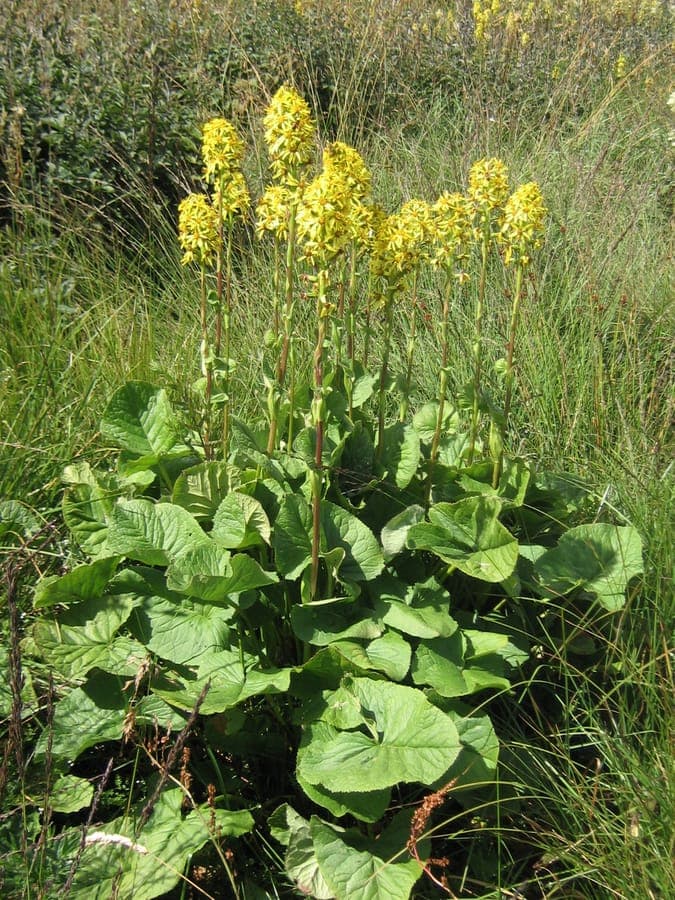
Planchon / CC BY-SA 3.0, via Wikimedia Commons
Siberian ligularia: complete guide
Ligularia sibirica
Want to see Siberian ligularia: complete guide in your garden?
Full design in HD: €7.99
Look after your Siberian ligularia with the GardenWorld app
Identify plants with your camera and get a care calendar with reminders for this plant.


Overview
Ligularia sibirica, also known as Siberian ligularia or golden-ray, is an impressive plant of the Asteraceae family originating from Siberia, Russia, and parts of Asia. This plant is renowned for its height, large foliage, and characteristic yellow flowers. It is an excellent choice for moisture-loving spots in the garden.
Appearance and Bloom
Ligularia sibirica grows as a stately plant that can reach 150 cm or taller. The plant features large, glossy green leaves with distinct venation and striking yellow flowers that grow in stiff clusters. Blooming occurs from July to September, providing valuable summer yellow color when other plants are declining.
Ideal Location
This plant thrives best in light shade to partial shade, though it can tolerate full sun if the soil is sufficiently moist. It prefers a protected location against strong winds. The plant grows well on the banks of ponds or streams and in moist wooded areas.
Soil
Ligularia sibirica is extremely moisture-loving and prefers moisture-retaining, rich soil. The plant thrives in both acidic and neutral soils (pH 6.5-7.0). Adding copious organic matter helps the soil retain water.
Watering
Regular watering is essential, especially during dry periods. The plant loves consistent moisture levels and can tolerate waterlogging more than many other plants. During hot summers, it must be watered regularly to prevent drying out.
Free preview
Want to see Siberian ligularia: complete guide in your garden? Make a free preview of your design.
Pruning
Minimal pruning is needed. You can remove spent flowers for appearance, though this is not strictly necessary. In spring, dead stems can be removed. The plant does not self-seed aggressively and should not be drastically cut back.
Maintenance Calendar
- Spring (March-May): Plant grows out. Water regularly. Supplement with compost around the plant.
- Summer (June-September): Plant blooms profusely. Water daily in hot periods. Monitor for slugs/caterpillars.
- Autumn (October-November): Plant slows. Continue watering while soil is moist.
- Winter (December-February): Plant dies back. Minimal care needed.
Winter Hardiness
Ligularia sibirica is extremely winter-hardy and grows well in cold climates. It tolerates temperatures far below freezing without damage.
Companion Plants
Combine Ligularia sibirica with:
- Speedwell (Veronica longifolia)
- Astilbe
- Hosta
- Siberian iris (Iris sibirica)
These combinations create a lush, moisture-loving garden.
Closing Thoughts
Ligularia sibirica is a majestic centerpiece for moisture-loving gardens. The yellow summer blooms and large foliage provide year-round interest. This is ideal for water gardens and moisture-loving shade. Find plant material at garden centers. For more inspiration for moisture-loving gardens, visit gardenworld.app for your next project.
More tips for moisture-loving plants can be found on gardenworld.app.
Frequently asked questions about Siberian ligularia
Is Siberian ligularia winter hardy?
Ligularia sibirica is extremely winter-hardy and grows well in cold climates. It tolerates temperatures far below freezing without damage.
When and how do you prune Siberian ligularia?
Minimal pruning is needed. You can remove spent flowers for appearance, though this is not strictly necessary.
How much water does Siberian ligularia need?
Regular watering is essential, especially during dry periods. The plant loves consistent moisture levels and can tolerate waterlogging more than many other plants.
Where does Siberian ligularia grow best?
This plant thrives best in light shade to partial shade, though it can tolerate full sun if the soil is sufficiently moist. It prefers a protected location against strong winds.
What soil does Siberian ligularia need?
Ligularia sibirica is extremely moisture-loving and prefers moisture-retaining, rich soil. The plant thrives in both acidic and neutral soils (pH 6.5-7.0).

See it in your garden
See Siberian ligularia in your garden
One photo of your garden and a few questions. You see the result in about a minute.
Try it with a photoIdentify this plant in your own garden. Identify a plant
Similar plants
Frikart's aster (Aster × frikartii): complete guide
Aster × frikartii
Everything about Frikart's aster (Aster × frikartii): position, soil, pruning and hardiness of the aster that flowers lavender-blue from July to October.
False aster (Boltonia asteroides): complete guide
Boltonia asteroides
False aster (Boltonia asteroides) covers itself in white daisies from late August to October. How to plant, cut back and combine this tough, tall perennial.
Daisy bush (Brachyglottis greyi): care guide
Brachyglottis greyi
Brachyglottis greyi, formerly Senecio greyi, pairs silver felted leaves with yellow summer daisies. Advice on position, soil, pruning, hardiness and companions.
