
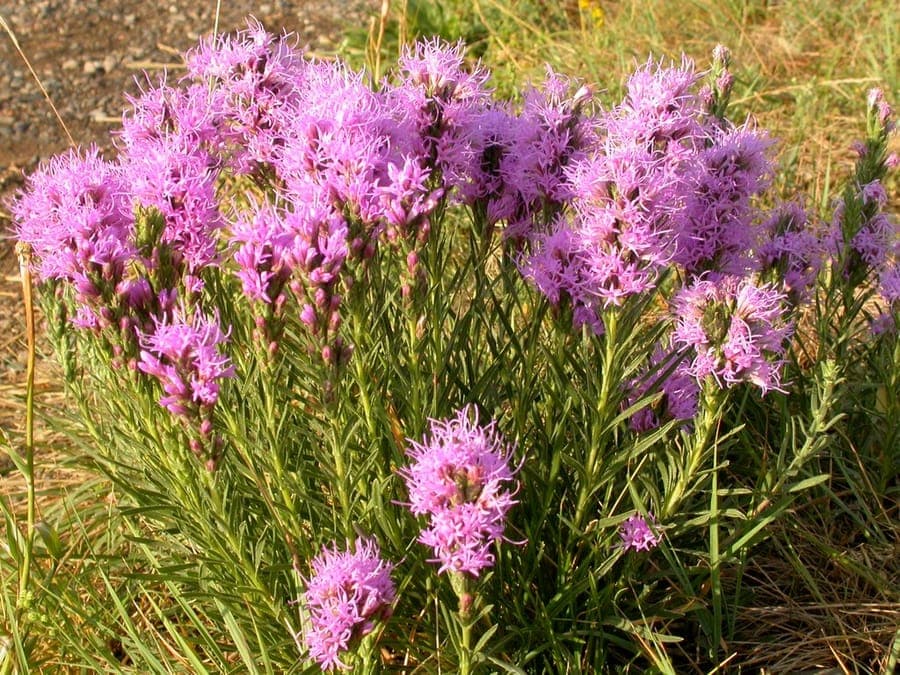
Matt Lavin from Bozeman, Montana, USA / CC BY-SA 2.0, via Wikimedia Commons
Dotted blazing star: complete guide
Liatris punctata
Want to see Dotted blazing star: complete guide in your garden?
1 minute, no credit card
Overview
Liatris punctata, commonly known as the dotted blazing star, dotted gayfeather, or plains gayfeather, is a perennial native to the dry prairies, rocky hillsides, and open grasslands of central and western North America. Described in 1833 by the Scottish botanist William Jackson Hooker, its native range extends from Alberta and Saskatchewan in Canada south through the Dakotas, Nebraska, Kansas, and Missouri to Texas, Oklahoma, and northeastern Mexico.
The species epithet 'punctata' refers to the dotted glandular spots visible on the phyllaries (the scale-like bracts enclosing the flower heads) - a botanical detail that distinguishes it from related species. Liatris punctata is a close relative of the more widely grown Liatris spicata but differs notably in its more compact stature, slower growth rate, and exceptional drought and heat tolerance - making it arguably the most resilient species in the genus for garden use.
In European gardens, dotted blazing star has gained a loyal following among naturalistic and prairie-style gardeners who value its late-summer flowering, minimal maintenance requirements, and striking vertical form. Its vivid purple spikes appear from August through October, a season when most border perennials are past their best. Explore how this plant fits into a late-season border design at gardenworld.app.
Appearance & bloom cycle
Dotted blazing star grows from a thickened corm-like rootstock, sending up multiple erect stems reaching 30–60 cm in height. On lean, dry soils - its preferred conditions - plants tend toward the shorter end of this range (30–40 cm), while slightly richer, still well-drained soils can produce plants up to 60 cm tall. Growth is slow and deliberate: in the first year after planting, above-ground development is often modest as the plant invests energy in building its underground storage organ. By the second and third year, flowering is markedly improved.
The leaves are narrow and linear, 5–15 cm long and just 3–8 mm wide, dark green, smooth, and closely crowded along the stem in a spiral arrangement. They resemble grass blades in form but are distinctly more fleshy and firm. The plant forms a tidy, multi-stemmed clump 20–40 cm across over several years.
The flower heads are densely packed along the upper half of each stem and open from top to bottom - the reverse of most composites, a characteristic behaviour of the genus Liatris. Each head is a tight cluster of small disc florets in vivid reddish-purple to bright magenta-purple, without ray florets. A well-established plant carries 10–30 or more heads per stem. The blooming period runs from mid-August through October, peaking in late August and September. The flowers are exceptionally attractive to monarch butterflies, swallowtails, bumblebees, and solitary bees.
After flowering, the spent heads develop small, feathery achenes dispersed by wind. The dried, silvery-buff stems and seed heads persist attractively through winter, adding structural interest to the garden.
Ideal location
Dotted blazing star demands full sun, requiring at least six hours of direct sunlight per day. It is thoroughly intolerant of shade: plants kept below four hours of sun become tall, floppy, and flower sparsely if at all. Site it in the hottest, most open position your garden offers.
In its native habitat it grows on exposed, often windswept prairies and hillsides, and this gives it very good wind resistance - an asset in open gardens where more delicate perennials would suffer. The compact height of 30–60 cm makes it suitable for front-of-border and mid-border positions, rock gardens, gravel gardens, and even container growing on a sunny terrace.
For gravel gardens, dotted blazing star is a superb choice: the sharp drainage, reflected heat, and lean substrate mimic its natural prairie habitat closely. Interplant it at 25–30 cm spacing within the gravel, with a 5 cm layer of fine grit mulch at the crown to prevent summer splash-rot from rain on heavy soil beneath.
Soil requirements
Liatris punctata thrives on poor, dry, well-drained soils and is one of the most soil-tolerant perennials available. In its prairie homeland it grows on thin, stony, often calcareous or mildly acidic substrates that would defeat most garden plants.
Optimal pH is 6.0–7.8, a broad range covering mildly acid through moderately alkaline conditions. Sandy loam and gritty, well-drained soils give the best results. Heavy clay that retains moisture through winter is the primary concern: the corm is susceptible to rot in wet, poorly drained conditions. On clay soils, raise beds by 15–20 cm or incorporate coarse grit and gravel to 30–40 cm depth.
Rich soils produce tall, floppy stems and reduced flowering. Organic matter should be kept to a minimum - at most a very thin layer of well-rotted compost worked in at planting time on very sandy soil. Fresh manure and nitrogen-rich fertilisers will make the plant lush but poorly flowering. Plant at 25–40 cm spacing in groups of five or more.
Watering
Dotted blazing star ranks among the most drought-tolerant perennials suitable for European gardens. Once established, it rarely requires any supplemental irrigation even in dry summers, making it ideal for water-wise planting schemes, gravel gardens, and low-maintenance borders.
During the first growing season after planting, water once a week during dry, warm spells to help the corm establish. Apply 5–8 litres per plant at each session, always watering deeply at the root zone rather than shallowly. Deep watering encourages root development that will sustain the plant through dry periods in subsequent years.
From the second year onwards, rainfall alone is sufficient in most northern European summers. Only during prolonged droughts of four weeks or more is a single deep watering beneficial. Water at the base of the plant - overhead watering promotes the wet foliage conditions that can encourage fungal issues. Persistent soil moisture, particularly in autumn and winter, is the greatest risk factor for crown and corm rot.
Free design
Want to see Dotted blazing star: complete guide in your garden? Make a free design now.
Pruning
Dotted blazing star is a naturally tidy plant that needs little or no pruning to maintain an attractive appearance. Its compact, stiff stems do not flop and rarely need staking.
After flowering in autumn, the spent stems and feathery seed heads can be left standing through winter. This is highly recommended: the structural form is ornamental, the seeds feed small birds such as goldfinches, and the standing stems provide overwintering habitat for insects. Remove stems in late February or early March, just before new growth begins to appear.
If you prefer a neater winter garden, cut stems back to 5–8 cm above ground level in late October or November after the first hard frost. This will not harm the plant.
Division is rarely needed given the slow growth rate. After five to eight years, if the clump has become dense and flowering has diminished, divide in early spring. Carefully lift the corm with a fork, cut it into sections with a sharp, clean knife, each section having at least one growing point, and replant immediately at the original spacing.
Maintenance calendar
March: Cut back any remaining stems from the previous year when new growth first appears. Inspect the corm for any winter moisture damage. No fertiliser needed on most soils.
April–May: New stems emerge and grow slowly. No active care required. On very sandy soil, scatter a thin layer of well-rotted compost (1–2 cm) around the base if growth appears very weak.
June–July: Stems reach their final height. Flower buds begin forming in late July. No watering needed unless extreme drought conditions prevail.
August–September: Peak flowering. Butterflies and bees are abundant. Leave the plant undisturbed.
October: Flowering ends. Feathery seed heads form. Leave stems standing for winter interest and bird food.
November–February: No active care. No winter protection needed on well-drained soils. On heavy clay, a thin layer of grit (2–3 cm) around the crown can aid drainage and prevent crown rot.
Winter hardiness
Dotted blazing star is exceptionally hardy, rated at USDA hardiness zones 3–9. It endures temperatures as low as -30 °C without any protection. In the Netherlands, Belgium, Germany, France, and the UK, it overwinters without difficulty even in the coldest recorded winters.
The underground corm remains fully viable through the coldest periods. On well-drained soils, no mulching is needed. On wetter, heavier soils, a thin layer of grit or gravel around the crown is recommended - not for frost protection, but to prevent the corm sitting in cold, wet soil all winter, which is the primary cause of loss in this species.
New growth appears in late spring, sometimes as late as May - this is entirely normal for Liatris punctata, which is a notably late riser in spring. Do not assume plants have been lost if no shoots appear in early April: wait until May before investigating.
Companion plants
Dotted blazing star is superb in dry, sunny borders, prairie plantings, and gravel gardens. Excellent companions include:
- Echinacea purpurea (purple coneflower, cultivars 'Magnus', 'White Swan', 'Sunrise'): shared flowering season August–September, complementary pink-purple and magenta tones alongside the bold spikes of Liatris.
- Rudbeckia fulgida ('Goldsturm'): warm golden yellow with dark centres, flowering August–October, creating a vivid colour contrast with the purple of Liatris in late summer.
- Helianthus nuttallii (Nuttall's sunflower): bright yellow, similar sun and drainage requirements, naturalistically compatible prairie companion.
- Sporobolus heterolepis (prairie dropseed): fine-textured, non-spreading grass with delicate summer plumes, providing textural contrast to the upright spikes of Liatris.
- Agastache foeniculum (anise hyssop): blue-purple spikes in July–September, draws the same pollinators and thrives under identical growing conditions.
- Penstemon grandiflorus or P. strictus (beard-tongue): tubular pink or purple flowers earlier in summer; outstanding drought tolerance compatible with Liatris.
- Sedum 'Autumn Joy' (stonecrop): horizontal flat heads of dusty pink ripening to copper-red in September–October, a perfect low groundcover beneath the vertical stems of Liatris.
Plant in groups of five to nine at 25–30 cm spacing for a naturalistic, prairie-style effect. The combination with ornamental grasses - particularly fine-textured species like Sporobolus or Nassella - emphasises the prairie character.
Conclusion
Dotted blazing star is an indispensable plant for the dry, sunny garden. Its vivid late-summer purple spikes, extreme cold hardiness, minimal water needs, and outstanding value for butterflies and native bees make it one of the most versatile and rewarding perennials for European garden use. Though slow to establish, it rewards patience with reliable, annual flowering that improves year after year.
Plan a border featuring dotted blazing star alongside its ideal prairie companions at gardenworld.app and see how this understated perennial transforms the late-season garden.
Want to see Dotted blazing star: complete guide in your garden? Make a free design now.
Upload a photo, pick a style, and get a photorealistic design with plant list in under a minute.
10,000+ gardens designed already
No credit card required


Similar plants
Calendula stellata: complete guide
Calendula stellata
Complete guide to Calendula stellata, the star-flowered marigold from Sicily: location, soil, watering and companion planting tips.
Korean chrysanthemum: complete guide
Chrysanthemum x rubellum
Chrysanthemum x rubellum is a hardy autumn perennial with single pink to copper flowers from August to November. Care and combinations.
Helianthus divaricatus: complete guide
Helianthus divaricatus
Helianthus divaricatus is a North American woodland sunflower with yellow summer blooms, ideal for naturalistic borders and shady edges.